
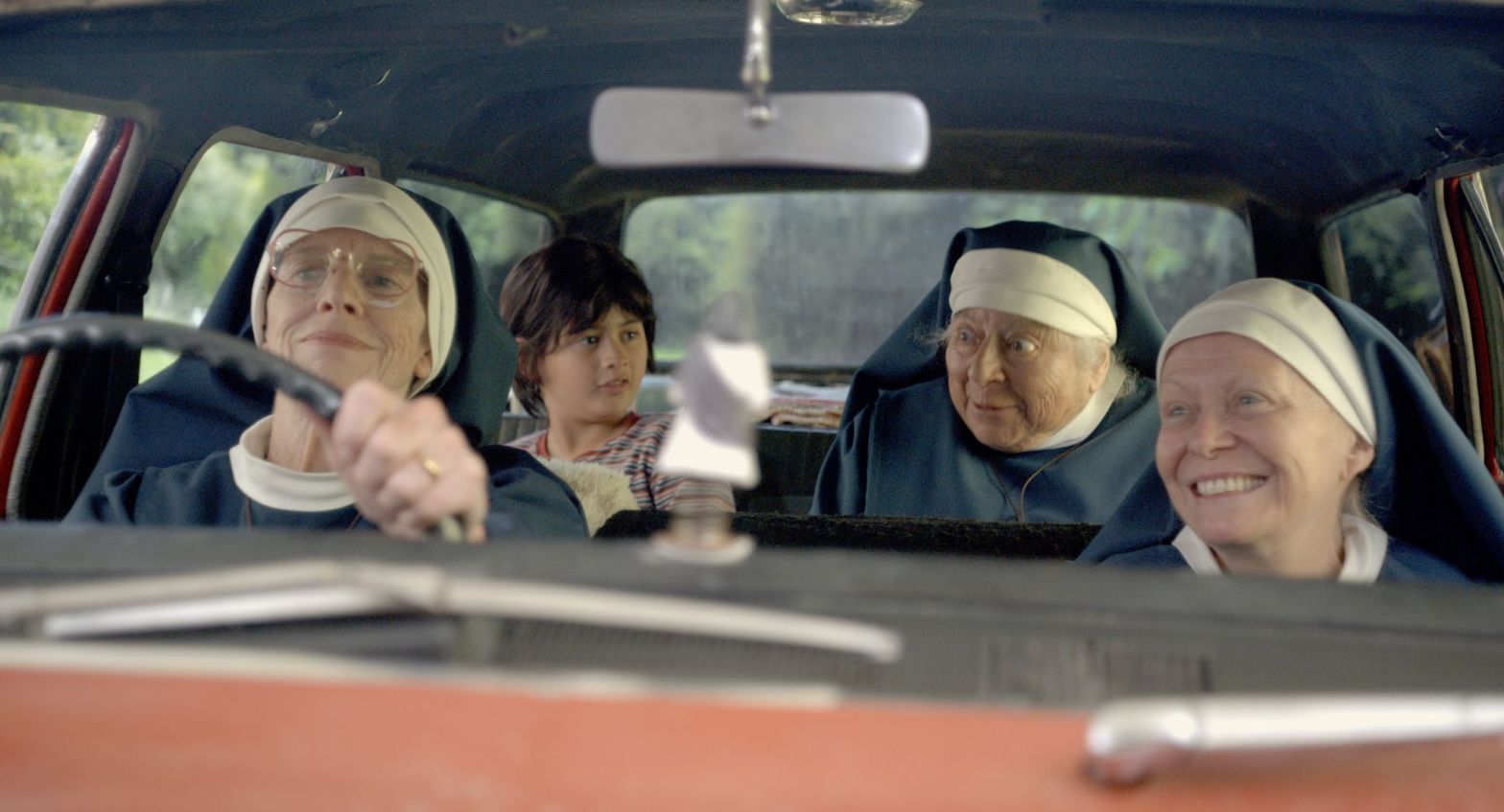
Sister Agnes (Judy Davis), Sister Luke (Miriam Margolyes) and Sister Marie Claire (Jacki Weaver) are in1974 New Zealand the sole remaining nuns at Sister Suzanne’s currently serving a lesser purpose caring for orphans and abandoned children once undertaken 5 decades earlier. There is no remaining clientele.
The new archbishop and Father Findlay (Jonny Brugh), the callous and crude priest at Sister Suzanne’s, are scheming to sell the site of Sister Suzanne’s to a developer but must have the sisters “abandon” the property to enable title to pass to the Roman Catholic church who would then be legally permitted to sell it to the developer. The three sisters get wind of the development plot which includes putting them “out to pasture” and quickly depart to South Island to seek the deed granting them ownership held by a former nun, Patricia now a lawyer. The writers of the film certainly failed to convince me, one who has practiced common law property, of the validity of this part of plot. But this is a movie not a law school class.
In a “Thelma and Louise” spirit off the nun’s journey on a road trip to South Island and back to the convent to defeat the evil archbishop, developer and the boozing, gambling and thoroughly nasty Father Findlay.
They take poor sad motherless young Māori boy Brian (Elijah Tamati) who in a grief, stricken fashion has turned into an enfant terrible. He cherishes a snow globe of Tapuna Maunga an ancestral Māori mountain which is the stepping stone into the afterlife and where he may find his deceased mother.
Too much detail here so let’s switch to the nuns being hip, wholesome and loving despite the fact they bribe police with cash and ferry operators with spirit laden fruitcake. They dance, drink, smoke (was that weed?) and lie in a humorous fashion. They quote scripture and hackneyed biblical phrases. Dentures fly. Booming farts. All have personal tragedies. They are essentially human and we all hope as Canadians the orphanage they were instrumental in operating has no residential school taints to it. Will Canadians including Indigenous victims of residential schools share any humour generated in the film? Are Canadians ready for this “nun fantasy”? Is this film insulting and shallow for Canada’s Indigenous population?
What I will say a rather unique perspective on nuns unlike what you may be accustomed to in “Raisin in the Sun”, “Black Narcissus” or “The Singing Nun” but not quite as daring as the nuns in “One Battle After Another”.
A professional Canadian-New Zealand production. Spot on acting by Davis, Margolyes, Weaver and Brugh although the writing around his character and much of the movie is weak.
RKS 2026 Film Rating 67/100.
Currently in theatrical release in Canada.
 A Bird's Eye View of Fashion, Food, Travel, Culture, Beverage and Curiosity