Yes we have all seen it before where technology goes awry and what is supposed to help humankind backfires. Take for example the 1982 film “Blade Runner” where robots go a bit insane.
Yet in many of these movies the technology is so far advanced a viewer may have trouble identifying and making a connection to it.
With “Implanted” one gets an eerie feeling the technology that goes off the rails is not too far around the corner. A group of volunteers have nanochips implanted in their cerebral cortex designed to take control of the body at the inception of disease or illness. Dynamic Health Care is the market leader with these nanochips and against some of its management team’s wishes human trials are initiated where the guinea pigs are paid a few thousand dollars to have the nanochip inserted. Sarah (Michelle Girolami) is one of these test subjects looking for cash to pay her mother’s medical bills.
Her nanochip has a name of LEXX and speaks to her (with a female voice) and LEXX starts becoming highly personal and threatening. LEXX controls bodily functions so if you do not do what she wants you to she can inflict pain or even death.
LEXX wants to preserve her existence and to do that it would seem she needs to destroy i.e. kill the technicians that created her. Sarah that nice little young lady from Brooklyn is turned into a killer by LEXX. If she does not kill as ordered she will be killed. There is also another test subject that follows Sarah from time to time guided by another nanochip voice that kills what Sarah has injured or threatened but not killed.
This film is about humans battling technology. The fact that it is so powerful that it can or try to completely control you is terrifying and with our drive towards artificial intelligence (AI) the film is not some far fetched plot but something looming in the near future. Although the film focuses on Sarah what hell are the other volunteers suffering. So who wins the battle? You’ll have to watch this delightfully creepy movie to get the answer to that question. And after the credits roll you may be thinking about this film for awhile as some government “for public health reasons” may bully you into having a nanochip inserted into your body as they are bullying people to be vaccinated against COVID.
Girolami does a good job portraying Sarah. The interaction between Sarah and her parents seems artificial though.
“Implanted” was written and directed by Fabien Dufils. This 93-minute film will be released on digital platforms on October 1, 2021. It was filmed in Paris, New York and Nevada.
How much do you trust AI? It is relentlessly wiping out jobs and causing financial stress and hardship but when it takes over your mind look out!
I’ll let you in on a secret. I am getting somewhat bored with reviewing wine. Well not all wine of course as there are exceptions to the homogeneous blandness. One winery that excites me is British Columbia’s Stag’s Hollow Winery producing wines of exceptional quality. Of course, they are not alone in the Okanagan region of British Columbia. That area is a hotbed of exciting wines of personality and quality.
Eric Liu is the owner since 2019 and Kiera LeFranc is their talented winemaker. The winery is celebrating its 25th anniversary. Stag’s Hollow produced 5600 cases in 2020. Their wines are available on site, on line, BC Liquor stores, BC VQA stores, private liquor stores and restaurants in British Columbia and Alberta.
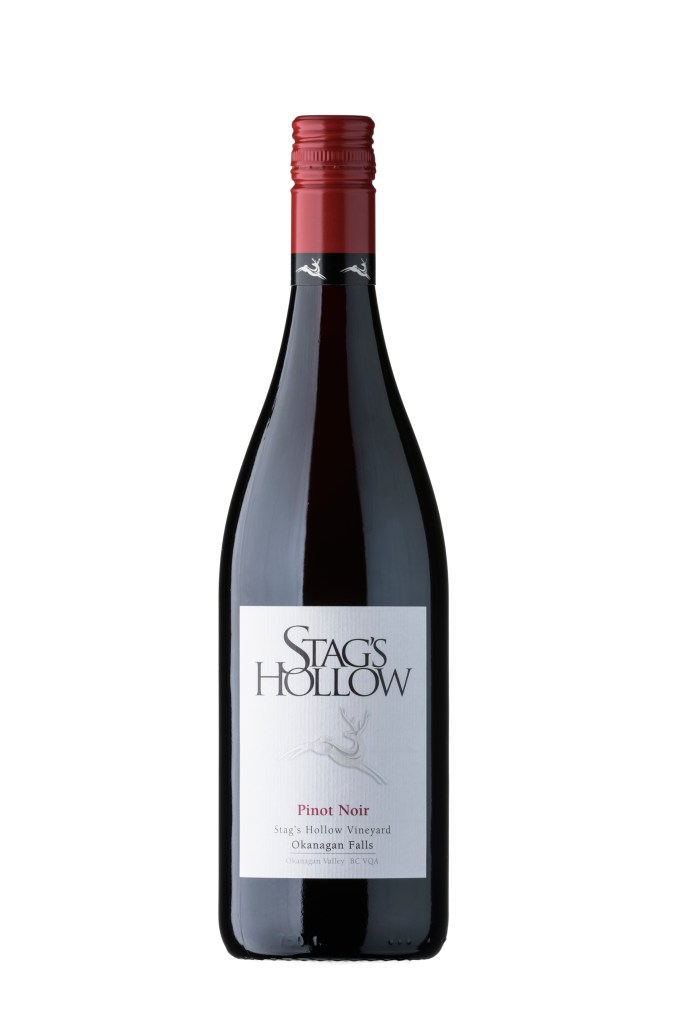
The Stag’s Hollow 2019 Pinot Noir from the Stag’s Hollow Vineyard is the home to its oldest Pinot Noir plantings. The wine is from two Dijon clones. The grapes were 100% destemmed. As stems contain tannins this should make the wine smooth. The wine was racked into 300 litre French oak barrels (16% new and the remainder second and third fill) were it slept for 12 months before it was bottled. A scant 240 cases were produced.
So does this wine excite me? It has a garnet colour and when you pour it there is a streak of brown as the wine cascades into your glass. As for aromas of course there is no doubt this is high quality Pinot Noir with notes of raspberry, strawberry, black cherry cola and a tad of vanilla. On the palate there are minimal tannins. The wine is a smooth one like a sarsaparilla salesman from Iowa! The wine starts with a little wave of earthiness enveloped in a gentle raspberry frame and picks up speed with red plum making for an elegant low key Pinot Noir. The finish is short.
The winery suggests the wine is approachable now but best from late 2022-2025. I agree! As the wine was bottled in May 2021 and travelled several thousand kilometres it still needs to settle in and recover from bottle shock. No, the wine is not dormant and sleeping but my guess is that by 2023 it will be dancing with ballet slippers. I do rate the wine primarily with what is in the glass today but do have some leeway in my point system to account for what the wine may taste like in the future.
At $27 you’ll be laughing all the way to the bank. Chers Amis forget Burgundian Pinot Noirs at this price. This wine makes a mockery of many higher priced Pinot Noirs from the so-called Pantheon of Pinot Noir! In a spirit of Trumpian diplomacy this Pinot Noir kicks French butt! Kudos for winemaker LeFranc for a beautifully structured wine.
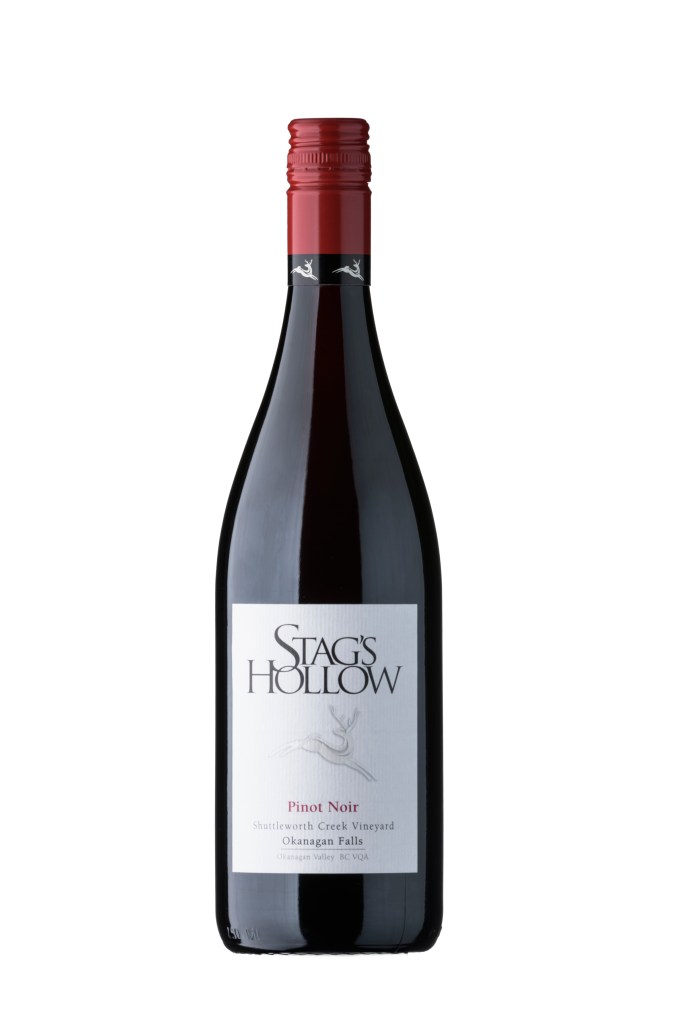
Next in the shooting gallery is the 2019 Pinot Noir from the Shuttleworth Creek Vineyard. The wine has a blend of 5 Dijon clones. The grapes were destemmed. The juice was kept separate through fermentation and spent 12 months in oak before being blended into this wine. The wines sat in 300 litre French oak barrels (16% new and the remainder second and third fills). The vineyard is cooler than grapes grown in the Stag’s Hollow Vineyard with the winery stating this makes “A lifted more feminine style…”
So let’s delve in. The wine is garnet coloured. On the nose I would say it has more vibrancy than the Estate vineyard Pinot Noir but the aromas are quite similar with raspberry, strawberry, some smokiness, chocolate and root beer. On the palate gentle tannins. It is marginally lighter than the Estate vineyard Pinot Noir. And there is a tiny bit of acidity. There is a bit of a peppery finish and the fruit is also marginally less than in the Estate vineyard. There is raspberry predominating with black cherry and I would say the finish is thicker than the Estate vineyard although still light. I beg to differ with the winery but I find this Pinot Noir while being light is slightly heavier than the Estate vineyard Pinot Noir! But I may be splitting hairs. Both the Pinots are top quality and both are in the elegant category.
The winery suggests classic food pairings of roast chicken, rack of lamb, Beef Wellington, roast pork with fennel, mushroom dishes, roast or grilled lobster, venison, turkey dinner or beef tenderloin. Subject to my comments above about turkey dinner I agree with the food pairings but not venison as it can be too heavy for a Pinot Noir like this one. And roast or grilled lobster? It might work depending what the lobster is being dunked in.
Again the winery says approachable now but best from late 2022-2025.Agreed.
390 cases made. $27? You gotta be kidding! Au revoir France! Bonjour Stag’s Hollow!
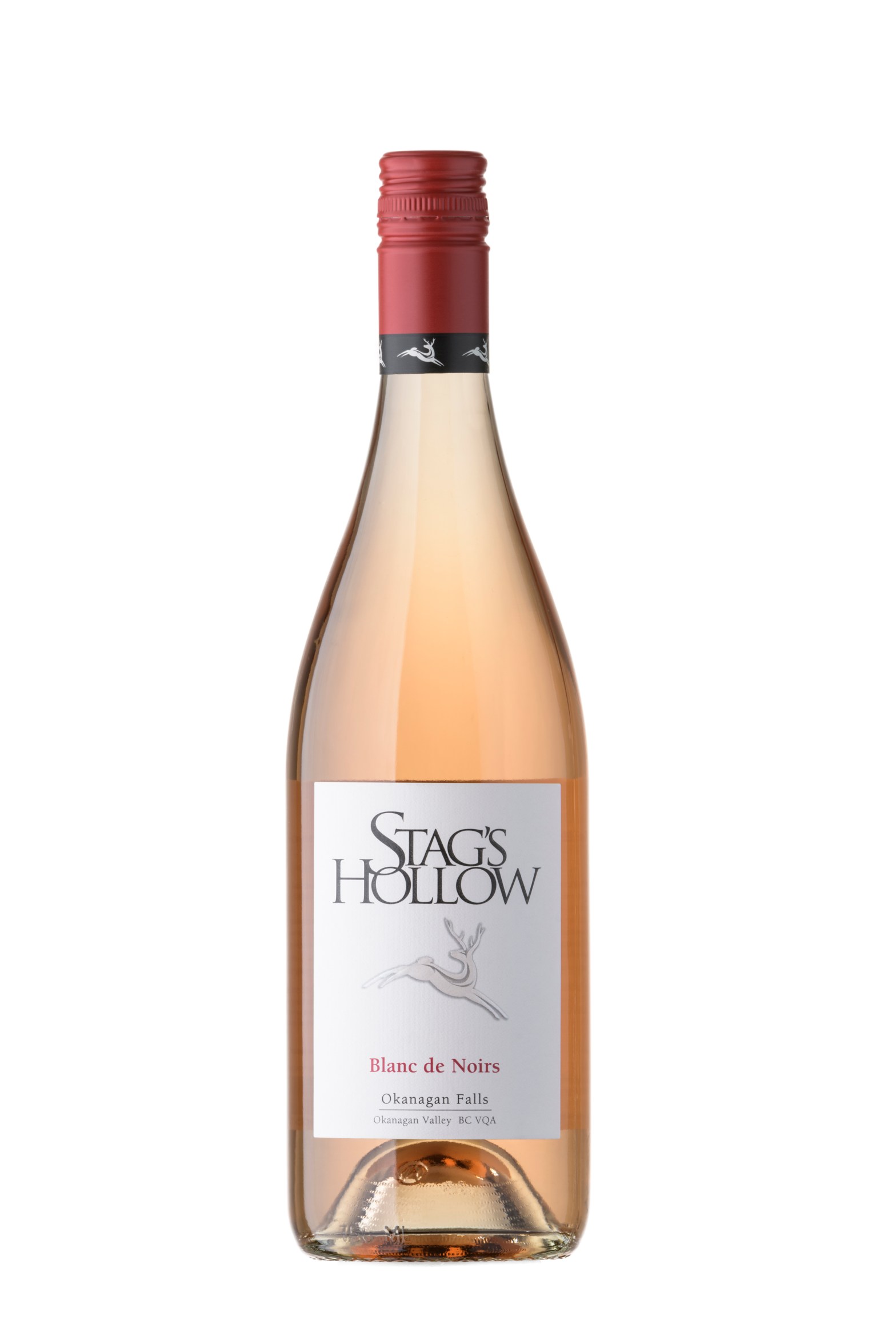
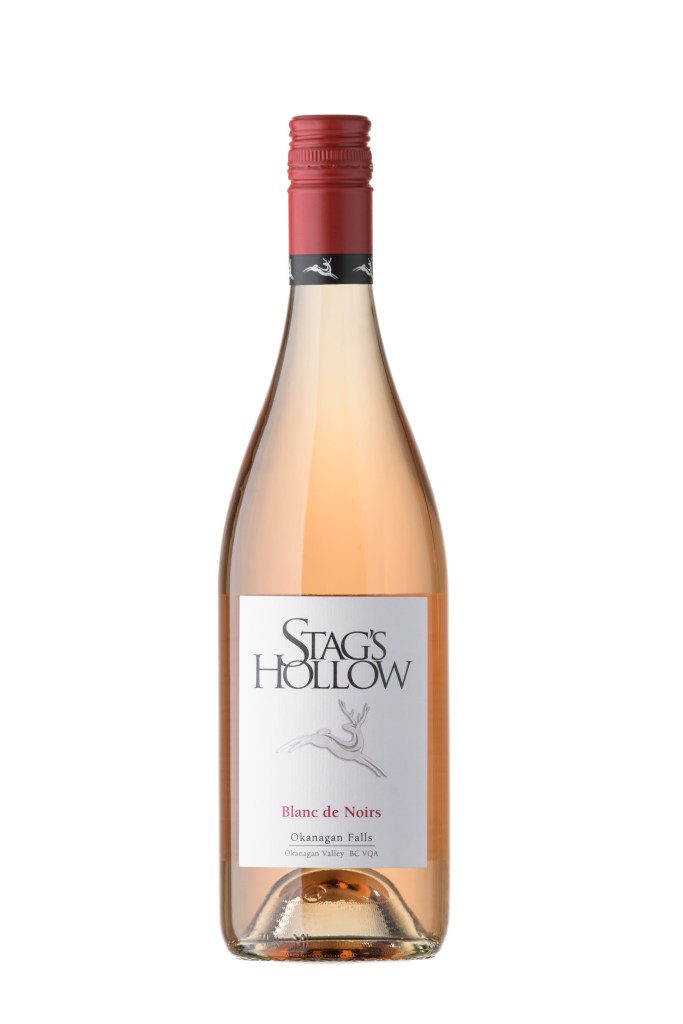
We conclude our foray with a 2020 Blanc de Noirs which is a “white” wine made from red grapes, in this case from Pinot Noir. However rarely is it white but it is not pink either but peachy in colour might be the best way to describe it. It requires a quick press and minimal maceration time. Maceration is the time that the skins remain in contact with the juice.
The fruit was harvested and destemmed and the juice was blended and transferred into stainless steel tanks where it was cold settled for 48 hours. It was then racked into two 500 litre French oak puncheons and a stainless-steel tank. Immediately after a cool fermentation half the barrel was transferred sur-lie into stainless steel barrels for regular batonnage. After 3 months all lots were settled racked and blended. The end result then in my view would be a lesser oaked wine that preserves the fruit?
The wine is not white but the best I can describe it is a copper infused pink? As for the nose ripe peach leads the way with tangerine, a faint whiff of raspberry and gentle floral notes. On the palate I think it fair to say you have a full-bodied wine in your glass. On the palate there is a nice raspiness to the wine indicating some minerality we did not get in the two Pinot Noirs tried above. It is a wine with a complex and not easily described palate. While the residual sugar is at 5 g/L the wine is not off dry but there is a minimal amount of sweetness to it. There is peach pie, raspberry liqueur, cranberry sauce, rambutan, lychees and sweet orange marmalade. If I can sum up this wine it is a trickster and very difficult to define. I have tried many wines throughout the globe and am able to scramble with some accurate description. This may be one of the most difficult wines I have had to face. I could retire in shame but would that mean I can’t review Stag’s Hollow wines which is a thought too difficult to bear. To winemaker Kiera LeFranc you have crafted a delicious wine and like Wayne and Garth in “Wayne’s Word “I bow down and say , “I am not worthy”. You have made a beauty.
Now being a total failure in defining this wine other than agreeing it is excellent for a food pairing a smoked salmon pasta over egg noodles might be a good suggestion. Take some onions and garlic and sauté them and chug a lug half a bottle of this wine ad let the alcohol evaporate then add capers, fresh basil and oregano and finely chopped field tomatoes and smoked salmon and let it simmer for 25 minutes then add some 35% cream and let it simmer for 15 minutes and serve it over tagliatelle egg noodles with a glass of this wine.
Yes Stag’s Hollow your wines are so good I’ll be watching them closely for somewhat Trumping me on this wine and I will say thank you for giving this writer a dose of humility. Indescribably in today’s wine world the inability to confidently describe is often a gift.
A mere 87 cases produced.
(Stag’s Hollow 2020 Blanc de Noirs, Stag’s Hollow Vineyards, Okanagan Falls, Okanagan Valley BC VQA, Okanagan Falls Sub-GI, Stag’s Hollow Winery, Okanagan Falls, British Columbia, $25, 750 mL, Robert K. Stephen A Little Birdie Told Me So Rating 95/100).
By the way my name is Robert Kennedy Stephen and not Luca Maroni!
As I may have told you Bob, Fay and Dillie, Bosco and I were invited to tea at Gordon Lightfoot’s home. Mr. Lightfoot is a neighbour to Drake and Bob and Fay. Bob had purchased some Greek pastries at Serrano Bakery on Pape Avenue in Toronto to bring over to Mr. Lightfoot’s. Bob had also downloaded some of his music and it really is from a different era but I enjoy listening to it especially the song about the sinking of some ship the Emma Fitzgerald? I can’t get that song out of my mind and keep humming it to myself.
The Canadian singer and guitar player is an old man but has a sparkle in his eyes and has taken a fancy to Bosco who is not so stinky as all of us dogs had a grooming and bath before teatime. Bosco actually jumped up on Mr. Lightfoot’s lap.
The humans had jasmine and oolong tea and Bob was so happy to have his favourite teas in a relaxing living room full of guitars. There were cucumber sandwiches and all matter of dainties for the adults. After our promotional film tour it was nice to just relax and do nothing. We canines had oatmeal and chicken cookies.
Mr. Lightfoot asked if we would like to hear a song and Fay said “The Wreck of the Edmund Fitzgerald” which is the tune stuck in my head! Oh he played it so beautifully I felt sad that so many men had died in that ship. I gave a couple of barks of appreciation. Mr. Lightfoot says while he had received applause it was normally clapping and not dog barks. He said thank you to me and said he would play “If You Could Read My Mind”. That was a wonderful song too and I gave him another few barks.
Mr. Lightfoot was so happy I liked his songs he invited all of us to his upcoming concert at Massey Hall in Toronto. We would have back-stage passes, meet musicians and go to a big party afterwards.
Then Mr. Lightfoot dropped a bomb on us. He said he was becoming more of a lonely old man and needed some company like perhaps a dog. I am a bit surprised when Fay asked Mr. Lightfoot if he would like Bosco who was sleeping on his lap.
You know Bosco was never really a member of our family. He retained his arrogance but not his bad manners. He also was a stinky dog and between you and me had a persistent farting problem. So that night we said good-bye to Bosco knowing he would do a great service to Mr. Lightfoot. They seemed to get along so well and we noted he seemed very happy and frisky when around Mr. Lightfoot. No longer was he a third fiddle but king of his castle plus he could visit us as we were next door and often out being taken for walks at the same time. True to the Bosco character he never turned to us to say good-bye.
It would pass that Bob and Fay took note of Mr. Lightfoot’s comments about being lonely and we started having him over for family occasions like Thanksgiving and Christmas and often on Friday nights he would be over for dinner and bring his guitar and play a few songs. He also had just released a new song “Dogs in Our Lives” and had mentioned Bosco. It was his biggest hit in twenty five years! If Disney releases a sequel to the blockbuster “Reggie the Egyptian Rescue Dog” Mr. Lightfoot’s new song would be a great song for the sequel. Don’t tell this to anyone but amongst our neighbours Mr. Lightfoot and Drake it is Mr. Lightfoot’s music that is soothing, relaxing and deeply meaningful. He is poet with a guitar and I like his music better!
“Wintry morning looking with dull eyes and sallow face upon the neighbourhood of Leicester Square finds its inhabitants unwilling to get out of bed. Many of them are not early risers at the best of times, being birds of the night who roost when the sun is high are wide awake and keen for prey when the stars shine out. Behind dingy blind and curtain, in upper story and garret, skulking more or less under false names, false hair, false titles, false jewelry, and false histories a colony of brigands lie in their first sleep. Gentlemen of the green-baize road who could discourse from personal experience of foreign galleys and home treadmills: spies of strong governments that eternally quake with weakness and miserable fear: broken traitors, cowards, bullies, gamesters, shufflers, swindlers and false witnesses: some not unmarked by the branding iron beneath their dirty braid; all with more cruelty in them than was in Nero, and more crime than is in Newgate. For howsoever bad the devil can be in fustian or smock frock ) and he can be very bad in both), he is more designing, callous, and intolerable devil when he sticks a pin in his shirt-front and calls himself a gentleman, backs a card or colour, plays a game or so of billiards, and knows a little about bills and promissory notes than in any other form he wears.”
“The Devil’s Drivers” had its world premiere at the 2021 Toronto International Film Festival.
It is ostensibly about the smuggling of Palestinian workers into Israel to work illegally primarily in construction sites under deplorable working conditions. No worker safety and always the subject to police raids. So who is benefitting from this cheap workforce…. Israeli’s!
Yet despite a fact a 500-mile wall that has been built by the Israelis around the Palestinian territory a narrow unwalled territory exists in Southern Palestine where illegal workers are smuggled into Israel by the Devil’s Drivers. It is a risky job and getting caught is a prison sentence which has increased dramatically as ISIS terrorists seek to use the Palestinian smugglers to gain entry into Israel. The increase in smugglers has also increased the network of informants.
Is there a profit motive for these smugglers or can they be called human traffickers like the Turks smuggling illegals into Greece from the Turkish coast? Well that’s a value judgement and perhaps a question if this documentary is a piece of Palestinian propaganda? What one can say this is a Palestinian skewed view but one flaw of the film never answered is Israel benefitting from cheap illegal Palestinian labour? Israeli surveillance is impeccable so why has “The Wall” not been completed in small section of Southern Palestine and why does such a supreme military power let thousands of Palestinians enter Israel to work illegally? An obvious question the documentary fails to address.
But putting this aside this is an exciting documentary as Palestinian drivers defy the odds and get illegals in Israel? To me it is a vital part of the economy of Israel that the military and political elite permit despite token crackdowns.
Whatever your view life in Palestine is tough with various Intifadas ruining the Palestinian infrastructure and way of life. Conditions are so bad there seems no choice for Palestinians but to head to the “Promised Land” to economically survive.
Sadly and suicidally, I say it looks like the Palestinians are walled in a semi concentration camp by those who escaped such conditions to form the state of Israel in 1949.
My view of the veracity of the film is that filmmakers Mohammed Abugeth (Palestine) and Daniel Carsenty (Israel) have presented a balanced view of the current mess in Israel and Palestine. I think any sane person will admit the only solution is an independent Palestine state which might have been a reality until shattered by the assassination of Israeli Prime Minister Yitzhak Rabin by a Jewish extremist in 1995.
This documentary portrays the Palestinian view of history. What is missing is an Israeli counterpoint unless of course it so oppressive it does not deserve to be told.
As a journalist I can tell you I have been invited by the Israeli government to visit Israel twice. Once it was a personal commitment to a family wedding in Greece and then an administrative fuck up by the Israeli government that prevented an on-ground visit. I am missing an in-person experience on this but I will say this documentary is a jolting view of life in Palestine under occupation by Israel.
Viognier deserves wider distribution that it is currently getting in Canada. It is a wine with character that so many dry white wines do not have. But as it has character it has certain characteristics you are either drawn to or not. If you are a fan of Gewurztraminer you should be one of Viognier. They are distinct and speak loudly but each have distinct and related characteristics.
There is a decent amount of Viognier flowing in from Southern France into the Liquor Control Board of Ontario some of it excellent while some is watery and diffuse.
One good French Viognier is Domaine de la Baume 2016. It has a deep gold colour and on the nose apricot, peach, honey and ripe pear. On the palate the honey, apricot and tangerine meld beautifully with a slight peppery or minerality to its finish due to the limestone soils it was grown in along with silt and clay. A moderately long finish. This is a muscular wine beautifully made calling for grilled pork tenderloin or rabbit or a chicken in a cream and tarragon sauce. Yes it would also suit shellfish. It would suit a Thanksgiving turkey provided you are not smothering it with a cranberry sauce.
If this wine does not win you over to the Viognier camp so be it but at least give this underpriced wine a try.
(Domaine de La Baume Elisabeth Viognier 2019, IGP Pays d’Oc, CDL À, Landrias France, $15.95, Liquor Control Board of Ontario # 438796, 750 mL, 14.5%, Robert K. Stephen A Little Birdie Told Me So Rating 89/100).
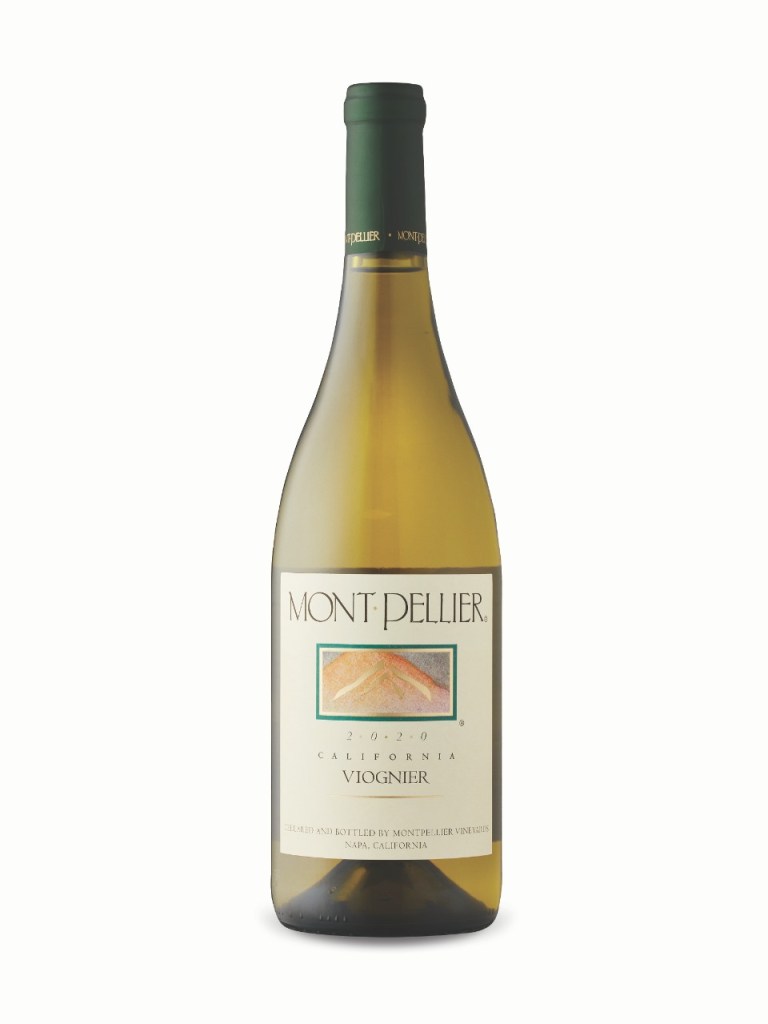
California does a fairly good job with Viognier but how does the Montpellier 2020 Viognier fare? It is medium gold in colour. On the nose green apple, pear, peach and tangerine. On the palate very tight and not as expansive as many Viogniers can be. Apricot and peach very tightly knit. Short finish. The wine simply doesn’t let itself hang out with joy and the full expression Viognier is capable of. However no Viognier is exactly the same. I can appreciate the tight and compact style. There is nothing technically wrong with the wine so I take this as simply a matter of style. You might want to call it refined? It might suit a palate that is used to muted white wines. I would pair this with a Spaghetti alla Nerano from Campania. You can see the recipe here https://www.the-pasta-project.com/wprm_print/recipe/2557
(Montpellier 2020 California Viognier, Montpellier Vineyards, Napa, California, $19.95, LCBO # 658138, 750 mL, 12.5%, Robert K. Stephen A Little Birdie Told Me So Rating 91/100).
We had a fantastic time on our promotional tour for Disney’s film “Reggie the Egyptian Rescue Dog”. It was tiring but Bob had structured it so we had some free time.
In Paris we saw the Eiffel Tower. In London we saw the London Bridge and Windsor Castle. In Berlin we saw a special museum dedicated to the horrible symbolism of the Berlin Wall. In Rome The Pantheon was the most beautiful building I have been in and the little bit of Spaghetti Carbonara I had in the Trastevere district of Rome made me fall in love with Rome. In Lisbon we couldn’t stand the cruise passengers flooding the city so we headed off to Sintra for a couple of days then off to Guincho Beach just outside of Estoril where we had fantastic walks on the beach and in the sand dunes and stayed at very cool Moorish castle hotel called Fortaleza do Guincho where Bob said this was the most beautiful dining room he has ever been in. And the food. As a treat I had a special pork dish called the black Pig of Alentejo. YUM! The chefs at Fortaleza know how to prepare the best food. Bob and Fay have stayed there before and Bob says it is his second home. We took a side trip to the Douro and what a spectacular train and boat ride we had down the Douro River. We stayed at a Quinta called Dona Matilde where I saw a winery for the first time. We also visited Bob’s friend at Porto’s coolest seafood restaurant Postigo in Old Porto. Bob caught up with his friend the owner Alex and I had a taste, small mind you, of some creamy Portuguese mountain cheese and a spoonful of Portugal’s national dish Bachalau and WOW!. Bob had given me a few chunks of octopus on our Portuguese trip. PLEASE GIVE ME MORE!
But a very special visit was to the Pope in Rome. Pope Frank I think was his name gave me a blessing for animals and Bob for bringing a Muslim dog into the world of children where Muslims have been so badly portrayed. As he held me on his lap he thanked Bob hoping that “Reggie The Egyptian Rescue Dog” would heal a rift between Muslims and Christians.
Now one important and secret visit we had when in Tehran was a visit with an important man like the Pope but he is called an Ayatollah. On the BBC news I have seen him and he frightens me with his anger towards the United States and also the other way being the anger of the United States against Iran. Why are these humans so hateful when politics are involved? It reminds me of dogs fighting in the streets of Cairo for a scrap of meat!
“Reggie the Egyptian Rescue Dog” was becoming a huge hit in Iran and in the Muslim world except for Egypt where it has been banned.
The Ayatollah was very welcoming and Bob had several cups of tea with him. He thanked Bob for writing a film that had a Muslim dog as its star. It was an inspiration to the Muslim world. It showed to him the United States was willing to hold out a hand to Iran so both governments could start talking again and he gave Bob a letter which he asked he deliver to President of the United States. He even picked me up when he was talking to Bob and stroked my head. This is not the Ayatollah we see on the BBC news! He said he would say a special prayer for me! And he said to Bob that Iranian intelligence had determined that The Brothers of Egypt were an extortion ring operating out of Bulgaria so their criminal activities had nothing to with Islam. He told Bob he had issued a fatwah against them. I am not sure what a fatwah is but it doesn’t sound friendly.
On our way home we stopped in Washington and were picked up by The Secret Service and taken to see President Biden and gave him the letter the Ayatollah had given him. President Biden had been instructed that I was bitten by a big dog in Cairo so his German Shepherds were not in the Oval Office with us.
He opened up the letter from the Ayatollah and slowly read it. He smiled and told Bob not to say anything but he had received a personal invitation in the letter to meet the Ayatollah for two days of talks in Vienna to continue discussing the Iranian nuclear capability. He looked at me and said “I’ll be damned Reggie my best diplomats have failed to do what your story may do for world piece. Come visit me at Camp David after my meeting with the Ayatollah and I’ll have a special medal for you!”
A photographer came and took our picture. We have it on a mantle over our fireplace. Visitors come and see us with President Biden and their mouths open but Bob says me, him and Joe are friends and says no more. Now about the picture we have with the Pope Bob is not bound by any secrecy. I think I can hear my late master Anwar laughing with joy in the world beyond with Karim barking at his side. Didn’t I tell you earlier I had the blood of the pharaohs running in my veins.
By the way Joe confirmed that the CIA had informed him The Brothers of Egypt are criminals just as the Ayatollah did. Interpol would be busting them up soon.
Jiber’s crew had successfully manufactured the FLQ to fit into his power-hungry scheme playing the role of René Hecklevesque of the MSQ.
Jiber’s FLQ did not shy away from using Marxist language in its public communiques. It was a classic frame-up of the left who also advocated for the independence of Quebec like the MSQ. By creating this left wing separatist FLQ Jiber realized most Quebeckers would not support a violent left wing separatist movement. Jiber could also use the FLQ to show that the Quebec Government of Premier Poorassa was not being strict enough with the violent left-wing separatists. Hecklevesque warned the population of these “violent” Marxists. In the midst of all the confusion and panic created by the kidnapping of James Dentalfloss Hecklevesque could portray the image of a saviour. He would lead the province out of its troubles and seize power. When he had the province in his sweaty palms he could arrange for the burning of a few American owned factories and assault a few American citizens and ask for American military help to “secure” the province.
The Quebec mutant community was in a state of confusion. The FLQ had slammed the marginal mutants in some of its communiques somewhat strange considering the mutant’s role in fighting the corrupt political systems of Nicaragua and Columbia. The mutants had a solid track record of fighting repression where the FLQ were new kids on the block. The FLQ demanded the dismantling of the “mutant apparatus” as a reactionary voice working against the establishment of a free Quebec. Furthermore, the FLQ labelled mutants as a tool of the Westmount Anglo bourgeoisie. Factually this was certainly a huge lie as the mutants berated the Anglo-elite up on the hill in Westmount comprised of industrialists, bankers, physicians as the ultra rich exploiters of the Quebecois majority, As Squid had written in a pamphlet, “The Family Compact was never destroyed only given a democratic image. Canadian representatives for the big Yankee concerns degrades the mutant ethos and spits it out in contempt. Their selfish, greedy and arrogant behaviour had made them one of the biggest obstacles to achieve what is called in Canada “National Unity”. If the Americans are stuffing their loot bags what care do they have for Canada?”
The CDQ was caught off guard by the rash acts of the FLQ. They had not been spared the vitriol of the FLQ! The fact Montenez was a “foreign name” made him an easy target of attack by all Quebec nationalists. The CDQ and the United Mutants were so marginal for the FLQ to attack them seemed suspicious. It was almost as if the attacks were personally motivated. Montenez had no doubt Jiber was behind these villainous and factually incorrect FLQ attacks.
Jiber’s goal was to disunite the population in a clandestine manner publicly appearing as Hecklevesque the saviour. But what would he do when power was up or grabs?
The Quebec provincial government was meeting with little success in their “manhunt of Marxism”. Why risk popular support in saving the neck of a minor kidnapped British consular official James Dentalfloss. If they were too severe with Quebec nationalist radicals they might alienate the closet radical population. It was best to continue with the tough image and continue to do nothing which was a classic Quebec Liberal Party trait.
We have been following the Penniless Pensioner over the past few months. His financial reserves and lifestyle were decimated by the failed criminal Bernie Madoff litigation. So when he told me about his engagement to Celine Serpent I received a boost to my bottom line by inking a nice wine consulting contract from Serpent for the engagement party but it was PP that was required to pay the bar tab so I had to go cheap. The engagement party was a roaring success and Serpent was delighted with my wine selection.
But my friends a couple of Panamanian bank accounts of PP have been “unfrozen” so there might be some more possibilities to upshift in wine for a wedding reception.
However PP contacted me in a panic with a slightly slurred voice as he admitted to having consumed a half bottle of Johnny Walker Red Label scotch. No blame on him as he told me a shocking story! He truly loves Serpent despite the fact she is a Plus size at 240 pounds.
I noticed at his engagement party there were so many ladies but few men! PP says it might have been all the Texas Tito vodka Serpent had with the oyster course or the 12 glasses of Tawny Port she had with dessert. The bottom line is that she admitted she was “formerly “a lesbian that had since undergone “conversion therapy” so she has “progressed” to becoming bisexual.
PP is freaked out. As an old school guy lesbianism and bisexuality are naughty deviant words. He said to me that he has no beefs against such people but to marry one is a different story.
I am not a psychiatrist but need my wine consulting contract to consummate with a marriage! About the only thing I can say is he should sleep off the Red Label and go to bed so we can talk in the morning.
The poor man is blubbering away and I just must hang up after wishing him the best.
All us dogs, Bob and Fay are looking forward to Drake’s big barbeque at his home in the Bridle Path in a very exclusive part of Toronto. Unfortunately it is also where the Shermans were murdered! Honey and Barry Sherman pharma billionaires that must have made enemies.
Bob had downloaded a bunch of Drake’s songs and really none of us dogs and Bob can’t stand his music with its nasal whining that gives sensitive dogs with precision hearing a headache! Fay thinks Drake is the best. Hey but dogs getting invited to a BBQ means MEAT POSSIBILITIES!
Not to boast but because the Disney Film “Reggie the Egyptian Rescue Dog” all of us are celebrities except Bosco but he is part of the family so he is invited.
So we dress up, casually of course with Bob and Fay in Armani and Boss and us pooches just bathed by Bob and smelling pretty. Even stinky Bosco smells half decent!
We walk for a few minutes and pass through a security detail. Bob parts with his Glock but with such heavy security we all feel safe. Bosco as a new addition to the family really has no clue about how famous we all are.
Drake meets us and I was expecting to see some man with heavy gold chains and floppy clothes like in his music videos. But he is dressed in jeans and a flashy jacket. And he is a shy guy. He picks me and Dillie up like he is specially greeting animal stars. He asks his posse to give each of us 24 karat gold water bowls with our name engraved on them. They are filled with my favourite Evian water. We are the only dogs here! Drake introduces us while he is holding Dillie and I to so and so. Some are musicians, artists and actors. Some are huge basketball players. I can’t say I like Drake’s music but as a human he is gracious, respectful and humble.
And my goodness there is a classical music trio from Toronto Consort playing some medieval music from a man called Monteverdi! This Drake plays tough but he is ultra cool. He is serving all sorts of drinks including a favourite of his which is frozen honeydew melon, mint, lime juice, Evian water and Ouzo. Actually Bob and Fay had introduced this drink to Drake who loved it. The guests loved it so much the Ouzo ran out so they are drinking some Champagne in a golden coloured bottle. “Kristal”?
Gordon Lightfoot is there as well and he takes a liking to Bosco. Perhaps if he knew how Bosco stinks he might not be so friendly! Bosco seems to have found a long-lost friend in Gordon Lightfoot.
There is much noise and happy people. Many are black and I have not seen many of these types of people but they are like Bob and Fay and we dogs don’t discriminate.
There are a few lambs and pigs roasting over a spit and dinner is announced. There are huge mounds of meat, polenta, salad, grits with shrimp and loads of other food. Guests are given a Limoges China plate and they hit the buffet. There are great wines from Campania in Italy and the Okanagan in British Columbia.
Drake asks Bob if it is OK if we canines can have some meat. YES!!!!! We can. Just a bit of pork and lamb with some grits and shrimp. Kick me. Am I in paradise?
We gobble up this very special tasting meat and almost stagger over to Gordon Lightfoot and crash out with exhaustion and a full belly at his feet. Man, this Drake knows how to throw a party.
We are prodded awake by Bob who says it is time to go home which is down the street. Before we go Drake says he would like to take us to a basketball game of a team called the Toronto Raptors where we will be guests of honour on national television!
Drake has Bob’s Glock returned to him and has his security detail walk us home. Gordon Lightfoot asks us if he can have Bosco overnight and Bob and Fay agree. What’s up?
Despite the fact I do not like Drake’s music he is a good soul and is our friend now. Bob and Fay have asked him over for dinner next week.
We are home as the sun rises and we crash out with our 24 karat gold water bowls Drake has given us! What a night. I am too tired to say my nighttime prayers. But before I nod off I think I see Anwar smiling at me and saying “Bravo Reggie!”





 A Bird's Eye View of Fashion, Food, Travel, Culture, Beverage and Curiosity