RKS 2024 Film: “The G”: Revenge of a Mean Old Goat

The movie opens with two men finishing off the burial of an “old goat” in the countryside. Before their departure one lights a cigarette, moves aside a bit of sand to expose a gaping mouth and the soon to be deceased has a last puff before biting the hand that proffered the cigarette.

Seventy-two-year-old Ann Hunter (Dale Dickey) lives with husband Chip in a modest condo. Chip is in rough shape on oxygen. Ann is a rather raunchy lady with wrinkles galore and certainly no spring chicken. She loves her vodka and smokes perhaps a bit too much to the detriment of Chip.

Then early in the morning while Ann and Chip are sleeping their door is bashed down and their “guardian”, Rivera, armed with a court order quickly transports them to a “care facility” named “Christ the King: Eldercare Facility”. For the next month they are locked in a barren room with food shoved in through the door. And the special “palliative care unit”! Ann learns the care facility is full of those under guardianship. Lonely, isolated and with assets which are of course under the control of guardians. Corrupt doctors work hand in hand with “guardians” to control asserts of the elderly. One important politician with his feet in the mud of corruption it seems owns a string of eldercare facilities.

The guardian, in this case Rivera, pressures Ann to disclose an inheritance she allegedly had received. Facing resistance, he orders Chip the invalid confined to a wheelchair beaten. Chip later succumbs to his injuries and the self described “not a nice person” Ann is forced into revenge mode. Her only ally is her granddaughter Emma (Romane Denis) and a shady ex-soldier from her family in rural Texas.

If you like your bad guys mean you’ll have them here and since they are abusers of seniors their meanness is amplified. But they underestimate Ann who is even meaner than they are but as befits good revenge films she has morals on her side while the bad guys only think profits.

There are also traitors, double dealers and psychopaths peppered throughout the film.

Being a typical revenge film moral justice is served perhaps predictably but the journey has its excitement. Can we change the name of the film to “A Country for a Mean Old Goat”.

Dale Dickey is brilliant and without her character and performance the film would be a mere echo of the reality of the senior guardianship business. “Dirty Harry”? “Fistful of Dollars”? A whole new genre of senior revenge?

Oh, by the way “G” stands for Granny!

Directed by Karl R. Hearne.

Plays at the Fantasia Film Festival in Montreal on 26July2024 with a possible Canadian theatrical release in September 2024.

RKS 2024 Film Rating 91/100.

RKS 2024 Film: “Crossing”: Exotic Road Trip Searching for A Georgian Trans Women

Mrs. Lia (Mzia Arabuli), a retired Georgian history teacher, is on a hunt for her trans niece Tekla. Finding Tekla is the dying wish of her sister. The hunt commences in a Georgian seaside village where Tekla was last seen, but Tekla has disappeared. Achi (Lucas Kankava), a young villager, claims to have Tekla’s address in Istanbul and speaking some English and Turkish persuades Mrs. Lia to take him to assist her in the hunt.

Travelling by bus they arrive in Istanbul which dazzles the viewer with its bustling calamity. Tekla is not to be found at the address provided by Achi which is amid the “trans quarter” populated by trans sex workers.

The search takes Achi and Mrs. Lia throughout many than less savory but colourful districts of Istanbul. They meet trans lawyer Evrim (Deniz Dumanli) in the midst of finalizing her female identity card. Evrim volunteers for “Pink Life” which protects the rights of the trans community.

Evrim is a bright light of optimism and charisma. Mrs. Lia is a tense tightly knit ball of negativity. Achi walks a tightrope between the two mouth agape at the seething life of Istanbul. This melange is odd but it works!

The search leads to a trans bordello run by “Mother” where it so happened Tekla worked but disappeared as “you know what it is like with girls and drugs”.

Is Tekla ever found? Interpret the end of the film as you wish.

The plot is rather simplistic; a search for a missing family member but the adventure is an exciting one highlighting an Istanbul most tourists will never encounter. In fact great credit must be given to the actors but Istanbul itself may be the star of the film. The Turkish music adds to the exoticism of Istanbul.

Yes, enjoy the adventure with a diverse group of characters but central to the film is forgiveness and self realization of a needlessly cruel behavior and attitude to the trans community where an apology may be too late hence tragic.

Written and directed by Levan Akin.

You can watch the trailer here https://www.youtube.com/watch?v=Sp7LGi5Uwg4

The Canadian theatrical release commences 26July2024.

RKS 2024 Film Rating 90/100.

RKS 2024 Film: “Inay” (Mama): The Mutual Pain of the Filipina Absent Mother

“Inay” is a Canadian documentary probing the pain of Filipina mothers leaving the Philippines to work as domestic workers in Canada primarily as child and elder minders. I knew several work colleagues that hired Filipina nannies to mind their children. Some of these nannies had left children and husbands behind and had not returned for years. This story is repeated in the documentary. Child abandonment in the Philippines was encouraged by a political, economic and cultural system the documentary explains. The path to Canadian citizenship and acquiring sufficient wealth to bring over children can take years. That wait inflicts emotional harm.

Abandoned children may suffer mental illness, often depression, brought about by constant sadness and loneliness. Two of the subjects in the film abandoned by their mothers contemplated suicide. And the mothers who abandoned are affected feeling shame and guilt.

The most poignant part of the documentary is two of the abandoned children (now adults) discussing with their mothers about the hurt of their abandonment. It is an emotional and powerful one and it is regrettable the discussion had not been more probing. The question never posed to the mothers was, “Was it worth it?”

The documentary could be interpreted as a journey of personal healing.

A good initial effort by Filipina Canadian producer and director Thea Loo but at times it meanders such as a puzzling discussion about Thea’s character by her husband and the overly discussed friendship/relationship between her husband and the abandoned Shirley Lagman. Some harder facts such as the number of Filipina domestics leaving their children behind to work in Canada as domestics and if that number has differed over the years and why would have been most useful.

“Inay” will have its premiere on 4August2024 at the Asian American International Film Festival in New York and will debut on the Knowledge Network in 2025.

RKS 2024 Film Rating 64/100.

The 4th Annual Greek International Film Festival (Canada): “Markings of Murder”:  Fatherly Love of a Self Diagnosed Serial Killer

Donald Brubaker Jr. (Griffin Cork) is the son of serial killer whose last words from his father were, “Good luck Junior”. Dad’s toll was 6.

Brubaker can’t shake the blackness of his past. It begins to overtake him causing him to sleepwalk at night waking up who knows where. It certainly can’t improve his mental health that he is an obituary writer. He obsesses if he is at heart like his father who chastised him as a child saying if you can’t kill you can’t be a man.

His marriage to Gwen (Elizabeth Chamberlain) has drifted over the last decade because of his unhealthy obsession.

A neighbourhood girl, Melanie Underwood, knocks on the door one evening and asks if he has seen her missing dog. Melanie disappears. In a sleepwalking dream he has strangled Melanie. The investigating police find Melanie’s body in a ravine behind Brubaker’s house. Then it is babysitter Charlene that disappears and once again a sleepwalking dream he slashes with a knife and hears a scream. Charlene’s body is found in a most incriminating location.

His self-imposed guilt augments with the discovery of a box full of “trophies” hidden in the furnace room. So dear viewer you are watching a film about the mind of a serial killer? Hauntingly clever but don’t we watch so many documentaries and films about Dahmer, Bundy, Manson, The Boston Strangler and Pickton?

Then the unimaginable blasts you out of your socks and while you are coping with that something even more unimaginable rocks you again. Brubaker’s rumination that the apple never falls far from the tree needs some adjusting. It fell a little farther than you want to believe.

Superb writing by JarvisG and for that matter the same goes for his directing. And what a soundtrack particularly the opening song “I Should Have Known” performed by Elizabeth Chamberlain.

All in all, an A List horror film saturated with intelligence and horror. And Gustav the Rabbit was wrongly blamed for the stench.

RKS 2024 Film Rating 94/100 for this Canadian film executive produced by Stanley A. Papulkas, Richard Baker and Todd Chamberlain.

One of the excellent films showing as part of The 4th Annual Greek International Festival Film Tour (Canada) playing in 11 Canadian cities 1-31October2024. You can find more about the Festival at https://gifft.ca

The 4th Annual Greek Film Festival Tour (Canada): “Operation Star”

“Operation Star” is a WW II film set in Northern Greece. British planned Operation Star mission fails. Eight men, 5 Greek and 3 British, are sent to blow up a mountain railway bridge but are ambushed by the Germans leaving two survivors Major Vasilis Kostakis (Konstantinos Lagos) and Seargent Pavlos Linos (Lefteris Dimiropoulos). They must go over the mountain to meet up with a small Greek force. They are pursued by the highly efficient and ruthless Captain Hans Schmeichel (Giorgios Hatzitheodorou).

Starting as a young lad you might want to say I have watched almost all war movies made. Is “Operation Star” unique or is it all the same stuff? In many respects it is your standard war movie with guns a blazing, lots of human interaction between soldiers and clear lines between good and bad. Of course, the winners are the good guys as they control the historical narrative.

The wild but lyrical partisan Kostas Kyriadikis

What might set “Operation Star” apart from other war movies is its soundtrack. Yes you have all the military drum themed music but the traditional Greek music adds a poignancy to the quieter moments of sorrow and love. My favourite scene was Kotsakis and Linos meeting up with partisan Kostas Kyriadikis (Manolis Savvidis) and his four “lions”. Kyriadikis is a wild man and quite a unique character for a war movie and his singing up on the mountain a Pontian Greek song is memorable and gives the movie a heartfelt Greek touch.

The film is important viewing for those unfamiliar with the ravages of German occupation. Resistance by Greeks was met by all manner of German atrocities including locking up of Greeks in churches and then setting fire to them. Public executions of villagers seen to be aiding the resistance is brutally portrayed in the film. Men, woman and children lined up and shot or burnt on the stake. This was reality and well documented but not known by many ex-Greece.

Some effort is paid to showing German occupiers as men who are soldiers and human but their brutality overcomes any shred of decency weakly set forth in the film. Given the German retributions, starvation of an estimated 300,000 Greeks in the war and the near complete elimination of its Jewish population what considerations of a decent humanity can be offered to the German soldiers in the film.

If you have watched war movies as “The Thin Red Line”, “Apocalypse Now” or “Platoon” you are familiar with the lush green scenery and the jungle noise. In “Operation Star” you will instead be rewarded with late fall scenery of Northen Greece and the sounds of the forest. Beautiful cinematography capturing the topography.

“Operation Star” offers even veteran war film watchers an excuse to watch it.

Directed by Vasilis Tsikaras.

You can watch the trailer here https://www.youtube.com/watch?v=3ZmYrFxBg88&t=4s

RKS 2024 Film Rating 75/100.

“Operation Star” shows as a film in the 4th Annual Greek Film Festival Tour (Canada) showing in 11 Canadian cities and online from 1-31October2024. Check out the festival website at https://gifft.ca

The 4th Annual Greek International Film Festival Tour (Canada): “Listen” (Akouse me)

“Akouse me” is a voyage into cruelty, turmoil, tragedy, suffering, bullying and a small measure of redemption.

Valmira (Efthalia Papacosta) is a 16-year-old girl attending a progressive school for the deaf in Athens. As the term ends she returns to a small village Katarrakis on the island of Chios in the Eastern Aegean to the home of her father Stamos (Yorgos Pirpassopoulos) where her step brother Aris (Dimitris Kitsos) and stepmother Tania also live.

Stamos had lost his wife and was so depressed Valmira lived with her grandmother but as grandmother died she returns to Chios. Tania, a Bulgarian woman who has lost her husband, is living with Stamos. Her son Aris is also living with Tania and Stamos.

Aris has been placed on probation at his school for vandalism and insulting the school’s director. One more transgression and he is out!

Valmira and Aris attend the local school while Stamos prepares to pay the upcoming semester’s tuition for the school of the deaf in Athens.

Aris and Valmira suffer the worst form of abuse, mockery and derision at the school for Aris’ Bulgarian ancestry and Valmira’s deafness. 16-year-olds can be incredibly vicious and they are led by Marios (Nikos Koukas) a poster for viciousness. He said to his classmates while bullying Aris if you are not a Greek you are a barbarian! Aris and Valmira must listen and endure the steam of invective.

Valmira had received a hearing aid from her grandmother but is reluctant to use it despite school administrators and friends pressuring her to do so. Given the abuse she suffers at school with Aris perhaps it is better she does not listen but her refusal obfuscates reality and on occasion she uses the hearing aid but what she listens to may be best not heard.

Although Stamos is a long-time resident of the village there are snickers about his deaf daughter and Bulgarian wife. Many of the older generation of Greeks have suspicions about Bulgarians and Albanians. When their communist regimes crumbled many fled (often illegally) to Greece.

Stamos does not have the money to pay the upcoming term’s tuition for the Athenian school For the deaf and his failure to pay by the deadline deprives Valmira of her place at the school and a dance opportunity with a theatre in Athens.

Bully Marios and Valmira form a relationship and Aris ,enraged by this, confronts Marios and slugs him in front of Valmira sending him to the hospital. Valmira makes a statement that Aris had threatened to kill Marios but how could she have heard that as she was not wearing her hearing aid. A snitch and a traitor!

A torrent of anger and frustration ensue. The entire family is furious with other family members for a variety of reasons. And to top it off Aris’ octopus has escaped!

As Aris is about to be expelled for slugging Marios and putting him into the hospital nasty Marios, facing his own crisis, redeems himself sparking a bit of school administration corruption. The great moral powers dictating the fate of Aris are immoral and corrupt.

With all the negativity encountered there is a somewhat non depressive ending. Perhaps if all the characters had truly listened to each other all the turmoil could have been avoided.

Valmira has most likely decided listening as opposed to signage enables her to more fully understand the world around her.

Directed by Maria Douza.

RKS 2024 Film Rating 86/100.

You can see the trailer here https://www.youtube.com/watch?v=KsDZbrxwf9U

For screening information and details for GIFFT check out https:/gift.ca

The 4th Greek International Film Festival Tour (Canada): “The Promotion”

“The Promotion” could only have been made by a film director about a film director who is himself!

It rolls along like a traditional film. In 1973 Nikos (Alexandros Logothetis) and his father Mr. Andrikos (Vasilis Kolovos) take the train from Athens to Thessaloniki. Mr. Andrikos wants to see where his son Nikos is living during his studies at The School of Mathematics in Thessaloniki. Nikos is too busy to show his father around despite his father’s offer to treat Nikos and his girlfriend to a dinner. Mr. Andrikos heads back to Athens on the train. Father spurned by a selfish son begets guilt on the son?

Fast forward to 2012 when Greece is beginning to feel the hot breath of German and French creditors otherwise known as the austerity and debt crisis. Nikos is regularly training to the School of Film at the Aristotle University of Thessaloniki where he teaches film to receive a promotion to assistant professor commemorated by a swearing in ceremony. As Nikos’ son Theofilos is attending a party he shuns the invitation extended by his father Nikos to attend the swearing in ceremony and as a replacement Nikos picks up father Mr. Andrikos and off they train it to Thessaloniki. Interesting how Theofilos spurned his father Nikos as Nikos spurned his father in 1973.

On the train trip and in Thessaloniki regrets, pleasantries and anger flows back and forth between Nikos and Mr. Andrikos over their past interactions as parent and son. Nikos is bitter that his father Mr. Andrikos can’t extend pride about his film and teaching career.

As a backgrounder Albanians embarking from the Athens to Thessaloniki train are arrested by the police in an identity check, an Arabic taxi driver ejects them from the taxi as he does not want to be stuck in traffic and angry university students are bellowing with rage over the noose being placed on the neck of Greece by the Euro Troika including the terminations of university staff.

Nikos takes his father to his acting class and Mr. Andrikos complains about the filthy conditions at the university so Nikos cleans up a stall so Mr. Andrikos can pee in sanitary conditions. Students mock Mr. Andrikos when he lectures them about their selfish behaviour. Nikos lambasts his students about their treatment of his 80-year-old father. Students are furious with their professor Nikos and some boycott his class unless he shows solidarity with dismissed university workers and puts the garbage he collected back on the floor where it was collected from. The idiocy of youth? Yes, Nikos was a youth himself once upon a time in 1973.

At this point high end Euro film kicks in as Nikos brings his dad into his acting class and Fellini kicks in with a sort of “Cinema Paradiso” and “8 ½” twist. Yes, I’d like to advise you about how so weird and wonderful the fantasy of Mr. Andrikos is but will you shout like me, “NO” when it smacks you in the face. Is Nikos a Mr. Andrikos to his son Theofilos?

A reflection on the old guard Greece, a liberal reaction to it and the misery caused by that interaction. Yes I have been in the middle of Thessaloniki demonstrations against austerity measures. Loud yes but at least no bombs exploding around me like in the bad days of Belfast.

Directed by Periklis Chouroglou.

You can see the trailer here https://www.youtube.com/watch?v=5Zbb4Is27Fs

Shows as a film in the Greek International Film Festival Tour (Canada) showing in 11 Canadian cities 1-31October2024.

RKS 2024 Film Rating 86/100.

The 4th Annual Greek International Film Festival Tour (Canada): “The Strangers’ Case”

“The Strangers’ Case” was filmed in Jordan, Turkey and Greece. It recounts the journey of several refugees from Aleppo in Syria to the island of Lesvos, Greece in the Eastern Aegean Sea.

Amira is a successful pediatric radiologist working in a hospital that is running short of supplies but is never short of blood and suffering.  After working a 72-hour shift, she takes her daughter Rasha to her parents to celebrate her birthday. As Rasha and Amira are lighting her birthday cake in the kitchen a rocket is heard approaching and her family in the dining room is gone in a flash of light. Bloodied and trapped under concrete Amira and Rasha are saved and quickly flee Aleppo locked in the trunk of a car and transported close to the Turkish border. At a checkpoint there are loud words heard outside then shots. The trunk is opened and Amira is yanked out of the trunk.

Mustafa is a” loyal soldier” of the Syrian regime. He despises the terrorists and participates in a raid with a secret police commandant arresting a child for scribbling anti-regime graffiti. Along with other “traitors” this child is shot in a public square. Mustafa has difficulty comprehending the slaughter of a child scribbler and he heads off to checkpoint duty with another soldier. The secret police commandant arrives unexpectedly and then a Mercedes appears driven by a captain. The commandant shoots the captain and the trunk is opened and Amira and Rasha appear. The commandant shoots the other soldier and orders Mustafa to pull the trigger and execute Rasha and Amira.

Then we encounter Marwan an African smuggler arranging for very shoddy boat transportation to Greece from Kusadesi, Turkey. The distance is relatively short but without sufficient lifejackets, overloaded boats and faulty outboard motors the trip is dangerous. Marwan has a young son at home and promises him they will leave Turkey soon. It is simply cash (no Amex, VISA or Mastercard) and if they make it or not who cares. He has his money.

And then there is Stavros, the Greek Coast Guard Captain, who has rescued thousands, seen many die some in his arms. He has a lovely wife a fine son but his mind is drifting, he experiences bad dreams and he is likely headed for PTSD. At lunch before a night mission we listen to his friends raise the concerns of many Greeks namely that the country is flooded with refugees that it is not equipped to handle quite like New York City forced to cut police and fire services, education and library cuts as providing 22 hotels and services for migrants flowing up through Mexico (some bussed up to New York courtesy of the State of Texas) is an expensive undertaking.

After a harrowing attempt to cross the dinghy is in serious trouble and some are overboard. But Stavros is there for a rescue and as he unsuccessfully tries to revive a child there is “that look” in his eyes.

Bearing in mind Marwan’s words the government creates the demand and the smugglers handle the supply the film ends with shots of devastated Aleppo and Turkish refugee camps. The supply remains.

There can be many sides on the issue of refugees (or are they economic migrants) and they are not just Syrians flooding into Greece most often the islands of Samos and Lesvos just off the Turkish coast. I have been in Samos several times and seen the German and Greek Coast Guard bring in mostly young men and I have talked to the locals about how they perceive the situation but now is not the time to tell you those stories.

You can see the trailer here https://vimeo.com/914869187

The film shows at the Greek International Film Festival Tour (Canada) from 1-31 October2024 in 11 Canadian cities. For more information visit https//gifft.ca

RKS 2024 Film Rating 95/100.

The 4th Greek International Film Festival Tour (Canada): “Lost on Kythera”

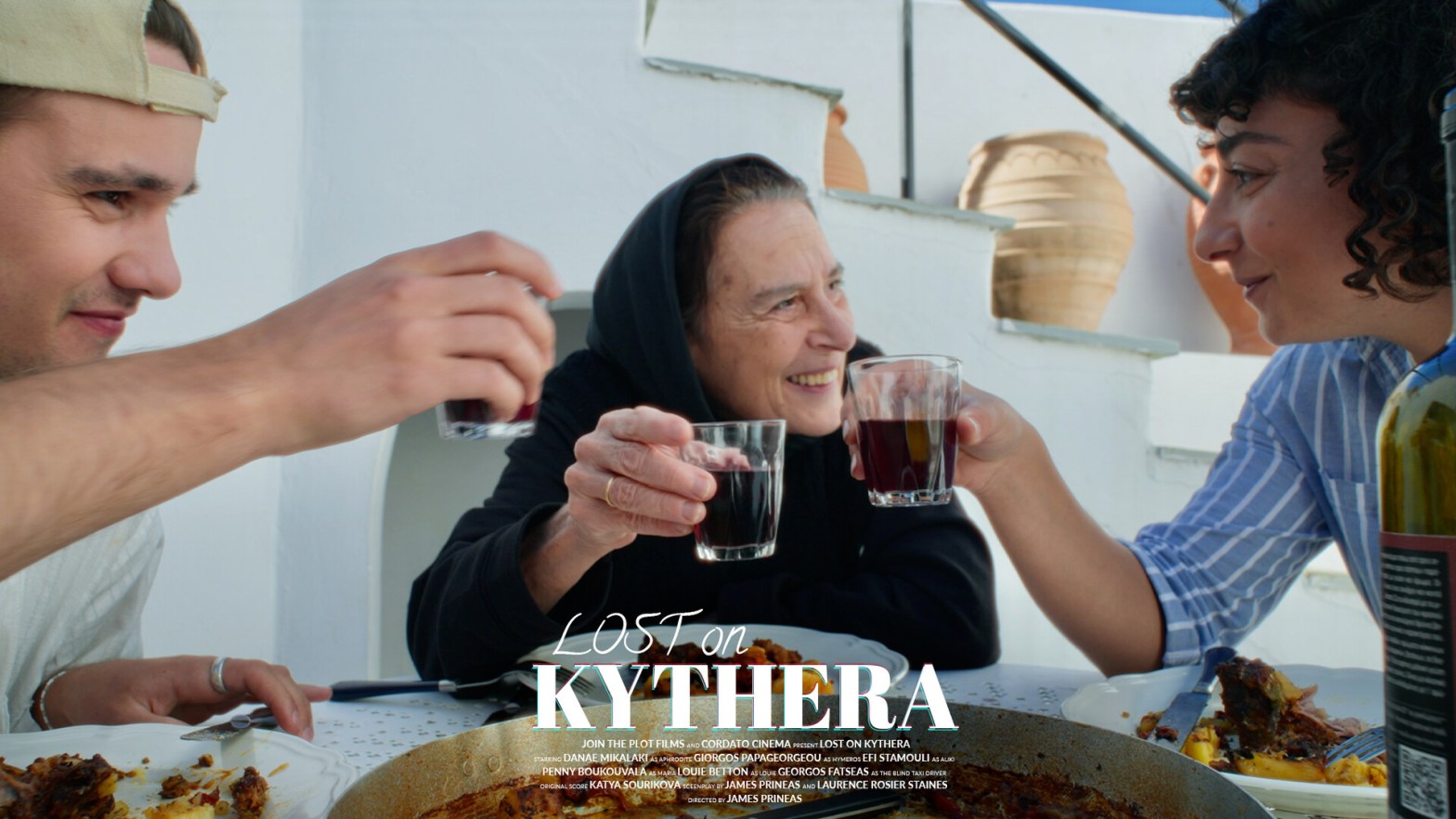
“Lost on Kythera” is a comedic spoof not afraid to jab here and there. It carries on a spoofing and satirical streak like Greek cinema of the 1960’s and 1970’s and at times verges on slapstick.

Louie (Louie Betton) and Maria (Nancy Boukli) both university students are twenty months into a romantic relationship and have taken some time off to visit the beautiful Greek island of Kythera. Maria is Greek.

After cavorting in the ocean they return to their campsite and encounter a taxi driver who offers them a lift back to their campsite, a house for purchase and a free tour. Yes the taxi driver is blind. Only in Greece could a blind driver obtain a taxi license! What tourist in Greece wouldn’t want a free tour. Is there an expression, “Beware of Greeks bearing gifts!”

The taxi driver leaves them in a small village and shows them the house for sale. Strangely, a bottle of wine and cheese plate awaits them as if someone knew they were coming. The taxi driver departs without advising the love birds and Louie and Maria can’t find a way out of the village. Wherever they go they end up in front of that house for sale. Again, strangely a beautiful dinner is in the outdoor oven awaiting their dining delight. After waking up the next day they try to leave and end up where they started and more strangeness as it is sunny in the village but it is surrounded by heavy fog. How many times have I heard in Greece a tourist say that it is so beautiful who would want to leave!

In the meantime, Aphrodite, up above, watches Louie and Maria as after all they are lovers. Hymeros, Aphrodite’s gay assistant, is by her side full of flippant comments. Yes Greeks practice inclusion!

We encounter Kytherians Georgos and Poppi elderly brother and sister farmers in a perpetual deadpan state. So deadpan it is comedic. Georgos wishes to drain their bank account and bury it in the ground as Greek politicians are crooks and their money will end up in one of the politician’s Swiss bank accounts. Nice jab at Greek politicians.

Then the Professor and her assistant Benson arrive. The Professor is a buxom lady and Benson a bumbling nerdy type. They are looking for Aphrodite’s Heavenly Temple thought to be once located up in the Kytherian Hills. Aphrodite is not amused with their mission. Comedic characters most likely due to their over the top stereotypic mannerisms. 

Then there is the crusty old lady widow the cigar smoking Aliki (Efi Stamouli) slightly menacing but not evil. She is the only inhabitant of the village and Poppi remarks to Georgos that Aliki now has “fresh blood” and too bad about the death of the last couple. Has horror now replaced comedy?

As to which characters are lost on Kythera? You may agree with me that all are lost if not physically then psychologically.

There are solid elements of fantasy, romance, suspense, horror, comedy, satire if not absurdity. A combination to keep all viewers happy.

In both Greek and English with English subtitles when Greek spoken.

If I was to say “Monty Python and the Holy Grail” lives in “Lost on Kythera” along with “Pyscho” and “North by Northwest” what would you think? And that strawberry jam on the pitchfork?

This Greek Australian production is directed by James Prineas.

You can watch the trailer here https://www.google.com/search?q=lost+on+kythera+trailer&oq=lost+on+kythera+trailer&gs_lcrp=EgZjaHJvbWUyBggAEEUYOTINCAEQABiGAxiABBiKBTINCAIQABiGAxiABBiKBTINCAMQABiGAxiABBiKBTIKCAQQABiABBiiBDIKCAUQABiABBiiBDIKCAYQABiABBiiBNIBCDc0NzRqMGo0qAIAsAIA&sourceid=chrome&ie=UTF-8#fpstate=ive&vld=cid:0dd22d2b,vid:3tskMBIow6s,st:0

It will be featured in the 4th annual Greek International Film Festival Tour (Canada) showing in 11 Canadian cities 1-31October2024. For more information see https://gifft.ca

RKS 2024 Film Rating 85/100.

The 4th Greek International Film Festival Tour (Canada): “Murderess” (Fonissa)

One of the very special films showing at the upcoming 4th Greek International Film Festival Tour (Canada) (GIFFT) showing in 11 Canadian cities 1-31October2024, Fonissa, had the highest box office sales in Greece for 2023.

It is based on an Alexandros Papadiamantis novel of the same name published in 1912.

Set in a small village in rural mountainous Greece circa 1900’s it has been filmed in greyish tones and almost at times it seems to be black and white and is accompanied by haunting choral style music. It is gloominess beautifully captured.

With a title of “Murderess” it becomes quickly apparent the murderess is an older woman Hadoula (Karyofyllia Karabeti) who is the village midwife and provider of basic health services. A string of deaths of female babies and young female infants sweeps the village.

Village life is patriarchal. The film opens with children dancing in a ring singing. “I wish I had a dozen little boys and not a single girl. The naughty little girls on a prickly pear”.

Hadoula’s daughter Delharo (Penelope Tsilika) gives birth to a girl and her husband on being told of this smashes a plate on the floor in anger and storms off.

The birth of girls is perceived with displeasure by many villagers and Hadoula smothers and drowns her way into being seen as a suspect in the death of many children all girls. Look carefully at some of her interactions with fathers “cursed” by too many daughters. It is almost as if a certain nod, eye movement or a sly word here and there gives Hadoula a license to kill. Hadoula recognizes that she has the hands to accomplish what many villagers will not do themselves.

Hadoula had an abusive mother. Eventually Hadoula marries with a pivotal scene being families negotiating a dowry treating Hadoula like a piece of livestock. Women are not treated well by men in the village and there are not that many of them as most have left to work abroad.

The village priest is blind both physically and morally as one is left with the impression he is a misogynist and even he had sight it would not be critically applied!

Some serial killers have specific missions and for Hadoula murdering girls saves them from enduring societal “torture”. “It is girls that come into life to be tortured and to torture us” she says. Hadoula believes her murderous deeds were not done out of free will. There is a belief by Hadoula God has sanctioned these murders.

Gendarmes arrive at the village investigating the string of children’s deaths and certain “informers” point the finger to Hadoula and she flees up into the mountains. What spectacular scenery almost otherworldly.

She returns briefly to her home and you may be dreading she just may do it. And when it happens you just might shriek, “Oh no!”. Hadoula is low but her last deed is beyond demonic. The village is in pursuit of Hadoula and like the widow in “Zorba the Greek” should they catch her she would be stoned to death. Instead she escapes back up the mountain and meets the spirit of her dead mother who has been dogging and chastising her throughout the film. It is clear at the film’s conclusion Hadoula has had a long fall from grace.

As the final credits role there is text describing the connection between infanticide and dowries worldwide. It was not until 1983 that dowries were abolished in Greece.

Hadoula is a murderess but it was village patriarchy and the dowry that were her accomplices. At the core is the economics of dowries.

A powerful film which is dark and brooding through its topic, cinematography and soundtrack. This Greek box office smash will be proudly screened at GIFFT. If you have difficulty sleeping after watching “Fonissa” don’t blame me. The most horrific film I have seen in some time.

Directed by Eva Nathena.

You can see the trailer here https://www.youtube.com/watch?v=cb8mQg7ibdM

GIFFT is unique in that it has showings in 11 Canadian cities and some films are available online.

For showing details for this film and others in the GIFFT programme go to https://gifft.ca

RKS 2024 Film Rating 94/100.