
As you are dear to me, go claim a younger
Bed as your due.
I can’t stand being the old one any longer,
Living with you.
Sappho (630 BCE-570BCE), “Come Close”

As you are dear to me, go claim a younger
Bed as your due.
I can’t stand being the old one any longer,
Living with you.
Sappho (630 BCE-570BCE), “Come Close”

But all dandyism and eccentricity is more or less unnatural in a world dominated by the desperate struggle for economic survival.
John Fowles, “The Magus”, 1977.
‘The human race is unimportant. It is the self that must not be betrayed.’
‘I suppose I could say that Hitler didn’t betray his self.’
He turned.
‘You are right. He did not. That was the tragedy. Not that one man had the courage to be evil. But that millions had not the courage to be good.’
John Fowles, “The Magus”, 1977.
Desolation. Rubble, fragments of plastered wall, broken rafters, the yellow splashes of lyddite everywhere, The drizzle that had started again gleaming on the stones. On the skin of corpses. Many Germans had been caught in the houses. In ten minutes I saw a summary of the whole butcher’s shop of war. The blood, the gaping holes, the bone sticking out of flesh, the stench of burst intestines – I am telling you this only because the effect on me, a boy who had never seen even a peacefully dead body before that day, was one that I should never had predicted. It was not nausea and terror. I saw several men being sick. But I was not. It was an intense new conviction. Nothing could justify this. It was a thousand times better England should be a Prussian colony. One reads that such scenes give the green soldier nothing but a mad lust to kill in his turn. But I had exactly the contrary feeling. I had a mad lust not to be killed.
John Fowles, “The Magus”, 1977.

The Toronto Blue Jays and an Entourage of Traitors
You see them on television in American ball parks
travelled across the border like duped marks
Obviously, baseball Trumps a sense of decent nationalism
A sort of ignorant traitorous priapism
Just let “you know who” rip and tear Canada and threaten and roar menacing insults
But you devoted baseball fans pour into the United States and spend your deflated Canadian dollars
Noticed here are your duplicitous hollers
Have you no sense of shame
Where a baseball game you attend bolsters the coffers of the USA
Assisting you know who to hold sway
When the camera comes your way
Canada knows you’ve sold them out
Best cover your face with a mask
So when returning no one can hold you to task
Robert K. Stephen
I acquired expensive habits and affected manners. I got a third-class degree and a first-class illusion: that I was a poet. But nothing could have been less poetic than my seeing-through-all boredom with life in general and with making a living in general. I was too green to know that all cynicism masks a failure to cope-an impotence, in short; and that to despise all effort is the greatest effort all. But I did absorb a small dose of one particular thing, Oxford’s greatest gift to civilized life: Socratic honesty. It showed me, very intermittently, that it is not enough to revolt against one’s past. The truth was I was not a cynic by nature; only by revolt. I had got away from what I hated, but I hadn’t found out where I loved, and so I pretended that there was nowhere to love.
John Fowles, “The Magus”, 1977.
The Four Horsemen of the Apocalypse are described in the Book of Revelation in the New Testament. Different cultures in different points of time have given varying interpretations of their meaning. The commonality is that their appearance is bad news for the world signalling its ensuing destruction.
The White Horse symbolizes conquest. Some believe it symbolizes Christ.
The Red Horse rider carries a sword representing war, bloodshed and civil strife.
The Black Horse symbolizes famine and pestilence.
The White Horse symbolizes death.
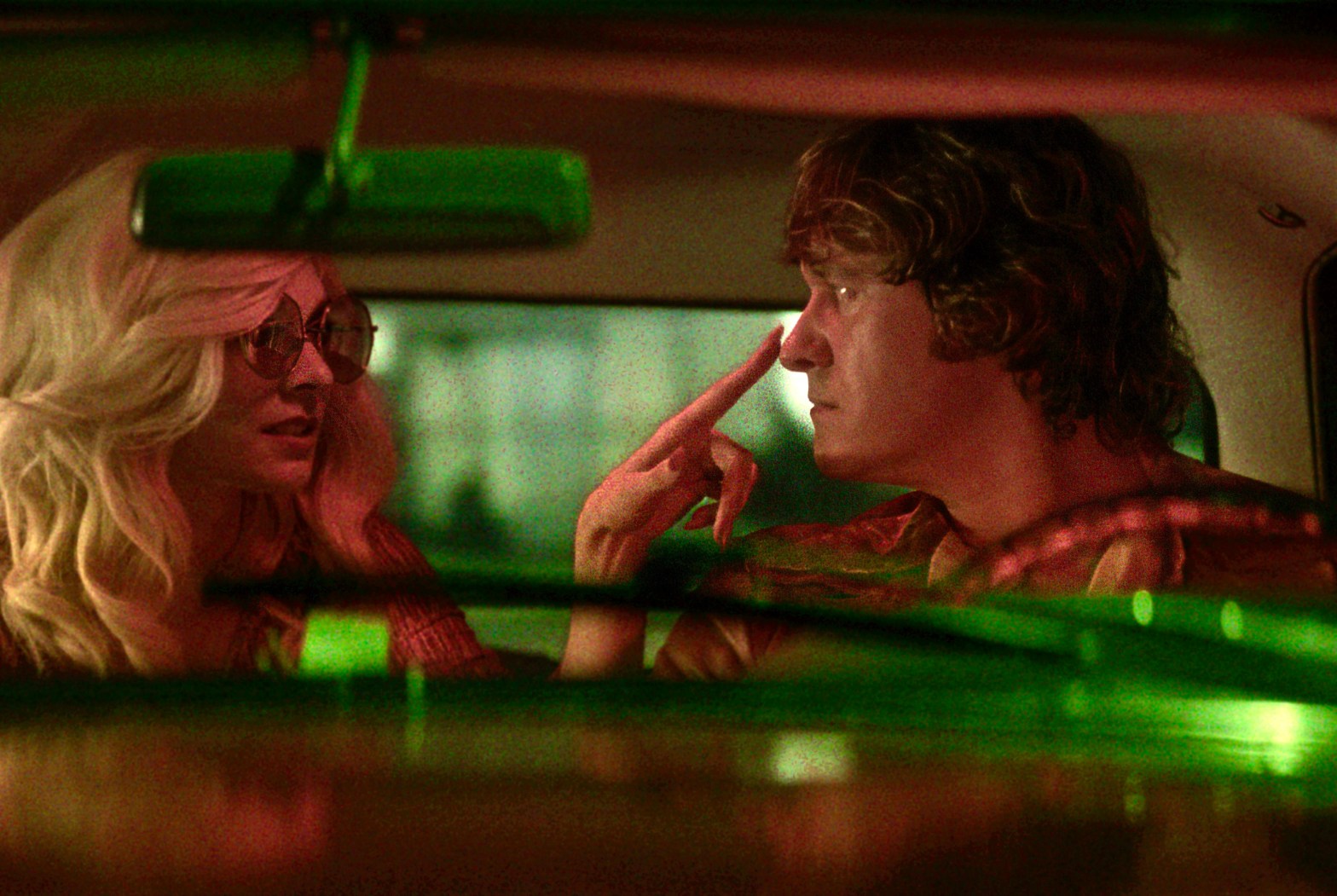
There are no horses in “Armageddon Road” rather 4 coloured miniature animated cars each representing one of the Four Horsemen.
Steve (Brian McCaig), a convict on parole in 1976 Las Vegas, chauffeurs Delilah (Natalie Grace) for a mob boss Big Moe. Delilah, a crass floozie, fatally overdoses on cocaine and touched by a sword of a horseman returns at 04:50 to Steve’s big red car with gleaming red eyes (for a moment) and sword ornament attached to her necklace loses her bimboish personality to a very serious one with a dignified British accent. It is clear she is on some sort of mission as they head out in the desert and encounter three other cars in the journey eventually meeting at a remote site in the Nevada desert, a nuclear test site of the past.
Is the world ready for destruction? Perhaps not at this point of rendezvous but who says destruction must be imminent as the four horsemen converge. The mere fact of convergence is a horrific omen irrespective of the Thelma and Louise ending whatever that should mean.
What genre “Armageddon Road”? Not easy and that may be half the fun of this film. Could it be horror satire, B movie satire, comedy, spoof or simply a poor movie with most interesting camera work? It might be a bit of all of these but the mere fact it has you guessing in my view takes it out of the B movie ream or at least a bad B movie realm. Sometimes those hard to figure out films are very good ones for whatever they stand for. If you are suffering from confusion at least enjoy the interesting soundtrack even if some of it is crotch rock.
The official premiere was in Vancouver 4/5August2026 and on September 4/5 it shows in Toronto.
You can see the trailer here https://www.youtube.com/watch?v=bsPl5DGsZRc
Directed and written by Karen Lam.
RKS CANADIAN FILM RATING 81/100.
Like all men not really up to their job, he was a stickler for externals and petty quotidian things; and in lieu of an intellect he had accumulated an armoury of capitalized key-words like Discipline and Tradition and Responsibility. If I ever dared – I seldom did – to argue with him he would produce one of these totem words and cosh me with it, as no doubt in similar circumstances he quelled his subalterns. If one still refused to lie down and die, he lost, or loosed, his temper. His temper was like a red dog, and he always had it close to hand.
John Fowles, “The Magus”, 1977.
I had long before made the discovery that I lacked the parents and ancestors I needed. My father was, through being the right age at the right time rather than through any great professional talent, a brigadier; and my mother was the very model of a would-be major-general’s wife. That is, she never argued with him and always behaved as if he were listening in the next room, even when he was thousands of miles away. I saw very little of my father during the war, and in his long absences I used to build up a more or less immaculate conception of him, which he generally- a bad but appropriate pun – shattered within the first forty-eight hours of his leave.
John Fowles, “The Magus”, 1977.

“Dear You” is an epic familial tale focusing on love, friendship, compassion and loss but there are many stories hovering around the apparent simplistic plot. And the film is a solid hit in China being the second highest grossing film there in 2026 and attracting audiences throughout Southeast Asia. It also has sparked controversy in Singapore.
A financially improvident grandson pursued by creditors relies on family history to pursue his supposedly wealthy grandfather Den Bhagseng thought to be residing in Thailand in hopes of securing funds to liquidate his debts.
The mystery of Den Bhagseng deepens as the grandson attempts to locate his grandfather in Thailand. His search ends with confirmation of his death in 1960 but why were qiaopi letters from him still being sent to his wife Sogriu until 1978? Qiaopi letters were sent by overseas workers from China in Southeast Asia and North America including important remittances back to China. In modern day parlance think of Pilipino domestics sending vast sums of money to support families in the Philippines.
It is a fascinating mystery including cultural and linguistic suppression of the Chinese workers and the Chinese language, poverty, love, compassion, deception, friendship, misunderstanding, arson and murder all presented in a wholesome manner with an abundance of sappy music and tears with a slight comedic touch.
It resonates with Chinese audiences including the Chinese diaspora throughout the world as it encompasses Chinese emigration and oppression.
The Chinese dialect of the movie was Teochew but the Infocomm Media Development Authority of Singapore which regulates films distributed in Singapore required Mandarin dubbing in line with Singapore’s Speak Mandarin Campaign in force since 1979 in an attempt to establish a common language amongst Singapore’s majority Chinese population where there are at least five Chinese dialects spoken. The film’s distributor managed to obtain permission to release the film in its original Teochew dialect for numerous showings.
When Rod Stewart sings, “Every picture tells a story don’t it” the picture in the film tells a devastatingly wrong story to some and a true story to others when it’s too late!
The film is directed by Lan Hongchun.
It opens in North American theatres on 4September2026.
RKS Chinese Film Rating 82/100.
Have a WordPress.com account? Log in now.

