RKS ARGENTINIAN FILM: “The Dollmaker” (Encantador) 2025: Political Horror?

American horror films in many respects are simply boring. Deserted cabin in the woods and take it from there. Canadian horror films are marginally superior.

The real horror resides of late in Mexican and Argentinian films.

“The Dollmaker” is no exception.

It combines sophisticated and clever horror with a political allegorical twist.

Expect Pee Wee Herman, Norman Bates, Chucky and David Lynch.

The setting is Palacios a small town with an entry billboard proclaiming nothing bad ever happens there. Quite the opposite. There are numerous missing women. There is more than meets the eye in this quirky rural façade.

Tomás (Rodrigo Noya) in character is quite a Pee Wee Herman and Norman Bates. He works in a video store “Boy Scouts” where the staff wears American Boy Scouts outfits complete with an American flag. The local constabulary wear yellow-coloured police shirts with “Santa Fe Police Department” also sporting an American flag. What is this “American angle”? Political perhaps?

Tomás has gruesome hallucinations of his dead father and mother and frequently mistakes humans for dolls. He crafts bizarre dolls for a hobby. He lives and cares for his invalid “mother”, so it seems.

A new police inspector arrives in Palacios with serious intent to locate the missing women. There are occasional shots of these women in a basement undergoing torture, mutilation and rape.

It is not terribly difficult to determine the abductor and torturer.

The film resolves itself with an exposed cover up, double murder suicide and evidence of an early age psychotic shielded for years by the cover up. As they say,“bad to the bone”.

With some imagination is the plot also an allegorical reference to the 30,000 or so missing and murdered during the brutal Argentinian military dictatorship of 1976-1983? The American flagged Boy Scouts outfit, as the Boy Scout organization was exposed as corrupt and youth predatory, and the American flag on the outfits of the Palacios constabulary are indicative of military force of the dictatorship and the tacit acceptance of such by the Ford administration of the United States? Pay close attention to the headlines cut and pasted with the opening credits featuring stories of missing people, human rights, bombing by terrorists and Hitler accusations levelled against President Roosevelt. A hint of an upcoming politically tinged film?

Of what importance is the Presidential announcement at the film’s conclusion? A deluded political swindle perhaps as the Argentinian junta purloined on Argentinians equally delusional as the abductor and killer?

Horror and political allegory? Have I gone too far or have you missed a subtlety? Is the subtlety horror and political history the main disguised theme of “The Dollmaker”

Another Argentinian beauty directed by José Maria Cicala with stellar music by Nahuel Maeso.

Arrives on VOD/digital 25August2026.

You may watch trailer here https://www.youtube.com/watch?v=fgydDAf50sc

RKS Argentinian Film Rating 90/100.
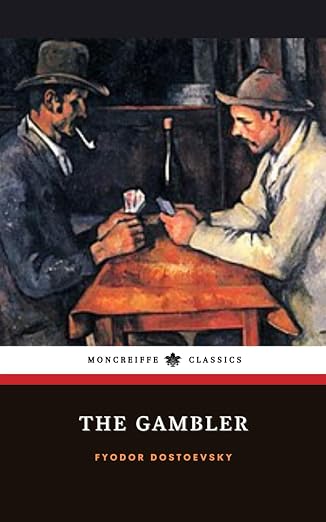
RKS RUSSIAN LITERATURE: With Gambling You Have Renounced Everything! (Fyodor Dostoevsky)

‘You have not only renounced life, with its interest and social ties, but the duties of a citizen and a man. You have not only given up the friends I knew you had, and every aim in life except winning money, but you have also given up your memories. Although I can remember you during the strong, passionate period of your life, I’m persuaded that you have now forgotten all the better feelings you had at that time, and your present dreams and aspirations do not rise above odd, even, red, black, the twelve middle numbers, and so on.’

Fyodor Dostoevsky, “The Gambler”, 1866

RKS RUSSIAN LITERATURE: Always…The Next Spin of the Roulette Wheel (Fyodor Dostoevsky)

I have a feeling of expectation and it can’t be wrong. I’ve got 15 louis d’or now, though I only began with fifteen gulden. If I play carefully to start with…..But no! Surely I’m not such a fool as that. I’m a lost soul. But why should I not rise from the dead? All I need to do is play cautiously and patiently at first and the rest will follow. All I need to do is keep control of myself for one hour, and my destiny will be forever changed. The key thing is character.

Well, I won, and twenty minutes later left the casino with a hundred and seventy gulden in my pocket! That’s a fact, and it shows what one last remaining gulden can do……But what if my courage had failed me. What if I hadn’t dared to make that decision?

Tomorrow. Tomorrow it will all be over!

Fyodor Dostoevsky, “The Gambler”, 1866

RKS Literature: What Does Song Show Us? (Salman Rushdie)

Our lives are not what we deserve; they are, let us agree, in many painful ways deficient. Song turns them into something else. Song shows us a world that is worthy of our yearning, it shows us our selves as they might be, if we were worthy of the world.

Salman Rushdie, “The Ground Beneath Her Feet”, 1999

RKS RUSSIAN LITERATURE: The Sordidness of Beggary After Being Wiped Out at Gambling! (Fyodor Dostoevsky)

Scarcely a year and a half have passed, but I’m worse off than the poorest beggar. But what is a beggar anyhow? Who cares about being a beggar? I’ve just ruined myself, that’s all. There’s nothing I could compare my situation to at the moment, and moralizing would serve no purpose in any case. At the present time nothing would be more absurd than moralizing. And as for those self-satisfied people, in their unctuous pride, are always ready, to mouth their maxims, if only they knew how fully I understand the sordidness of my present state they wouldn’t trouble to wave their tongues at me! What can they say to me that I don’t already know. And is that the point in any case? The real point is this – that in a single turn of the roulette wheel, everything changes.

Fyodor Dostoevsky, “The Gambler”, 1866

RKS RUSSIAN LITERATURE: Bloodsucker Mademoiselle Blanche Completely Cleans Out Our Protagonist (Fyodor Dostoevsky)

I frequently had recourse to champagne because I constantly felt depressed and bored, owing to the fact that I was living in the most bourgeois, mercenary milieu imaginable, where every sou was counted and grudged. Indeed, two weeks had not gone by before I realized Blanche had no real affection for me, even though she dressed me in elegant clothes, and tied my cravat herself every day. Quite simply, she utterly despised me. But that did not bother me at all. Bored and depressed I generally spent my evening at the Château des Fleurs where I would get drunk and dance the cancan (which in that establishment, was performed pretty indecently) with some distinction. At length, the time came when Blanche had drained my purse dry.

Fyodor Dostoevsky, “The Gambler”, 1866

RKS RUSSIAN LITERATURE: Mademoiselle Blanche an Unapologetic Bloodsucker (Fyodor Dostoevsky)

‘What do you want with money?’ she would say to me with an air of total simplicity, and I never argued the point. She fitted out her flat very nicely with the money, which did not stop her from saying when, later, she was showing me over the rooms of her new home.’ See what care and taste can do with the most scanty means.’ That ‘scantiness’ however, had cost me fifty thousand francs! With the remaining fifty thousand she purchased a carriage and horses. Also we gave a couple of balls, evening parties attended by Hortense, and Lisette and Cléopâtre women remarkable both for the number of their liaisons and (though only in some cases) for their good looks. At these gatherings I had to play the ridiculous role of host, to meet and entertain fat parvenu merchants, unbearable both in their rudeness and their boasting, colonels of various kinds, starving authors and journalistic hacks, all in fashionable tailcoats and pale yellow gloves and displaying such conceit and boastfulness as would be unthinkable even in St. Petersburg- and that’s saying a lot!

Fyodor Dostoevsky, “The Gambler”, 1866

RKS Literature: Giving Thanks to God When There is No One Else to Give it To (Salman Rushdie)

I always in my own godless way found it hard to believe that she actually believed in an actually existing god. But she probably did; I was probably wrong about that too; and anyway, what other word is there? When there’s that gratitude in you for life’s dumb luck, when there’s nobody to thank and you need to thank somebody, what do you say? God, Vina said. The word sounded to me like a way of disposing emotion. It was a place to put something that had no place else to go.

Salman Rushdie, “The Ground Beneath Her Feet”, 1999

RKS RUSSIAN LITERATURE: Charlatan Poles at the Casino Robbing Grandmother (Fyodor Dostoevsky)

An hour later, the two Poles who earlier in the day had been thrown out of the casino, made a reappearance behind the old lady’s chair and renewed their offers of service, even if only to be sent on errands; but Potapych told me these rascals exchanged winks with the said “gentleman of honour”, and the latter handed something to them. Next, since Grandmother had not yet had lunch – she had scarcely left her chair for a moment – one of the two Poles ran to the casino restaurant and brought her a bowl of soup and afterwards some tea. In fact both Poles hastened to run errands for her. Eventually, at the end of the day there were no fewer than six natives of Poland who had never been seen or heard before: and as soon as the old lady staked the coin in question, they took no further notice of her, but pushed their way past her chair to the table, grabbed the money and staked it, shouting and arguing all the while, and squabbling with “the gentleman of honour” (who had also forgotten Grandmother’s existence) as though he was their equal. Even when Grandmother had lost everything and was returning to the hotel, some three or four Poles could not bring themselves to leave her, but continued running beside her chair and protesting volubly that Grandmother had cheated them and that she ought to be made to hand over what was not hers. Thus the party arrived at the hotel, from which the rogues were unceremoniously ejected.

Fyodor Dostoevsky, “The Gambler”, 1866

RKS RUSSIAN LITERATURE: Croupiers at Casino Guardians of Assets of the House (Fyodor Dostoevsky)

At the casino Grandmother seemed to be expected, for no time was lost in getting her to her former place beside the croupier. It is my opinion that though croupiers seem such ordinary humdrum officials – men who couldn’t care whether the bank wins or loses – they are, in reality anything but indifferent to the bank’s losing, and are given instructions to attract players, and to keep a watch over the bank’s interests, and that for such services, these officials are awarded gifts and bonuses. At all events the croupiers of Roulettenburg seemed to look on Grandmother as their rightful prey.

Fyodor Dostoevsky, “The Gambler”, 1866