COVID-19 Fatigue: What are the symptoms?

In addition to incessant mention about COVID-19 in the media it is as if “COVID Fatigue” itself is a disease so let us call it CF as that has a nice disease ring to it. If the medico-politicos had their way they would have you believe CF will automatically lead to COVID contamination.

You can be suffering from many or simply a few symptoms. Off the bat let us say “COVID Distress” is a far more serious condition and may require medical assistance of a mental health nature.

So what are some of the symptoms of CF?

Being Sick and Tired of Hearing the Name COVID-19

The CF victim has reached a tipping point of numbness when hearing the words “COVID”. If a television or radio is involved the CF victim may be heard yelling insults at the commentators and saying, “shut up”.

Being Sick and Tired of the Media Coverage

The CF victim exhibits frustration and tingling of the feet about the parroting of the medico-political elite leading the COVID charge by the media who have apparently lost the ability of critical thought. Extreme indigestion often results from a lack of critical analysis by the media.

Being Sick and Tired of the Never-Ending Parade of Statistics

Case counts, death counts, 7 day moving averages and the like cause dizziness. The lack of realistic per capita statistics is rarely mentioned.

 Being Sick and Tired of the Propaganda

CF victims of this exhibit deafness after months of propaganda (public health announcements) best understood by toddlers, Major episodes of frustration have been reported amongst CF victims upon hearing “social distancing”, “hand washing” and “mask wearing”.

Being Sick and Tired of the Abandonment of Political Responsibility

Many CF victims suffer chills from witnessing the politicos “deferring” to the “medical team”. The best therapy for this may be at the ballot box. Many politicos really do seem to be fighting the plague and caring about their populations but some jurisdictions have had to suffer morons for political leaders that ply their political agenda while the death count claims in their jurisdictions soar. In such jurisdictions CF may cause political violence and national divisions thereby increasing bouts of rage for CF sufferers.

Being Sick and Tired of Hero Stories

There is a high prevalence of gagging amongst CF victims all of whom appreciate the dedication of front line workers but are disgusted with the sappy framing of their dedication by the media anxious for a dramatic story.

Being Sick and Tired of Lock-Downs (continual imprisonment)

CF victims display extreme impatience with continual restrictions of regular everyday movement, employment losses and restrictions on political rights.

Being Sick and Tired of Well-Meaning Stoolies and the COVID Police

Some CF victims claim to experience hallucinogenic episodes of time travel some claiming to have travelled back to Nazi and Stalinist times where stoolies and spies turned in dissidents and by-law enforcement officers become Gestapo or NKVD agents.

Being Sick and Tired of the Massacre in Long Term Care Facilities

Years of long-term care facility neglect and the siphoning off dividends in for profit care facilities to shareholders reportedly has caused angry outbursts by CF sufferers and even worse amongst those who have lost loved ones in those facilities.

Being Saddened by the Less Affluent in Society are More Likely to be Sickened or Damaged by COVID

Even in the midst of a plague the poor suffer higher mortality and infection rates and job losses than the more affluent segments of society. Many CF victims experience bouts of sadness with symptoms.

Being suspicious of warp speed and fast-tracked vaccines

CF victims may experience fear and/or suspicion about COVID vaccines that have been rushed to production where in most cases Big Pharma producing these vaccines controls the test statistics.

CF can only be controlled by herd immunity but even then the symptoms may be life altering with possible bouts of paranoia setting in about the next upcoming virus.

The Great Transfer of Wealth

While COVID creates a greater pool of the poor the transfer of wealth to billionaires has been unprecedented during the plague. CF sufferers express a great degree of puzzlement why the billionaires are doing so well.

For those suffering from COVID Distress there are mental health hotlines, psychologists, psychiatrists and often employee assistance hotlines that can help those feeling in serious distress.

Life at Up Up and Away Investment Management International : Chapter 15 Is there anything good at all about largecorp?

Chapter 15

Is there anything good at all about largecorp?

I think you would agree that I have painted a bleak picture of largecorp. It is fuelled by greed through obscene executive compensation. This involves fleecing shareholders and exploiting employees to the point of burning and spitting them out. Through the business schools of management, it has created and holds in its pockets an ideology that promotes, legitimizes and excuses its abuses.

In fact, corporate funding chokes these “schools of management” from any true degree of academic impartiality to the extent that MBA professors and graduates are the pimps and hookers for largecorp. If Trump has created the terms “fake news” these schools of economics have created “fake economics”. In the crudest terms the MBA graduates are Stalinist “Young Pioneers” of largecorp. Just look at how these management institutes describe themselves! Always named after some largecorp philanthropist. The same applies to hospital wings. Steal from shareholders and employees yet the press burbles and burps over generosity of the biggest exploiters. And just where did they get all this money from? The Senior Management Team and Putin have many similarities.

So, can largecorp create any good in society? I rather doubt it. But let’s try to be innovative here.

First of all, let’s say that largecorp does employ many people which is positive sounding to many an economist. However, it unemploys many people particularly in the last twenty years with unceasing outsourcing. It also subjects many of its workers to mentally unsafe working conditions. Many largecorps exploit cheap labour abroad when they outsource to foreign jurisdictions. Employment quality ought to take precedence over simple employment. If a clothing factory creates a thousand jobs in Bangladesh under horrifically dangerous conditions at ultra low wages how valid is the creation of employment. In an attempt to create new terms I say that largecorp specializes in creating negative rather than positive employment whether it be domestically or internationally.  And let us not forget the ultimate goal of largecorp is to utilize artificial intelligence to eliminate as many jobs as possible.

I can say with some conviction largecorp offers to many of its employees’ decent employee benefits such as health and dental care and some sort of retirement income pension plan. We are now at the point that the majority of Canadian workers have no pension plan. Working for a largecorp just about guarantees a pension plan. How generous it is rather reliant on how the Senior Management Team calculates its own liability for not offering one or improperly administering the pension plan. Believe you me the SMT members responsible for administering the pension plan treat it as a landmine of personal liability.

In the early days of largecorp, employees were often in defined benefit plans which meant although both employee and largecorp would contribute to the pension plan the employee would receive a pension payment based on some formula whether it be on career average earnings or best year’s earnings. Assuming a solvent employer and accurate actuarial calculations the employee would receive a “guaranteed and calculable” amount as a pension. largecorp bore the risk of delivering the promised benefit. It bore the risk of poor investment returns and claims that it mismanaged the pension fund or plan.

Many largecorps have realized recently upon actuarial advice, that these defined benefit plans have left them with huge “pension deficits and unfunded liabilities”. In other words, the SMT has been sucking up so much in executive compensation, engaging in share buy-backs and increasing dividends to shareholders to the extent that it has ignored properly funding its defined benefit plans so that huge deficits have arisen forcing largecorp to lobby politicians and have legislation passed permitting them temporarily to maintain underfunded pension plans by posting letters of credit to the pension fund. This means in simple terms they are excused from funding what is necessary to fund promised pension benefits. Largecorp employees in peril while largecorp executive compensation rages out of control. Sound like familiar SOP for largecorp? Why did the politicians bend over backwards to placate largecorp’s begging for a temporary halt to pension fund contributions?

It is a bit of a useless pissing match to whine and complain what largecorp has done to protect its interests concerning defined benefit plans because it has been mercilessly converting its defined benefit plans to defined contribution benefit plans. It won’t be long before there are no defined contribution pension plans sponsored by largecorp. The land of milk and honey defined benefit plans will be in the purview of government bureaucracies.

In a defined contribution pension plan the employee and employer contribute to the pension plan fund but the pension benefit funding beyond mandatory employer contributions is no longer a concern of the employer but rather based solely on the performance of funds the employee has selected! This is a very attractive reason to convert defined benefit pension plans to defined contribution pension plans. Largecorp is still on the hook for the defined benefit promises for pension benefits it has promised prior to the conversion to a defined contribution pension plan but on a moving forward basis it is off the hook for pension benefits arising out of a defined contribution pension plan. It has a legal obligation to administer the pension plan in a proper fashion and making its contributions to it in a timely manner as required under pension benefits legislation but once it has done those things it is no longer responsible for payment of the pension benefit.

There are very few employees In Canada that benefit from defined benefit pension plans. The exceptions are government employees and some highly unionized largecorp workplaces but even in the latter the switch to defined contribution plans is in high gear.

At the end of the day the Millennials are facing a defined contribution landscape if they are fortunate enough to even have a pension plan but it is certainly better than having no pension plan. My Millennial daughter Lexia works for a largecorp in Toronto and to my great shock she has no pension plan!

Before patting largecorp on the back we should see how the SMT treats itself! It benefits from whatever the pension plan offers but it then offers the higher ranking SMT” Retirement Compensation Arrangements” (“RCA’s”). As a big earner there is only so much you can contribute from your “earned income” to your pension plan as permitted under Canadian tax legislation. However, you can set up an RCA for the SMT high earners which permits the SMT to exceed in percentage what salary as “earned income” can be contributed under tax legislation into their pension plan into RCA’s. RCA’s impose a punishing tax on largecorp contributions made to it which is borne by shareholders and ultimately employees. The SMT in effect ravishes its revenue to “legitimately” line their pockets by the creation of these tax punishing RCA’s. And of course, the employee benefit consulting firms retained by largecorp legitimize this corporate looting as being justified by market competitiveness and a part of key “retention of management” strategy. And wasn’t it Justin Trudeau who promised the Canadian electorate to protect the interests of the “middle class”? The existing tax legislation pertaining to RCA’s favours the 1%. Why hasn’t it been repealed?

Working for largecorp offers employees knowledge and experience on how to survive in their next largecorp after they are inevitably terminated from largecorp. As the folks who run largecorp like to say,” We are offering you skills for life not a job for life”. Working for largecorp is a life sustaining skill!

Please remember I am a bit of a discontent. There are countless largecorp employees who fall hook, line and sinker for the largecorp experience and like countless sheep throughout history bleat the largecorp ideology and persuade themselves they are content, happy and challenged. Some are promoted but most never reach the golden arches of the SMT. As they say there are plenty of suckers out there.

In conclusion for a thinking and discerning person largecorp throws out chum bait to its employees and admirers with a minority swallowing it while the majority try to grin and bear it to keep the funds rolling in.

Any benefits bestowed by largecorp to its employees are essentially token, diminutive and a pittance of how the SMT stuffs their own wallets. At best the employee is rewarded with a paycheque and a somewhat decent benefits package.

At the end of the day largecorp employees are expense centres to be calculated, sliced and diced and often thrown into the street in the name of efficiency and cost reduction. The SMT rises above this crudity unless a particularly greedy, sociopathic and quasi-criminal cadre engineers a hit of its own taking out fellow members of the SMT thereby increasing a bigger slice of the pie for remaining SMT members.

Although I would not exactly characterize this as “good” one should understand that largecorp often targets older workers in downsizings and in selective hits. This cull clears the way to hire younger and cheaper replacements therefore giving some mobility to the younger employees of largecorp. I am all for mandatory retirement at 65 which I see as mercy rather than ageism.

No Mad Rush in Canada for COVID Vaccine

More Canadians than ever willing to receive the COVID-19 vaccine: Angus Reid poll

Mark VillaniCTV News Calgary Video Journalist

@CTVMarkVillani ContactPublished Monday, December 14, 2020 12:04PM MSTLast Updated Monday, December 14, 2020 9:37PM MSThttps://imasdk.googleapis.com/js/core/bridge3.432.0_en.html#goog_1750030757Volume 90% COVID-19 vaccinations to start Wednesday NOW PLAYINGAlberta health care workers will be among the first to receive 3,900 doses of the COVID-19 vaccine on Wednesday. Mark Villani explains.

SHARE

CALGARY — A new poll suggests more Canadians than ever are willing to get the recently approved Pfizer-BioNTech vaccine as soon as possible.

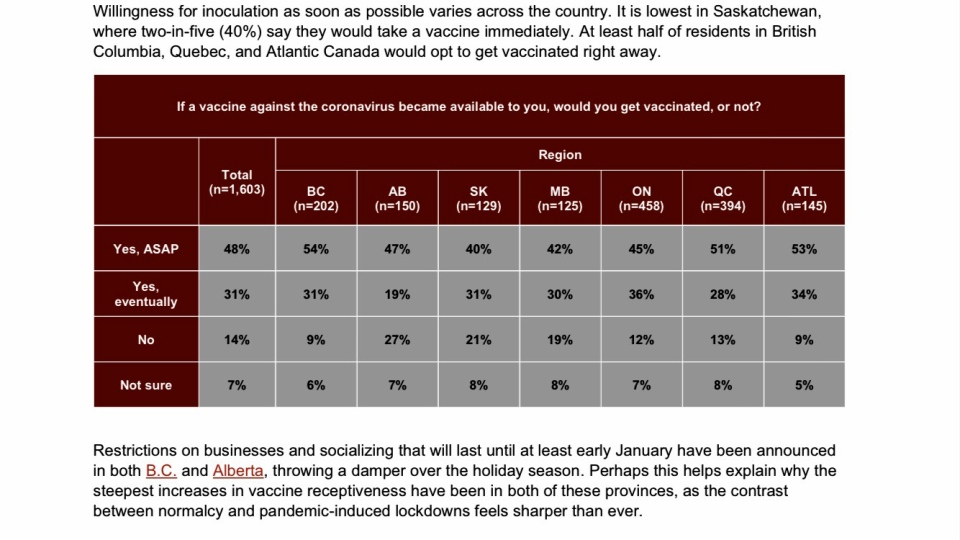
According to a survey of 1,605 Canadians from Dec. 8 to 11 by the Angus Reid Institute, 48 per cent said they would be willing to get the shot immediately and another 31 per cent said they would get the shot after a wait.

That’s a big jump compared to the same survey conducted by the non-profit independent research group from Nov. 12 to 16, when 40 per cent said they would get the shot as soon as possible.

Related Stories

The numbers are up significantly in Alberta as well.

In November, only 32 per cent of Albertans said they would get the vaccine immediately, but that number has now jumped to 48 per cent since the latest rounds of COVID-19 restrictions have been imposed by the Kenney government.

That number may be increasing, but of Albertans who took part in the survey, 27 per cent said they would not get the vaccine, and seven per cent said they were not sure. 

And that 27 per cent saying ‘no’ is the highest in the country, according to the poll. Almost twice as high as the national average. 

Angus Reid Poll COVID-19

According to the poll, respondents aged 65 years and older are the most likely to get the vaccine (61 per cent), while the 35 to 44-year-old demographic scored the lowest (42 per cent).

In total, 70 per cent of those surveyed states they were concerned about longer-term side-effects and 14 per cent are against receiving a vaccine under any circumstance.

The overwhelming majority — 88 per cent — agreed that the vaccine should not be first come, first serve, but instead go first to those most at risk. 

As for who should be required to receive the vaccine, 71 per cent agreed that it should be mandatory for all healthcare workers, followed by extended care-home workers at 69 per cent. 

Half of respondents said the vaccine should be mandatory in schools, while workplaces (43 per cent) and public events (40 per cent) were deemed to be of lesser risk.RELATED IMAGES

  • The number of Canadians willing to get a COVID-19 vaccine has gone up in recent weeks, suggests a recent poll. (File photo)

COVID-19 and Suicides: Black Americans Suffer Jump in Suicide Rates

During early coronavirus lockdown, Black suicides spiked, Johns Hopkins study finds — and now experts worry about winter

By TATYANA TURNERBALTIMORE SUN |DEC 16, 2020 AT 5:00 AM

During the early months of the coronavirus pandemic last spring, experts and doctors worried about the mental health toll of so many losses, from isolation to layoffs and deaths. Some predicted there might be an increase in suicides. Now, in what is believed to be one of the first studies of its kind, Johns Hopkins researchers who examined deaths across Maryland have found evidence of a rise in suicides — and also of the inequities between Blacks and whites.

In the study, published Tuesdayin JAMA Psychiatry, the researchers determined that among Black residents, suicide deaths appeared to double the recent historical average in one key period — from March 5, the date Maryland declared a state of emergency and shut down, until May 7, when the first public spaces were reopened. During the same time, scientists found that the suicides among whites appeared to drop by half.

Dr. Paul Nestadt, co-director of the Johns Hopkins Anxiety Disorders Clinic, led the study, which involved researchers from the Johns Hopkins School of Medicine, Johns Hopkins Bloomberg School of Public Health and the state Office of the Chief Medical Examiner. They looked at 1,079 deaths by suicide recorded across Maryland from January 2017 until July 7.

“This year, closures, economic impact and the number of people in the African American community who have been on the front lines and have not had the resources for child care, or do not have a job that affords them to work remotely, can cause a lot of stress,” Nestadt said. “I think the bottom line is we are not in the same boat, and we do not have the same economic cushion. Some are feeling these stresses more than others.”

PAID POST

What Is This?

Ad Choices
Pair Of English Jasperware Lidded Black-ground Wedgwood Vases With Zodiac Panels

Pair Of English Jasperware Lidded Black-ground Wedgwood Vases With Zodiac Panels

1stdibs.comGO !

Sponsored Content by 1STDIBS CANADAhttps://datawrapper.dwcdn.net/ESC8s/6/

Suicide numbersamong Black residents returned to the normal range as restrictions began being lifted, according to the study. Researchers noted while the numbers are small and should be interpreted cautiously, they highlight the importance of identifying high-risk groups early.[Most read] Maryland weather: Road conditions deteriorate as winter storm brings snow, ice to Baltimore region »

The study offers more evidence of COVID-19′s disproportionate impact on the Black community. According to the COVID Tracking Project, Black people are dying of illness caused by the coronavirus at 1.8 times the rate of white people. Black people also are more likely than white people to have essential, front-line jobs and aren’t able to work remotely.

With the number of coronavirus cases continuing to spike, Nestadt said he fears another increase in suicides.On Tuesday, The Sun reported more than 2,400 new COVID cases and 61 more deaths, the most fatalities in one day since May.

“We are entering a bigger peak where COVID rates are four to five times higher,” Nestadt said. “We need to have more financial support in place, if something isn’t done we may see [the increase] again.”

The researchers noted that the decrease in suicides among whites was unexpected. They theorized it may have been because white residents may have had a greater ability to do remote work and because they received greater benefits from government relief programs.

Newly elected Baltimore City Council President Nick Mosby said that COVID has exacerbated the preexisting socioeconomic hardships that many in the Black community face.

Dr. Paul Nestadt, co-director of the Johns Hopkins Anxiety Disorders Clinic, led the study, which looked at 1,079 deaths by suicide recorded across Maryland from January 2017 until July 7.
Dr. Paul Nestadt, co-director of the Johns Hopkins Anxiety Disorders Clinic, led the study, which looked at 1,079 deaths by suicide recorded across Maryland from January 2017 until July 7. (Bloomberg School of Public Health)

“It’s one of the underbellies we don’t talk about,” said Mosby, noting that the loss of jobs, inability to work remotely from home and financial instability are all stressors on mental wellness.

He said even trying to get help during the pandemic has been tough.

“People would have [unemployment] applications in for months, they’d wait to speak with someone on the phone for hours, with no one on the other end to answer, and meanwhile bills continued to pile up,” said Mosby, adding that there is a stigma around mental health issues in the Black community, which has not helped.

He is worried about how difficult things will be this winter.

“This is a tough time. This is the holidays, and people are laid off,” Mosby said.[Most read] Eddie’s Market of Charles Village closing Dec. 30 after decades as a neighborhood staple »

Mosby said he and others plan to dig deeper into this dataand look at other factors including age and gender, so they can target solutions for the city’s most vulnerable residents.

The Rev. Dr. Alvin C. Hathaway, senior pastor of the historic Union Baptist Church in West Baltimore, said COVID is unveiling an unfortunate new normal for many people.

“How you treat one another during this time is important, you may encounter a victim of trauma and trigger feelings such as ‘No one cares about me,’” said Dr. Alvin C. Hathaway Sr., senior pastor at Union Baptist Church.
“How you treat one another during this time is important, you may encounter a victim of trauma and trigger feelings such as ‘No one cares about me,’” said Dr. Alvin C. Hathaway Sr., senior pastor at Union Baptist Church. (Amy Davis / Baltimore Sun)

“COVID is saying every day, there is a loss of life, someone is sick in the hospital, and you are potentially the victim to this unseen virus,” Hathaway said.

He added that in this confusing time, people have a lot of questions, but sometimes lack reliable resources — and that can cause despair. He believes the solution is in how people talk to one another.

“We have to be fragile with our language and interactions,” Hathaway said. “How you treat one another during this time is important, you may encounter a victim of trauma and trigger feelings such as ‘No one cares about me.’”[Most read] Only two states have coronavirus numbers low enough to be left off Maryland’s COVID-19 travel advisory »

Rates of mental illnesses in African Americans are similar to the general population, but African Americans often receive poorer quality of care and lack access to culturally competent care. According to the American Psychiatric Association, only one in three African Americans who needs mental health care receives it. There are also few Black mental health providers.

But studies have found there are effective ways to help people who have considered suicide — like getting treatment and support.

The Morning Sun Newsletter

Daily


Get your morning news in your e-mail inbox. Get all the top news and sports from the baltimoresun.com.

Edgar K. Wiggins, who founded and directs Baltimore Crisis Response, a citywide crisis and hotline program, said its workers are seeing the stress from their callers.

“COVID is a beast that is changing life as we know it,” Wiggins said. “You can’t turn on the TV without seeing people who are sick or losing their jobs and are all of a sudden in need of food assistance.”

He added: “To say I’m concerned is an understatement.”[Most read] Howard County parents file lawsuit challenging student school board member’s voting rights »

Although the vaccine offers a light at the end of the tunnel, people will need to continue to observe restrictions until the vaccine is widely distributed, Wiggins said. He emphasized that even though it’s trying to be in isolation, people don’t have to endure the stress alone: “There are people who are available and want to talk to you.”

Warning signs of suicide

  • Talking about wanting to die
  • Talking about being a burden, or feeling trapped
  • Acting anxious, agitated or recklessly
  • Sleeping too much or too little
  • Withdrawing or feeling isolated

What you can to do help

  • Do not leave the person alone
  • Remove any firearms, alcohol, drugs or sharp objects
  • Call the Here2Help free, confidential crisis hotline at 410-433-5175.
  • Text HELLO to 741741 for free, 24/7, confidential emotional crisis support.
  • Call the National Suicide Prevention Lifeline at 800-273-8255

Source: Recommendations from consensus statement of public health and international suicide prevention experts led by SAVE

Tatyana Turner is a 2020-21 corps member for Report for America, an initiative of the GroundTruth Project, a national service program that places emerging journalists in local newsrooms. She covers Black life and culture. Follow her @tatyanacturner.Ta

Inequality of Nations as to Vaccine Allocation

One-quarter of the world may not get a Covid-19 vaccine until 2022, experts warn

By ED SILVERMAN @Pharmalot

DECEMBER 15, 2020Reprints

Pfizer vaccine vial close
An example of a vial for the Pfizer/BioNTech vaccine.ANDREW HARNIK/GETTY IMAGES

As wealthy governments race to lock in supplies of Covid-19 vaccines, nearly a quarter of the world’s population — mostly in low and middle-income countries — will not have access to a shot until 2022, according to a new analysis.

As of mid-November, high income countries, including the European Union bloc, reserved 51% of nearly 7.5 billion doses of different Covid-19 vaccines, although these countries comprise just 14% of the world’s population. Meanwhile, only six of the 13 manufacturers working on Covid-19 vaccine candidates have reached agreements to sell their shots to low and middle-income countries.

The analysis, which was published in the BMJ, noted that access “varies markedly” across these countries. For instance, the U.S. reserved 800 million doses, but accounted for one-fifth of all Covid-19 cases globally. By contrast, Japan, Australia, and Canada reserved more than one billion doses, though these three countries combined did not account for even 1% of all current cases.

ADVERTISEMENTSPONSOR CONTENTInnovating lung cancer treatment during a pandemicThe unprecedented challenges presented by Covid-19 has put a new spotlight on the importance of timely, uninterrupted care for patients with lung cancer.BY SANOFI 

Looked at another way, the projected vaccine courses per capita by country show Canada, followed by Australia, the U.K., Japan, the European Union, and U.S., have reserved at least one vaccine course per person. Canada has reserved 9.5 doses, or well over four courses, per person. By contrast, low- to middle-income countries, such as Brazil and Indonesia, reserved less than one course for every two people.NEWSLETTERS

Sign up for Pharmalot

Your daily update on the drug industry.Privacy Policy

Meanwhile, only high and upper-middle-income countries have been able to procure mRNA vaccines—notably from the Pfizer (PFE) and BioNTech (BNTX) partnership, as well as Moderna (MRNA). The Pfizer/BioNTech vaccine has secured emergency use in the U.S. and other countries. But both it and the Moderna vaccine require cold chain distribution and storage, which means they not be readily available in countries with limited infrastructure.

ADVERTISEMENThttps://bca2bb8d01ccdf1feb5a4a35934267a5.safeframe.googlesyndication.com/safeframe/1-0-37/html/container.html

“High-income countries have sought to secure future supplies of Covid-19 vaccines, but have left much of the rest of the world with uncertain access. Those hopes are today focused on a handful of lead vaccine candidates, some of which might yet falter or fail,” wrote the authors.

However, some contracts have not been disclosed or are heavily redacted, making it difficult to pinpoint supply priorities. The authors argued that greater transparency is needed about manufacturer agreements as well as underlying R&D costs, public sector financing and pricing arrangements in order to achieve more equitable access.

“Such limited transparency will fuel concerns about vaccine nationalism, and planning and accountability for ensuring broader access to Covid-19 vaccines could be seriously encumbered,” the authors warned.Related: 

Covid’s strange moment: Joy over vaccines coincides with new levels of deaths and hospitalizations in U.S.

The situation is compounded by the different priorities for allocation in each country and region, according to another analysis in the same issue of The BMJ. For instance, if vaccines are preferentially allocated to priority workers to help maintain societal functions, the global target population is 258.3 million people.

The analyses arrive amid increasing concern over access to affordable Covid-19 vaccines now that distribution of the Pfizer/BioNTech (BNTX) vaccine — the first to win regulatory authorization in the U.S. —  has started. As anticipation builds that still more vaccines will become available over the next several months, there is a growing push by some governments and consumer groups for greater access.

For instance, 100 advocacy groups, academics, and health experts from around the world urged the chief executives at 15 vaccine makers in the U.S., Europe, China and Russia to commit some of their output to low and middle-income countries. They also asked the companies to disclose trial results, various costs, prices, advance purchase commitments, and resources received from public and charitable sources.

One reason for such missives is that an ambitious program organized by the World Health Organization called COVAX, which hopes to provide vaccines to 92 low and middle-income countries, has not met all its goals. As of last month, $2 billion was pledged by the European Commission, the Bill & Melinda Gates Foundation, and others. But another $5 billion is still needed to finance the targeted 2 billion doses by the end of 2021.

As the study authors noted, by pooling resources and candidate vaccines, COVAX can provide access to a diversified pool of potential vaccines and economies of scale. But there is concern some countries may “double dip,” or purchase supplies through both COVAX and individual agreements. COVAX, by the way, is jointly run with the Gavi Vaccine Alliance and the Coalition for Epidemic Preparedness Innovations. So far, about 80 countries have committed to purchasing vaccines.Related: 

What does success look like for the Covid-19 vaccine effort?

To date, the number of confirmed purchases of Covid-19 vaccines worldwide totaled 7.4 billion doses, according to the Duke Global Health Innovation Center. Of those, high-income countries purchased 3.9 billion doses, upper-middle-income countries secured 1 billion doses and lower-middle-income countries contracted for 1.8 billion doses. Low-income countries bought non. COVAX secured 700 million doses.

“Countries – not Covax – are purchasing nearly all the output that is being produced and is projected to be produced into 2021. Countries pay more per dose on their own than were they to procure collectively via Covax, but purchasing directly secures a space toward the front of the queue,” wrote Kenneth Shadlen a professor of international  development at the London School of Economics, who studies pharmaceutical pricing, patents and access, in a recent blog.

The anxiety over access is something of a moving target, though.

Earlier this week, the Canadian government committed to provide $380 million to various global initiatives designed to provide equitable access to Covid-19 diagnostics, therapies, and vaccines. Canada has reportedly been in talks to donate excess vaccine doses as well, but no commitment or details have been made public.

“As the uncertainty diminishes over which vaccines will succeed and which will not, Canada’s commitment to ensuring an effective global response will be tested,” Anthony So, one of the study authors and a professor at the Johns Hopkins Bloomberg School of Public Health, wrote us.

“How and at what point will it share effective Covid-19 vaccines it has procured with those faring worse in the pandemic or in greater need of receiving even the first round of doses? The same question may face a number of other high-income countries that have entered into bilateral agreements with vaccine manufacturers: scale-up at home or share abroad.

“Investing and coordinating globally through COVAX can help address this challenge, but the U.S. and Russia have declined to participate,” he continued. “So Canada’s commitment to developing a mechanism for equitably reallocating vaccine doses — through COVAX, by exchange or donation — sets an important first step for the global community to follow.”

About the AuthorReprints

Ed Silverman

Pharmalot Columnist, Senior Writer

Life at Up Up and Away Investment Management International: Chapter 14 Welcome to the post-industrial revolution

Chapter 14

Welcome to the post-industrial revolution

Somewhere in your education you must have encountered those terrible stories of poor British children toiling in coal mines during the British Industrial Revolution subsisting in workhouses under horrific conditions. Poor dirty ragamuffins working for treacherous capitalists dying by the dozens in rockslides or in a myriad of industrial accidents or victims of consumption and disease caused by both horrible working and living conditions. Do you remember your outrage when reading about these poor defenceless children? Smugly then you reflected just how far society has progressed in improving working conditions so such terrible tragedies would never repeat themselves. You believed in continual enlightenment and progress until you finally understood Queen Victoria was one of the biggest dope dealers ever! You were wrong!

Working in largecorp is akin to child labour in those British coal mines except what kills is stress. Yes, the rags have been replaced by “office casual”. The office tower has replaced the coal mine. Paper has replaced chunks of coal. The owners of coal mines have been replaced by the Senior Management Team. Exploitation has “evolved” with the well fed and dressed largecorp office worker becoming the new coal miner child in the Post-Industrial Revolution.

Now there are worker bees in largecorp toiling on the shop floor, but they have the protection of the union to prevent flagrant workplace abuse by largecorp however the office worker is hanging out on a limb without much protection.

The office worker at largecorp rarely even thinks of unionization as that would be the quickest way out the door. That would make it so much more expensive for largecorp if it had to pay overtime for the excessive long hours the largecorp office employee logs. Largecorp silently demands unpaid overtime for job tenure. The employee is supposed to be grateful for this privilege and expected to find challenge and satisfaction working under abusive largecorp conditions. Being part of a “dynamic and winning team” does not tolerate a 9-5 culture. Family and community involvement are lauded if you are a SMT member but implicitly discouraged for everyone else where paper pushing and the bottom-line reign supreme.

The “employee playbook” of largecorp encourages community involvement and quality family time. Yet more doublespeak from the MBA theorists inspiring the Human Resources Department. Let’s face it after 8 hours who wouldn’t want to pack it in and head home to a family or any other form of personal life but this runs terribly afoul of corporate commitment. The reality is slavery with a smile and as a largecorp worker in the office tower there is no socially conscious reformer or union looking after their interests. At least those coal mining children seemed to have someone on their team seeking to reform their exploitation. The largecorp office tower employee has no reformer against abuse but rather a justifier and promoter of abuse being the largecorp Human Resources Department.

One of the most vicious and competitive largecorps around in Toronto are the large national law firms headquartered on Bay Street. Lawyers have billable hour requirements foistered upon them by the law firm’s management committee. The targets are excessive and assume a lawyer works late in the evening and on the week-end. These elite pieceworkers make a very nice salary but their family is held together by a Filipino nanny. Therefore it is no surprise Filipino immigration to Canada amounts to 60,000 people a year. To patch up a decaying family structure through hired help such immigration is required. How many times have I been at the park walking my dog on the week-end seeing nannies playing with the children. The parents have been sucked into the office towers of largecorp. But the Audi 6 runs so smoothly and the salary of Mom and Dad is enough to choke a boa constrictor!

While large law firms are perhaps the most abusive sort of largecorp the same conditions exist for much lower paid non-law firm largecorp office tower employees where the SMT trumpets praise to those who have gone “the extra mile” by working ruinously long hours. Geez I recall many an e-mail from management teams I supported praising me from going that “extra mile”. I used to go home, have dinner with the family then drive all the way downtown and work well past midnight for years at CRAP. Given the Blessed Event what a fool I had been. I recall one Christmas Eve morning being in the office at 5 a.m. finishing a project which I managed to complete late in the evening. I saved Christmas Day for my family! If I hadn’t delivered on that project I would have been thrown out the door.

Perhaps one of the most interesting and eye-opening events for me at CRAP occurred one Saturday morning while I was in the office. My manager, Manny Fister, approached me and said in a strangely frank way, “What the fuck are you doing here on a Saturday? Don’t you realize the more you deliver the more will be expected of you? Get the fuck out of here and spend some time with your family.” I ignored his rather strange and bombastic advice and kept on working but over the next few days increasingly gave thought to his advice. So I toned things down and became a 9-5 man even when transferred to Felicity Poker’s Legal Department. And I found it really didn’t seem to make a difference unless it was grounds for the Blessed Event that struck me.

Poor Manny Fister had a meltdown on a flight to Vancouver on business several days after his outburst to me. A crying baby sent him into a nervous breakdown and at 55 he was never heard from again. The prevailing thought was the poor man had suffered a nervous breakdown. The bowling ball of largecorp had just knocked down another pin!

A conclusion to be drawn here is that fear of termination for not slogging your brains and body out is a prime motivator for largecorp employee productivity. That is not a healthy motivator. Don’t let your full stomach, faux mahogany office furniture and well-made clothes make you think you are very much different from the British coal miner child. Don’t fall for the crock of bullshit fed your way by largecorp’s Human Resources Department gurgling how important your quality of life is to largecorp. If it was so important why the rise of mindfulness sessions, Employee Assistance and Wellness programmes? These programmes amount not to compassion but desperation.

If you stand up and attempt to challenge largecorp abuse you aren’t going to take largecorp down like Harvey Weinstein but more likely to end up in the workhouse like poor Oliver Twist. Most likely you are powerless against largecorp but hopefully you have your head screwed on tight and realized you are victim of largecorp. Perhaps in time a collective of victims can unite to press for social reform of largecorp. I am trending towards thinking that unionization of office tower largecorp employees just might be the answer. The “Me Too” hysterical outing approach may take down a bunch of predatory movie executives but it isn’t going to budge largecorp.

Presently it would seem we are under the thumb of largecorp and their Human Resource’s Department grinding out tons of propaganda. Our worst enemy is our fear.

“Girl Lost, A Hollywood Story”: Pure Evil

So the storyline is not exactly innovative. Young unhappy teen Hope (Moxie Owens) is lured to Hollywood by her former babysitter and sexual molester Paige (Cody Renee Cameron) so Paige can launch Hope into an “acting career”. Paige and Destiny (Serena Maffucci) are setting up an escort service and in essence are pimps but Hope is so juvenile and ignorant she doesn’t realize Paige and Destiny are marketing her as a prostitute. Paige and Destiny are also marketing single mom Baby Girl (Psalms Salazar). Both Hope and Baby Girl love their vodka.

Baby Girl played by Psalms Salazar

Baby Girl is easily manipulated by her poverty and Hope by childlike gullibility. That Paige and Destiny are “grooming” Hope make Paige and Destiny vile and disgusting human beings manipulating poor Hope who discovers far along in the game exactly what the two pimp ladies are up to.

So basically the film is about sex trafficking which in the case of Hope and Baby Girl is about exploitation of primarily a psychological nature. Violence is not part of the pimp’s ploy which makes the storyline a bit flimsy. The acting, apart from Salazar, is weak and stilted but that could be caused by the weak writing. Page and Destiny are pure evil and their poor acting strangely makes them more evil due to their detachment from their roles.

However weak the acting and script may be the evil streak running through the film makes it worth watching. The smile by Hope at the conclusion of the film is a chilling . Yes some sex trade workers need to make a living and morals may be prudish by many but in the case of a minor like Hope the pimps Paige and Destiny have no morals and their evil nature is unfortunately a regular feature in a world where 80% of run away girls turn to prostitution. They are easy pickings to the pure evil of Paige and Destiny. As director, writer, producer and editor Robin Bain states,” Shot on location on the streets of Hollywood, Girl Lost, A Hollywood Story is a character study surrounding four women involved in the sex industry. The film explores the social, cultural and economic plights of these women as they struggle to survive in an unforgiving world. Far away from the perceived glamour of Beverly Hills, the film captures the darkest and most despairing elements of the city and the journey of the characters.”

You can watch the movie and see the trailer on these platforms https://www.bgpics.com/movies/girl-lost-a-hollywood-story/

From right to left Baby Girl, Paige, Hope and Destiny

Life at Up Up and Away Investment Management International: Chapter 13: “So how does largecorp hang on?”

Chapter 13

So how does largecorp hang on?

Largecorp is still out there despite a stream of Millennials and burnt-out Boomers threatening so many of its dear values. The Millennials have seen many of their parents burnt out and chewed up by largecorp. It is tempting to say they are spoilt and from an “entitlement” generation however that may be largecorp speaking. Call them what you may but as a minimum many of them are very wary of what largecorp can offer them.

Perhaps these Millennials are wiser than the Boomers who suffered through tough economic conditions and had to bear economic exploitation with a contrived smile? When times turn tough will the Millennials buckle down and beg for mercy from largecorp?

Now if there are exceptions to the lackadaisical Millennials there are always the large accounting and law firms where the thirst by Millennials for wealth and power remains. But in other sectors, particularly in the financial services sector, largecorp is running a bit scared. Hence the concept of keeping employees engaged and happy! Exploitation has been replaced by a more sophisticated type of exploitation going by the name of “employee engagement”. Chief Happiness Officers are now appearing in largecorp as desperate largecorps attempt to deal with a silent rebellion of “I do not want to be your slave Millennials” in their workplace.

One strategy they have devised is work from home (WFH) which connects employees to work through a home computer. This sounds liberating but personally I have found WFH to be more intense than driving into the office and making the return trip which amounts to two hours. Instead of that mindless driving I spent those two hours glued to the computer, so my productivity and stress is increased by two hours and add on to this the lack of personal interruptions, lunch and human face time!  COVID-19 and WFH is making WFH more tedious than it ever was.

Although Millennials are a challenge for largecorp the expanding greed of the Senior Management Team dictates token concessions lest productivity be disrupted.

If you toil in the corporate offices of largecorp you may become immune to some of the outrageously abusive techniques employed by the SMT to increase productivity by squeezing employees. Many of these techniques have a gloss of being beneficial. Some of these techniques ooze compassion and care for employees. They are no more than cost saving ploys.

Witness the emphasis on “Wellness Programmes” which can range from bringing in dieticians, mindfulness meditation and employee assistance programmes offering assistance for psychological problems and substance abuse all of which arise from issues that threaten productivity and employee output. Care and concern for employees or an obvious goal of limiting short- and long-term disability claims by overworked and over-exploited employees at the hands of largecorp? If largecorp gives a shit about its employees it is always about their productivity and nothing more!

Look at the surging popularity of “corporate mindfulness programmes”. These Mindfulness Based Stress Reduction (MBSR) programmes have as their goal the reduction of stress in the workplace most particularly through meditation and better enabling employees to learn techniques to manage stress through focusing on the body and breath with the message being that employee stress is the employee’s fault in becoming stressed out because they don’t have the correct mental mind set to deal with the stress. Nowhere is it admitted it is the possibility that workplace stress is not the fault of the employee, but the overwhelming amount of stress heaped on employees by a greedy largecorp more prone to outsourcing and downsizing than to some equitable and fair distribution of work.

Again, as mental illness like extreme stress stress is the leading cause of long-term disability claims for largecorp it has an interest in solving this as cheaply as possible while contemporaneously distancing itself from any ideological responsibility for the destructive tsunami of stress sweeping over its employees.

Most of these “Wellness” and MBSR programmes are peddled through largecorp’s Human Resources Department. Placate and accommodate the ideology of the day adopted by the SMT of largecorp. A truthful cause and effect analysis might reveal some validity for these two programmes but additionally one might very well point a finger at largecorp for terminating and outsourcing thousands of jobs then heaping the slack on paranoid and overworked domestic employees.

While many of the techniques used by largecorp to increase productivity and to project a positive public image are subtle and ostensibly beneficial to the employee there are a host of crude and demeaning Human Resources Department controlled programs. They are designed to augment productivity and the public image of largecorp. Through compulsion and extortion employees are compelled to participate.

One of the high-pressure tactics used to threaten employees and boost the image of CRAP was spearheaded by the United Way. For weeks there were mini putt contests, candy trolleys, auctions and countless other “United Way” contests designed to gouge employees to contribute to United Way. In fact, the President of CRAP and his compatriots in other insurance companies treated their United Way fund raising competitions as a private old boy’s contest to see which largecorp could raise the largest per capita contribution.

Imagine all senior managers and Assistant Vice-Presidents of CRAP being summoned to a “United Way Leadership Breakfast” at which they were subject to a miserably cheap breakfast and intense pressure to donate a minimum of $1,000 to United Way so their name could be published in in special United Way category the name which escapes me. So crude and primitive. Upon hearing about this circus, I never gave a penny to United Way despite being harassed by CRAP’s Human Resources Department to do so. A few years later CRAP dropped United Way and started a list of approved charities an employee could contribute to which would be matched by CRAP. Of course, the amount of paperwork required to obtain this matching contribution was accompanied by a wall of bureaucracy to the extent it was too time consuming to obtain the CRAP matching contribution.

I have previously described certain productivity programmes initiated by CRAP but before I forget there are a couple more I can remember.

The “Bee Smart Productive” programme where any employee that suggested a better way of accomplishing tasks that was chosen by the department’s manager would win a “Bee Productive” winner’s badge and would be forced to wear a bumble bee hat for a week. What idiots dreamt up this incentive for disproductivity? Can you imagine the humility of wearing such a hat? I was delighted never to have been a winner. I feared more from winning than being terminated for failing to actively participate in such a programme. Can you imagine the SMT wearing such hats for devising the best way of squeezing SMT incentive payments to themselves from largecorp revenues? The Bee Productive program lasted a mere month. No cash for employee winners, only a pair of movie tickets. Not only is the SMT insatiably greedy it was terribly stupid and ruthlessly cheap.

Although I can give you countless other brazen programs one which was very enlightening and continues to the present day in one form or the other occurred one year in the last two months of the Registered Retirement Savings Programme (RRSP) contribution season throughout CRAP’s retail insurance network.

RRSP’s are huge businesses for banks and insurance companies in Canada. Unobtainable targets are established, and immense pressure is placed on all retail branch employees to sell, sell and sell. Feeble seniors, welfare recipients, wife beaters, child molesters, illiterates and sexual abusers were all legitimate sources of RRSP contributions. The devil himself would have been welcomed! I suppose the incentive of free doughnuts and coffee was thought to be exceedingly generous even though the doughnuts were cut in quarters!

In any case retail branch employees were formed into RRSP selling teams compelled to wear baseball caps and T-Shirts denoting their team. Their daily results were posted in each retail branch totally visible to the public. Some MBA whiz kid had developed this program I heard and it was of course sanctioned by some Executive Vice-President in the retail side of CRAP. Of course, any team on the bottom of the competition or near the bottom was shamed. Also, any cash incentive for RRSP contribution increases to CRAP went to the SMT. The winning team received a $50 gift certificate each to some cheap chain restaurant.

Can the Millennials be bought off with such shallow and debasing contests? I would think they would be rightfully turned off.

2020 Wines: Mostly Blah or Consistently Acceptable

I have done my best this year to investigate a panoply of wines from a price point and geographic perspective. While there have been a few wines that are horrific the general rule I am finding is a sense of general acceptability and lack of daringness. Go for the safe offend nobody and keep sales attuned to the supermarket buyer in Europe  or Canadian liquor monopolies and you’ll make a decent profit. It is as if these “flying winemakers” are not heroes but purveyors of sameness.

At year end I take a gander at my scores and most are in the 86-89 range. Drinkable wine and much of it at a reasonable price considering the Draculian governmental taxes but as savvy wine drinkers this is getting mundane.

We wine drinkers are somewhat captive to large supermarket chains or liquor monopolies making our wine choices their wine choices.

And there is not much we can do except to circumvent the monopoly and look to direct shipping from producers which is often strangled by governmental powers seeking to extract maximum tax revenues. For example, in Canada there is a federal freedom of inter-provincial shipment of liquors that in effect is up to control of provincial liquor monopiles. Contradiction? Indeed.

We are cut off here in Ontario from Liquor Control Board of Ontario decisions of what can be imported into LCBO outlets and it is blah blah blah sameness. California is safe and sure for revenue. Slovenia, Romania, Bulgaria, Brazil, Quebec, Ontario, British Columbia, United Kingdom, Croatia all are risks to profit.

The huge bright light in the tunnel is British Columbia in Canada which astounds with innovation and risk but the state liquor monopolies play the game of prohibition for products that do not assure profit so hey as a resident of other than British Columbia you can private order and be welcomed into the yoke of expensive and paternalistic liquor monopoly.

The LCBO performs a huge disservice to Ontario and other Canadian wineries preferring the easy buck off California juice.

About the only exciting trend this year is the bravado and courage of British Columbia wineries that delightfully confound the taste buds. But they face the challenge of the SAQ/LCBO if they dare challenge the profit model of these liquor monopiles that don’t give a shit about consumers but always about their profit. The LCBO and SAQ are anti-Canadian wine forces.

Robert Stephen’s Best Red Wines of 2020

Robert K. Stephen’s Best Red Wines for 2020

Fogolar 2016 Picone Vineyard Cabernet Franc $44.20, Ontario (94)

Pentage Winery GSM 2015, $28.61, British Columbia (94)

Pentage Winery Gamay 2017, $20, British Columbia (94)

Crescent Hill Winery 2017 Mad Medusa Merlot, $29.95, British Columbia, (94)

Fogolar 2016 Cabernet Franc, $22.20, Ontario (93)

Mayhem Wines 2017 Cabernet Franc/Merlot, $21.74, British Columbia (93)

Meyer Family Vineyards Old Black Pinot Noir 2018, $43.48, British Columbia (93)

Mayhem 2018 Cabernet Franc/Merlot, $21.74, British Columbia (93)

Stags Hollow 2019 Simply Noir, $22, British Columbia (93)

Château du Chatelard Cuvèe Les Vieux Grantis Fleurie, $23.95, France (93)

Cave Spring 2018 Gamay, $16.95, Ontario (93)

Fiuza Eminente Reserva Tinto 2017, $15.95, Portugal (93)

Cabriz Colheita Selecionada 2018, $14.95, Portugal (92)

Villa Antinori Chianti Classico Riserva 2015, $29.95, Italy (92)

Meyer Family Vineyards Pinot Noir Okanagan Valley McClean Creek Road Vineyard, British Columbia, $40 (92)

Donnachira Irpina Aglianico 2017, $24.95, Italy (92)

Oak Bay Vineyards 2018 Pinot Noir, $20, British Columbia (92)

Oak Bay Vineyards 2017 Foch, $22, British Columbia (92)

Oak Bay Vineyards 2018 Pinot Noir, $19, British Columbia (92)

Pentage Winery Tempranillo 2015, $26, British Columbia (92)

Stobi 2017 Vranec, $14.95, Republic of North Macedonia (92)

Confidencial Reserva 2014, $13.95, Portugal (92)

Stags Hollow 2018 Pinot Noir, $27, British Columbia (92)

Godelia Mencia 2015, $24.95, Spain (92)

Marqués de Caceras Excellens Rioja Crianza 2016, $17.95, Spain (92)