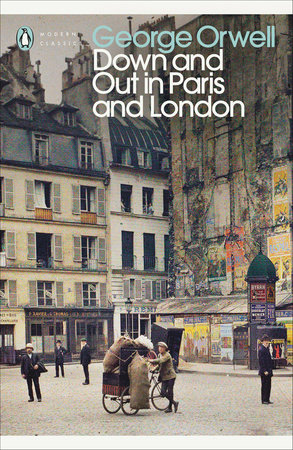
RKS Literature: The Less than Luxurious Hotel des Trois Moineaux in Paris (George Orwell)

“The walls were as thin as matchwood, and to hide the cracks they had been covered with layer after layer of pink paper, which had come loose and housed innumerable bugs. Near the ceiling long lines of bugs marched all day like columns of soldiers, and at night came down ravenously hungry, so that one had to get up every few hours and kill them in hecatombs. Sometimes when the bugs got too bad one used to burn sulphur and drive them into the next room; whereupon the lodger next door would retort by having his room sulphured, and drive the bugs back

George Orwell, “Down and Out in Paris and London”, 1933.

RKS Japanese Literature: Tomada’s Transformation into a Westerner (Tanizaki Jun’Ichiro)

‘I was Japanese no longer! I had been transformed into a Westerner!

To get there (Japan) you’d have to travel down to Marseilles and board a ship for the Orient. Eastward and eastward you’d sail crossing the seas for six weeks or more until you’d finally reached a small island country called Japan, where the people have yellow faces and live in dark, gloomy houses. They speak in tiny, mumbling voices, and in the morning they sip miso soup out of wooden bowls coated in black lacquer. What a dank, colourless existence. And they don’t even have furniture in those shadowy houses. No beds, no chairs, nothing. They spend their lives down on the floor, crouching under low ceilings and sitting on their heels. Just imagining it made me feel claustrophobic.’ Tanizaki Jun’Ichiro, “The Story of Tomada and Matsunaga”

RKS Literature: A Representative Paris Slum (George Orwell)

“It was a very narrow street-a ravine of tall leprous houses. Lurching toward one another in queer attitudes, as though they had been frozen in the act of collapse. All the houses were hotels and packed to the tiles with lodgers, mostly Poles, Arabs and Italians. At the foot of the hotels were tiny bistros where you could be drunk for the equivalent of a shilling. On Saturday nights about a third of the male population of the quarter was drunk. There was fighting over women, and the Arab natives that lived in the cheapest hotels used to conduct mysterious feuds and fight them out with chairs and occasionally revolvers.”

George Orwell, “Down and Out in Paris and London”, 1933.

RKS Literature: Pretty, Undefended and Natural Daisy Miller (Henry James)

“Winterbourne was not pleased with what he had heard: but when, coming out upon the great steps of the church, he saw Daisy, who had emerged before him, get into an open cab with her accomplice and roll away through the cynical streets of Rome, he could not deny himself that she was going very far indeed. He felt sorry, not for her-not exactly that he believed that she had completely lost her head, but because it was painful to hear so much that was pretty and undefended and natural assigned to a vulgar place among the categories of disorder.”

Henry James, “Daisy Miller”, 1878.

Toronto Hot Docs Festival: “Parasisi”: Wayana People Plagued by Intruders

“Parasisi” is a quiet yet threatening documentary. Take the opening minutes in a tender moment with a father and child bathing at dusk in the river then a scene with some roughnecks unloading battered steel barrels from a truck onto the riverside. What is in the barrels certainly can’t be beneficial for the river. Threatening for sure.

The Lawa River borders Suriname and French Guyana and is home to approximately 2,500 Wayana People survivors of the diseases brought to them through Dutch and French goldminers in a gold rush starting in 1885  continuing today through Brazilian small time gold miners pumping an estimated 5,000-10,000 kgs of mercury into the Lawa River as a by product of gold mining. Mercury may cause severe brain damage and possible death for the unborn and young children.

The Lawa people call those who have swarmed into their lands parasisi translated into English as “intruders”. Gold miners mine gold and evangelists mine souls and both operate in the Lawa. In addition to these parasisi there are Dutch language teachers, French medical teams, researchers and foreign culture.

Mercury poisoning is the most physically dangerous intrusion a “gift” of the small time Brazilian gold miners as were the diseases brought into the Lawa during the 1885 gold rush which nearly eradicated the entire Wayana People.

This beautifully shot black and white documentary does not brandish a spiked club swinging about on the screen but lets the camera and the people tell the story many who don’t seem particularly well informed about the full nature of the assimilation, exploitation and interference they face. Perfect colonialism that is menacing their health and threatening the very existence of their culture.

You can watch the trailer here https://www.youtube.com/watch?v=hJzq1Re42FI

Directed by Zaïde Bill and Sébastian Segers.

RKS Documentary Film Rating 79/100. 

RKS Literature: Low-Minded Menials Talking About Daisy Miller (Henry James)

Winterbourne-to do him justice- as it were- mentioned to no one that he had encountered Miss Miller, at midnight, in the Coliseum with a gentleman; but nevertheless, a couple of days later, the fact of her being there under these circumstances was known to every member of the little American circle, and commented accordingly. Winterbourne reflected that they had of course known it at the hotel, and that, after Daisy’s return, there had been an exchange of jokes between the porter and cab driver. But the young man was conscious at the same moment that it had ceased to be a matter of serious regret to him that the little American flirt should be “talked about” by low-minded menials.”

Henry James, “Daisy Miller”, 1878.

RKS Japanese Literature: Tomada’s Increasing Intoxication and Infatuation with the West (Tanizaki Jun’Ichiro)

‘My infatuation and intoxication grew deeper with every mile we travelled. When I reached Paris I threw myself wholeheartedly into a life of decadence. The bashful Oriental mind can hardly imagine the things I found there. Paris was a whirlpool of lust and desire-a dizzying vortex of excess, debauchery and sick perversions. It’s everything I’d dreamed it would be-a paradise of sensual pleasures. I leaped in headfirst, desperate to be sucked into the whirlpool. I gave myself up to it body and soul. A true hedonist is quite happy to pay with his life for pleasure. Alcohol, tobacco, gourmandizing and women; a hedonist would happily sacrifice his health and life to satisfy his appetite for these toxic pleasures. I lived in the moment, resigned to the knowledge that each wave of pleasure might be my last.’

Tanizaki Jun’Ichiro, “The Story of Tomada and Matsunaga”

RKS Japanese Literature: The Failure of Orientals to Deal With a Full Dose of Excitement (Tanizaki Jun’Ichiro)

‘Subtle they call it. Suggestive. Refined. What a lot of nonsense. It’s a question of aptitude. Orientals just can’t deal with a full dose of excitement. Take singing. Here in the East, no one would dream of really opening up and belting out the loudest voice they can produce. It’s more refined you see to sing in that lonely little whine. When a woman is preparing herself to enter mixed company, does she do whatever she can to make herself attractive? Quite the opposite. She buries whatever charms she may have under several layers of sleeves and sashes. It’s supposed to be more alluring that way you see. Poppycock. The truth is that they don’t because they can’t.’

Tanizaki Jun’Ichiro, “The Story of Tomada and Matsunaga”

RKS WINES OF GREECE: A True Greek Blend: Novus Altitude White

A blend of 60% Moschofilero, 25% Assyrtiko and 15% Malagousia.

Aroma: Peach, apricot and Nafplio marmalade

Palate: Explosion of Greek peaches and juicy oranges with a long spicy finish.

Personality: A true Greek blend I am.

Food Match: Gavros tiganitos (fried anchovies).

Cellarbility: Drink in 2026.

Price: $18 CDN.

RKS WINES OF GREECE Rating: 87/100.

(Novus Altitude White 2024, PGI Peloponnese, Novus Winery, Tripoli, Greece, 750 mL, 12.5%).