“Lost in Puppydom: Rory Dylan Stephen’s Puppydom”: THE ABDUCTION OF RORY DYLAN STEPHEN: ALL ABOARD THE EASTERN & ORIENTAL EXPRESS!

The Singapore Times Exclusive: THE ABDUCTION OF RORY DYLAN STEPHEN: ALL ABOARD THE EASTERN & ORIENTAL EXPRESS!

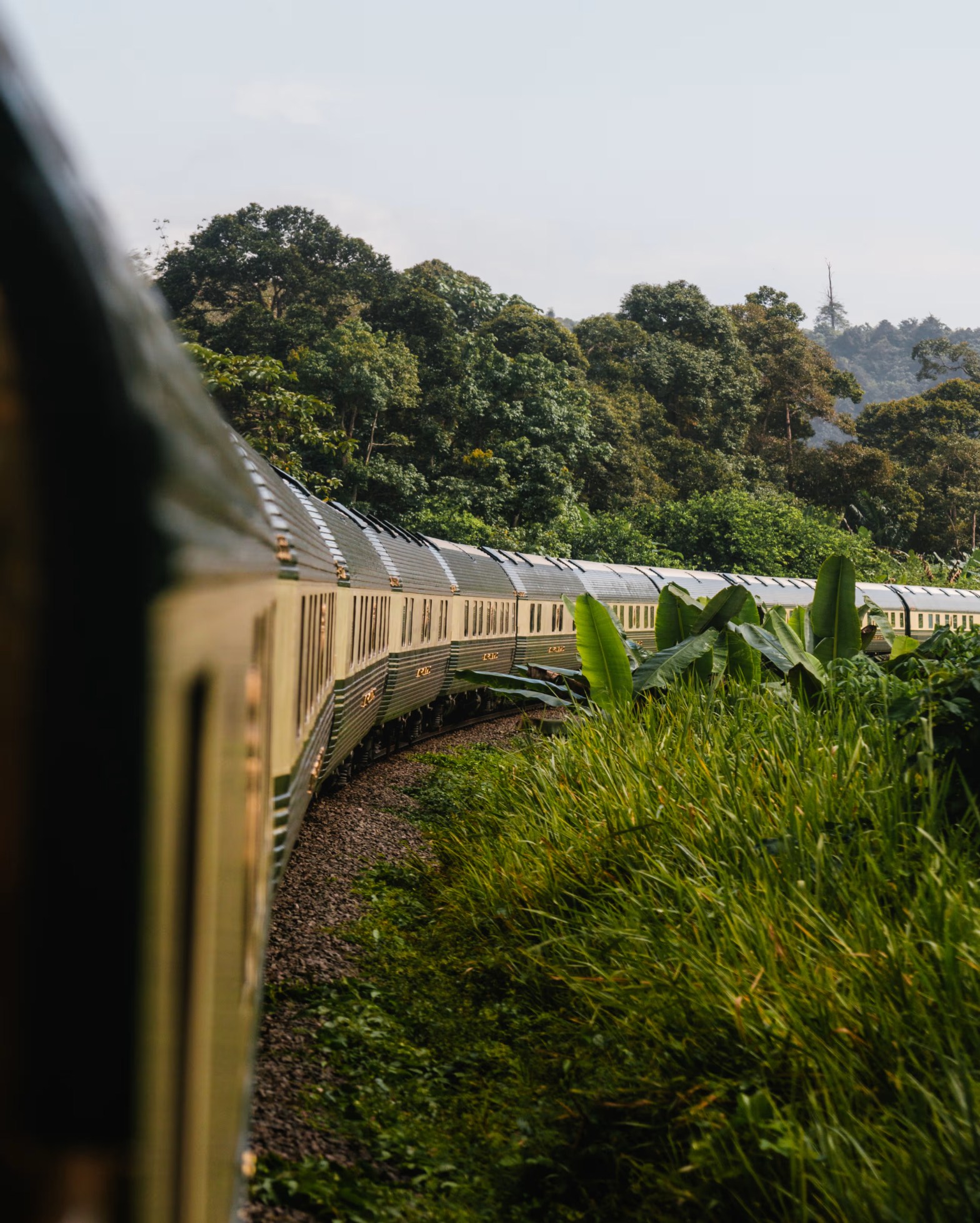
Bags all packed and taken to the luggage desk of our hotel Singapore Shangri-La we head down for a light breakfast and for me a small bowl of jasmine tea. Bobby Jr. mutters, “Eat light. Nothing but the best on the Eastern & Oriental Express (E&OE)!”

We grab a limo to the Woodlands Train Station in Singapore and are processed out of Singapore and into Malaysia. Easy for me with Bobby Jr. presenting forged rabies certificates bearing my alias, Cuddlecakes. Bobby Jr. seems endlessly having thumbprints taken, eyes scanned and passport presented.

Finally on the platform we are guided to our coach and our State Cabin. Our private butler Keith queries if he may unpack our luggage and hang up clothes. Our State Cabin is the second largest category of cabins. It is tiny by hotel room standards. But it’s lush and ornate. Beautiful cherrywood panelling, Thai silks and Malaysian embroidery. A large sofa faces two large windows giving us a panoramic view. A large armchair is by the sofa and there is a small table ledge under the window. Each night our butler converts the furniture into two beds. A bottle of Veuve Clicquot in an ice bucket is on the table as well as a pitcher of fresh Durian juice and a bottle of vodka with plenty of ice cubes in a silver bucket. Two silverplated dog bowls are on the floor near the window and two bottles of Evian water are on a side table. Our butler fills my water bowl with Evian.

Madame Fong and Sir Reginald Nicomshire have Presidential Cabins.  

Our butler unpacks and hangs clothes and Bobby Jr. walks me down to the end of the train to an observation car which includes a bar. The hallways are very narrow and once the train is moving you sort of bounce from wall to wall. One wall has the entrances to all the berths.

We arrive at the observation car and the train starts to roll on. Bobby Jr. sits on the bench on the outside part of the observation car and enjoys a glass of Veuve Clicquot in a crystal flute to accompany his view. I hop up on the bench by Bobby Jr. and enjoy the warm breeze watching the Malaysian countryside drift by. Big time jungle out there. I do note an armed security guard is discretely sitting in a corner of the observation car.

I look forward to afternoon tea to be served either in your cabin, the dining car or in the observation car. We are having ours in our cabin. Bobby Jr. will informing me of my mission!

RKS Japanese Literature: The Steam Train Representative of Twentieth-Century Civilization (Natsume Sōseki)

“We are being dragged deeper into the real world, which I define as the world that contains trains. Nothing can be more quintessentially representative of twentieth-century civilization than the steam train. It roars along, packed tight with hundreds of people in one box, merciless in its progress, and all those hundreds crammed in there must travel at the same speed, stop at the same places, and submit to a baptismal submersion in the same swirling steam. Some say that people ride in a train, but I would say they are thrust into it; some speak of “going” by train but it seems to me they are transported by it.

Whenever I see one of those fierce trains hurtling along, treating all on board indiscriminately as so much freight, and mentally balance the individuals crammed in there against the train’s utter disregard for their individuality-I can only say, Watch out, this could be nasty if you’re not careful. Modern civilization in fact reeks of such dangers. The steam train hurtling blindly into the darkness ahead is simply one of them.”

Natsume Sōseki, “Kusamakura”, 1906.

RKS French Literature: Extreme Poverty and Quasi Starvation (Émile Zola)

“Buried beneath the blanket, all that could be seen of her was her long face with its broad features, which had a certain heavy beauty, but which at the age of thirty-nine, had already been disfigured by her life of poverty and the seven children she had borne.

She told him how there was no food in the cupboard, and how the little ones kept asking for bread and butter, how there was no coffee left, and how the water gave you colic, and about the long days spent trying to cheat their hunger with boiled cabbage leaves.”

Émile Zola, “Germinal”, 1885.

RKS French Literature: The Reek of the Human Herd in the Coal Miner’s Tenement (Émile Zola)

“At the Maheus’ house, Number Sixteen in the second block, nothing stirred. Thick darkness filled the one and only first-floor room: it bore down like a crushing weight on the people sleeping there, whose presence could be felt rather than seen as they lay crowded together, their mouths open, stunned by exhaustion. Despite the bitter cold outside, the air was heavy with the warmth of the living, that stuffy heat to be found even in the best-kept bedrooms, with its reek of the human herd.”

Émile Zola, “Germinal”, 1885.

RKS Japanese Literature: Suffering the Result of Attachment (Natsume Sōseki)

“While we live in this world with its daily business, forced to walk the tightrope of profit and loss, true love is an empty thing, and the wealth before our eyes mere dust. The reputation we grasp at, the glory that we seize, is surely like the honey that the cunning bee will seem sweetly to brew only to leave his sting within it as he flies. What we call pleasure in fact contains all suffering, since it arises from attachment.”

Natsume Sōseki, “Kusamakura”, 1906.

RKS Japanese Literature: The Lack of Beauty of Western Food (Natsume Sōseki)

“Not a single Western food has a color that could be called beautiful-the only exception I can think of are salad and radishes. I’m in no position to speak of its nutritional vale, but to the artist’s eye it is a thoroughly uncivilized cuisine. On the other hand, artistically speaking, everything on a Japanese menu, from the soups to the hors d’oeuvres to the raw fish, is beautifully conceived. If you did no more than gaze at the banquet tray set before you at an elegant restaurant, without lifting a chopstick, and then go home again, the feast for the eyes would have been more than sufficient to make the visit worth your while.”

Natsume Sōseki, “Kusamakura”, 1906.

RKS Japanese Literature: Eyes Blinded by Worldly Passions and the Artist (Natsume Sōseki)

“I suppose you could say that the artist is one that lives in a three-cornered world, in which the corner the average person would call “common sense” has been sheared off from the ordinary four squared world that the normal inhabit.

For this reason, be it in nature or human affairs, the artist will see the glitter of priceless jewels of art in places the common herd fears to tread. The vulgar mind terms it “romanticizing”, but it is no such thing. In fact the phenomenal world has always contained that scintillating radiance that artists find there. It’s just that eyes blinded by worldly passions cannot see the true nature of reality. Inextricable entanglements bind us to the common world; we are beset by obsessions of everyday success and failure and by ardent hopes-and so we pass by unheeding….”

Natsume Sōseki, “Kusamakura”, 1906.

RKS Poetry Anthology (All We Get Are The Coffee Grinds)THE BIG B

THE BIG B

Your sons and daughters attend the best schools

While we carry the tools

and you try to categorize us as uncouth fools

cocaine at the big frat party

where anyone over 50 considered farty

drive the big cars

travel to countries afar

their brown Adriatic touched faces gleam

but for us Winnipeg is but a dream

sometimes it feels like we are being used

shoved out and abused

they live it up

we throw it up so they can flaunt their Afghan puppies

I’m just as content with my guppies

Robert K. Stephen

RKS WINES OF ARGENTINA: Kaiken Ultra 2022 Cabernet Sauvignon

Kaiken can be trusted to deliver good Malbecs but can the same be said for its Cabernet Sauvignons? The only way to so determine is to open a bottle of Kaiken Ultra 2022 Cabernet Sauvignon from Mendoza.

Grapes grown at 1,050 metres. 45% of the wine in French oak barrels (1/3 each in new/second/third use) for 12 months.

Aroma: Blueberry rules the roost. Way behind black cherry and dark chocolate. Decant for a richer nose and palate.

Palate: The blueberry keeps on rolling on big time. Overstimulated raspberry rollicks on the tongue. Tannins leaning on the heavy side. A mid length peppery hot finish with a tad of sweetness.

Personality: If blueberry is the hallmark of many a Californian Cabernet Sauvignon and you wish to avoid patronizing the wines of a threatening country and becoming state 51 like Canada, Greenland or Venezuela a good alternative awaits.

Food Match: Thai grilled pork.

Cellarbility: Down the hatch no later than 2028-year end.

Price: $23 CDN.

RKS Wines of Argentina Rating: 94/100. Joaquíin Hidalgo 94.

Kaiken Ultra 2022 Cabernet Sauvignon, Mendoza, Aiken, Lujan de Cuyo, Mendoza, Argentina, 14.5%, 750 mL).

Sampled 3June2026.

RKS Japanese Literature: The Journey and its Poetic Component (Natsume Sōseki)

“While we are on our journey, shod in our straw sandals as of yore, we may do nothing but grumble about its hardships from dawn to dusk, but when we come to tell the tale to others, we will never make a murmur of such complaints. No, we will speak smugly of its fascinations and pleasures and even proudly prattle on about all the things that annoyed us so much at the time. We do not do so from any intention to deceive ourselves or lie to others. Rather, the contradiction arises because on the journey we are our everyday selves, while when we tell the tale we speak as poets.”

Natsume Sōseki, “Kusamakura”, 1906.