Where you may wish to cry is for Argentina’s hunting down of political dissidents and their murder and disappearance between 1976-83 those days hopefully will never return to Argentina although this butchery currently exists in Iran and Myanmar.
Moving on the more cheerful matters we try a Ben Marco Malbec from the Valle de Uco in the Mendoza region. This wine is certainly not a newbie at the Liquor Control Board of Ontario (LCBO) but it has been a while since I have tried it so you might say I come to it without memories.
The wine has a purple colour. On the nose blackberry, black currant, plum and a dusting of milk chocolate. Quite rich. Some moderate tannins. On the palate black cherry, blueberry and cranberry muffins. Thank goodness there are enough acids here to keep the tannins in check. This is a full-bodied wine with much depth to it. It is firm and dense but the fruit is well managed and not oozing out of a bathing suit like a Russian grandmother bathing in the Caspian Sea. It is a pleasure to sip and what a match with steak and chimichurri sauce or mushroom ragout over polenta. The grapes were grown at 3,000 metres altitude which helps ensure it is not flabby and clumsy like some low altitude Malbecs. No crying over this wine. It was aged in used oak barrels for 11 months and you have difficulty detecting the oak which should be the case with most wines as don’t you like wine over wood?
(Benmarco Malbec 2018, Los Chacayes, Uco Valley, Mendoza, Dominio del Plata Argentina, $19.95, LCBO # 657601, 14.5%, 750 mL, Robert K. Stephen A Little Birdie Told Me So Rating 94/100).
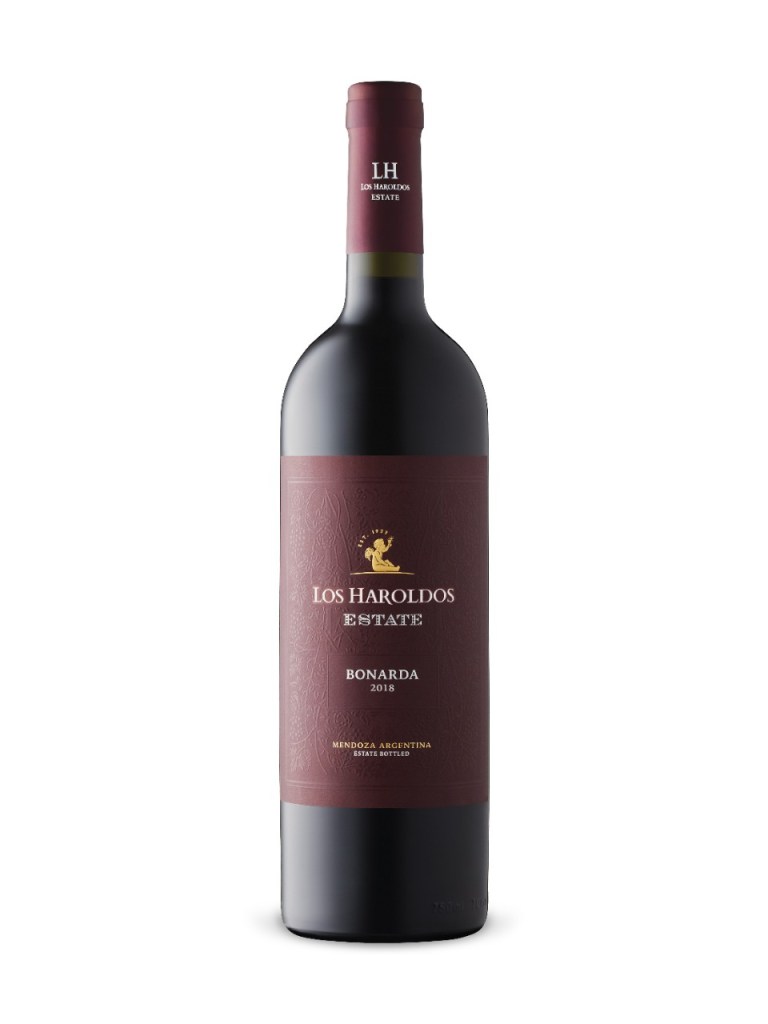
We move to a Los Haroldos 2018 Bonarda from Mendoza. It is black cherry in colour and almost purple. On the nose loads of black cherry, blackberry and plum all tightly knit together. Moderate tannins. There is some black cherry, blackberry and a touch of pepper on the palate. The finish is short. This is a well made and tightly bound wine quite like the Benmarco Malbec above. But I say it is more food centric and it would pair well with beef or some pasta e ceci (Roman chickpeas with pasta). I think it needs a couple more years to smooth out. Aged in oak for 6 months and most likely older oak as it is subtle, thank goodness.
At $14.95 no tears need be shed for Argentina.
(Los Haroldos Estate Bonarda 2018, Mendoza, $14.95, Liquor Control Board of Ontario # 629626, 13%, Robert K. Stephen A Little Birdie Told Me So Rating 89/100).
Fittingly and hopefully not in reality we try a wine Fin Del Mundo from Patagonia. I am not quite ready for the end of the world quite yet.
As for colour black cherry bordering on purple. As for aromas black cherry, blackberry, raspberry layered over by a smoky tinge. As for the taste it’s on the juicy lip-smacking side of things. There is sweet red cherry and rhubarb pie. All said and done this is a lively wine. A good Malbec but not an excellent one. No sense in cellaring this one. It would have been good with the homemade pizza tonight especially if my homemade dough had not been frozen. Yes I have become a tyrant with my bread machine. This is my third one. The previous one gave up the ghost a decade ago but it made such good pizza dough I decided to snap up a Cuisinart bread maker at COSTCO for $99 which certainly beat the Cuisinart website price of $150. My previous bread maker pizza dough recipe used beer instead of water. The beer-based dough is superior.
(Fin Del Mundo 2018 Malbec, Patagonia, Bodega Fin Del Mundo, Patagonia, Argentina, $ 15.95, Liquor Control Board of Ontario # 17381, 14.5%, 750 mL, Robert K. Stephen Set The Bar Rating 89/100).
Dual Canadian-US citizen Kimberly Polman who left Canada, her husband and three children after she saw on Facebook nursing skills were required by the caliphate
Kudos to Alba Sotorra for holding a hot potato and making a documentary that features several women from Canada, United States, Germany and the Netherlands who fled their countries to join ISIS. Neither their government nor the media is willing to forgive them. Should we viewers forgive them?
It would appear all fell prey to ISIS propaganda films and ISIS dominated social media platforms. They thought they were on a noble mission as did the ISIS fighters.
So approximately 100,000 of ISIS women and children sit in Kurdish detention camps one of which Sotorra was given access to. While the ISIS fighters languish in jail their wives and children sit in Kurdish detention camps waiting for a fate they have no idea of. At best their countries are willing to accept their children but not the mothers. The U.S. State Department calls one of the U.S. ISIS wives a traitor. The women are counselled by Sevinaz Evdike a Kurdish women’s rights activist who lost family members to ISIS.
Perhaps the most chilling scene is some young boys in the detention camp playing and talking amongst themselves that jihadists are invincible, no one can harm them and if they should die they will ascend to heaven immediately. What sort of heaven would accept men who buy their wives at sex markets? Or the caliphate saying marriage at 9 for a girl is acceptable?
The detention camp is so very far from home for these “Westerners” but they have a common bond in that they feel duped and victimized. In the hands of ISIS they were subject to forced marriages, imprisonment, rape and the particularly misogynist perverted form of Islam eschewed by the “men of ISIS”.
The women in the film regret their mistakes and ask for a second chance. But their home governments do not want them to return. That would require forgiveness and the electorate may not be sympathetic to the women that defected to the barbarian camp.
You’ll hear each of their stories and decide for yourselves if they were victims of their naivete and character or are simply expressing remorse because they are on the losing side. They certainly paid a heavy price but I don’t see any evidence they harmed anyone. Their existence also must be somewhat precarious surrounded by burka clad ISIS wives many of whom may have no regret.
So the question to you is after seeing the film should these governments and their electorate exercise some compassion and forgive? Not an easy question to answer. Sotorra who lost friends in skirmishes against ISIS says, “The only way, out for all of us, is to leave hatred behind and start over with compassion, forgiveness and understanding.”
This Spanish and UK production is a 90-minute-long film. It is one of the 15 films in the Special Presentations program.
The Toronto Hot Docs Festival runs from April 29-May 9. The full lineup will be announced March 23rd. You can access the Hot Docs website here https://hotdocs.ca/p/hot-docs-festival
Country by country different rules pray for quickness in the church pews but in so many cases it is a question of who you know in the medical system to perhaps pull a few favours and get the jab no need to moralize about a moralistic scab you have it ahead of everyone aren’t you devious and smart so you’ll be first out in the patio in the sunshine without fear drinking a pint but your cheating is dubious and so very smart your deception is art you most likely will never be caught so smirk away you clever little cheater they’ll soon be a documentary about you and your lack of morals you selfish little cheating bastards effectively a murdering cabal of dastards
“ Learning how to suspend all your doing and shift over to a being mode, how to make time for yourself, how to slow down and nurture calmness and self-acceptance in yourself, learning to observe what your mind is up to from moment to moment, how to watch your thoughts and how to let go of them, how to make room for new ways of seeing old problems and for perceiving the interconnectedness of things-these are some of the lessons of mindfulness.”
Squid rushed to Mobouto pleading with him to exercise the utmost caution with this new band of white men. Squid recounted his past experiences but to no avail. The local folk were enchanted with the new visitors and unfortunately so was Mobouto. He would hear no bad words about these men. Squid, in desperation, took to the streets warning the population not to fraternize with the white men. The royal court had ordered Squid to desist. Frantically Squid stormed into Mobouto’s chambers but there were a crowd of royal messengers with a terrible tale. A group of white men had attacked the royal mint and killed 16 guards with their sharp metal sticks. Half the gold had been stolen and 34 women had been led off in chains.
Mobouto lifted his head from his hands and said in a trance like voice, I’m sorry about this. You warned us and we ignored you. Stupid me thinking they were here as friends. As for your advice I will issue a royal edict forbidding any white man from entering the kingdom. As for those criminals a war party has been sent outnumbering the whites who were making slow progress with their stolen gold and women. Our warriors will deal these cowards a death they deserve.”
Squid replied,” You have chosen wisely but fate will overcome you and your noble people More of their kind will eventually return. They want your gold, your bodies and most of all your souls. Beware Mobouto. Beware.” And with these dire warnings he promptly turned and sauntered out of the royal chamber heading to his favourite café for some fortified yam juice.
Well Squid was correct. Years later an entire army of men arrived looting, raping and torturing dragging the great Mobouto to the slave markets in Charleston. Then came the blackrobes, like flies alighting on an animal carcass, carrying crosses and staring into the sky praying to their gods. What people were not carted away in chains heard their gods being ridiculed and their temples set afire and before they knew it they had all been baptized as Christians awaiting salvation from the almighty God and his son. Squid mused these blackrobes were going to require a lot of forgiving from their god. In the name of their god they had normalized polite genocide and slavery.
Squid was distraught and hid in the jungle sometimes venturing into the city in disguise. There was nothing that could be done. They were finished. It was time for him to depart or was it simply escaping the issue? Squid instinctively knew he would be compelled to stand up and fight one day. It was impossible to escape this omnipresent situation.
Just to start off I thought I’d reflect on how decent I thought police were for so many years. Then my son was mugged years ago luckily unhurt but shaken. I phoned Toronto police who arrived and the constable was surly, rude and accusatorial. You know that 1960’s expression that referred to the police a “pigs” well this cop was a pig.
Add on to this unpleasant memory the recent police killings of African Americans. Usually attacked by white police. And our poor Sammy Yatim a disturbed young man shot by James Forcillo a Toronto police officer relishing in his untoward and unnecessary shooting. 8 bullets from his gun and he escapes with an attempted murder conviction.
So people I lost my smugness about how decent a police force was years ago. Canada wipe that smirk off your face.
I wonder if the culture of brutality and violence is so ingrained in the Calgary Police Force one can fairly say they are rotten to the core? Well watch “No Visible Trauma” and come to your own conclusion. In my view defund the police is an American imported term and one might better focus on accountability and transparency.
The title of the documentary rather spills the beans on the Calgary Police Service (CPS) as it focuses on several flagrant abuses of power by the CPS. In the case of Godfred Addai—Nyamekye, a black man, he was acting as designated driver returning friend to their homes after a party and his vehicle became stuck in the snow in a cold minus 28 Calgary at 3 a.m. He was taken on a “starlight tour” by the CPS meaning he was dumped off in a remote part of the city. Clad only in a track suit he phoned 911 and was cut off repeatedly. Then come a bevy of police vans and although pinned down by handcuffed police helicopter footage shows him being pummelled by a CPS constable. He suffered severe injuries and then to the day he suffers from PTSD. Believe it or not, despite photos to the contrary, the police intake form as for Godfred states there was no visible trauma! And he was charged with assault that charge being dismissed in court. The assaulting officer was never charged then went on to beat another citizen. 7 years later his complaint against CPS has still not been resolved.
Then there was the fatal shooting of Anthony Heffernan in a hotel room. The hotel phoned police about his erratic behaviour and 5 officers stormed into his room. He was shot in the head and chest and died all this done for a simple wellness check. The constable involved was then again involved in another shooting incident.
Irene and Patrick Heffernan took the matter up with ASIRT (Alberta Serious Injury Response Team) which is supposedly a regulatory body comprised of police investigating police. Then in an unprecedented move the Deputy Minister of Justice intervenes and says there was no unjustified use of force! It would seem killing a man with a syringe in his hand is justified force.
There are other incidents of questionable force.
Why did this happen. Well the CPS Union Head, Les Kaminski, carries out his job of defending police officers rather than helping find out the truth. Kaminski is eventually charged with assault and perjury.
Former CPS Chief (2015-18) Roger Chaffin resigned 3 years into his 5-year contract. His goal of establishing transparency in the CPS was not well received. Chaffin noted the tremendous power police have to upend somebody’s life all steeped in a culture of always being right.
In 2018 CPS shot and killed more people than the Toronto, New York and Chicago police departments did. In 2016 9 officers were facing charges including bribery and assault.
Calgary Mayor Naheed Menshi starts off the documentary at a press conference by saying the Calgary has one of the best police forces in the world. Watch thus documentary if you can stomach it and wonder what planet he may be from.
We also hear from Meaghan Grant a court and crime reporter for CBC in Calgary. She said once she started reporting a various CPS “incidents” the floodgates opened.
We then hear from Jennifer Magnus a retired CPS police officer who reported on her first day on the job where her superior asked whether he was a bitch, slut or lesbian. Being a junior police officer, she was afraid to challenge the hierarchy. She resigned in an emotional scene at a press conference. It was obvious she was wracked with anguish. Claiming bullying and sexual harassment within a toxic workplace.
I could go on but I think you get the picture and I dare say what is going on in the CPS is going on throughout Canada and the United States.
A through but rather sickening and sad tragedy in the CPS and for the citizens of Calgary. Great material for all of us concerned about the state of policing in Canada and the United States. My doubts about the friendly people in blue have only ballooned after watching this documentary. Truth can be ugly and the damage caused by some “bad apples” may lead you to a sobering conclusion you may draw from the film it is the entire barrel that is rotten. Rather like the Canadian Armed Forces of late.
As co director Robinder Uppal states, “with growing numbers of people across the nation realizing that systematic racism and excessive force are not distinctly American issues, but are also widespread in Canada – like the courageous participants featured in the film, the public is demanding that the police be accountable for their actions.”
The documentary is co-directed by Marc Serpa Francoeur and Robinder Uppal. The film runs from March 4th to April 1st through the Hot Docs at Home BIPOC-focused screening series “For Viola”. There is no charge https://www.hotdocs.ca/p/for-viola
While COVID has upended the $8 trillion global travel industry, the pandemic has also paved the way for tourism and hospitality professionals to reflect, rethink and reshape the sector, making it better – and ultimately more sustainable – for people and places around the world.
As UNWTO Secretary-General Zurab Pololikashvili said:
Which key findings and statistics will help inform hospitality and tourism professionals as they recover from the impact of the pandemic and prepare for a more resilient and sustainable future?
1. Sustainability is in growing demand
While the term “sustainable tourism” is tossed around with increasing frequency, many professionals have only a vague understanding of what sustainability really means. Essentially, sustainable travel refers to tourism that supports the natural and cultural heritage – as well as the economic viability – of destinations.
While sustainability refers to harm reduction, a new concept has recently cropped up among tourism professionals: “regenerative travel”. Built on the sustainability concept, regenerative tourism, which is even more ambitious, refers to leaving a place even better than you found it. Six nonprofit organizations – including the Center for Responsible Travel and Sustainable Travel International – have established the Future of Tourism coalition, which aims to “build a better tomorrow”. Dozens of hotel groups, destination marketers and travel organizations have signed on to the coalition’s 13 guiding principles, including “demand fair income distribution” and “choose quality over quantity.”
On a somewhat encouraging note, however, the World Travel and Tourism Council’s latest economic forecast predicts that as many as 111 million global travel and tourism jobs could be regained in 2021. That will depend, of course on restoring traveler confidence through vaccine distribution, mandatory mask-wearing and comprehensive COVID testing. And key to all economic recovery is investment. As UN Secretary-General Antonio Guterres urged, “Let’s invest in an inclusive and sustainable future driven by smart policies, impactful investments, and a strong and effective multilateral system that places people at the heart of all socio-economic efforts.”
Travel companies are facilitating that desire to help. New businesses – such as the booking agency Regenerative Travel – features sustainable destinations and resorts and committed to a sustainable future. The interest in giving back to destination communities is even evident among armchair travelers. Global Child “Travel with Purpose”, a popular series available on Amazon Prime, is now in its third season. According to the series’ creator, “We wanted to inspire travelers to remember that everyone is part of one global family, it’s time to leave the divisive behind and embrace the future together. Doing good in each place we visit, not only is a great blessing for each place we visit, but it actually does wonders for our own soul.”
Along with a global focus on the pandemic, concern over climate change has reached new levels this past year, with an increasing determination by businesses and individuals everywhere to do their part to mitigate carbon emissions. In fact, one of the silver linings of the pandemic has been the decrease in travel-related carbon emissions.
Hotels can do their part to help further reduce emissions through sustainable building design, the efficient use of energy, by addressing issues in their supply chains and reducing single-use plastics. They can also reduce purchase carbon offsets with companies such as Cool Effect to offset their emissions. One important way that hotels and restaurants can contribute to reducing emissions – and address consumer concerns – is by serving sustainable foods. A recent survey from EU consumer organization BEUC, which focused on consumers’ attitudes toward sustainable food, found that more than half of consumers say that sustainability has some or a lot of influence on their eating habits. That means, for example, reducing red meat, which has a huge carbon footprint, and serving more plant-based and foods from local farms.
Even during the pandemic, concerns about the future of our planet are top of mind and driving decisions. As revealed by the Deloitte Global Millennial Survey 2020 – which explores the views of more than 27.5K millennials and Gen Zs, both before and after the start of the COVID-19 pandemic – “despite the individual challenges and personal sources of anxiety that millennials and Gen Zs are facing, they have remained focused on larger societal issues, both before and after the onset of the pandemic. If anything, the pandemic has reinforced their desire to help drive positive change in their communities and around the world.”
The world’s top hoteliers and industry professionals are heeding the call. Just as 9/11 increased their focus on security, the pandemic has raised hoteliers’ awareness of health and wellness – concerns that are closely linked to sustainability. Along with contactless and touchless check-in and room controls, new hotels are being designed with a focus on nature and wellness.
The Asian brand Six Senses, for example, whose ethos is built on sustainable design and customer experience, is opening their first hotel in Brazil. Another new hotel in the Negev Desert in Israel will include an Earth Lab, where guests can learn first-hand about the brand’s efforts around marine conservation, forestry and farming, as well learning practical applications for sustainability, including composting and organic gardening
Can you feel sorrow for an uncle you never met? Well Uncle Bill was a 22-year-old man I never even saw he died before I was ever born shot down in the Battle of Britain and now buried in Lincolnshire in the United Kingdom alone and unvisited yet it is only in the past few years his memory haunts me such an indescribable tragedy who said good-bye and kneeled by his grave? 22 and killed in war on Remembrance day in the past few years my heart is torn I have no hate for the German pilot that shot him down most like he himself was killed and no longer around so Uncle Bill I have promised to visit your grave and after I think several double scotches neat Perhaps our souls will meet and my tears and sobs Might show you the respect you deserve and lighten my heart that is broken for the life you deserved but never had
The CDC recently released guidance for individuals who have been fully vaccinated with a COVID-19 vaccine available under Emergency Use Authorization by the FDA.
This guidance pertains to gatherings, quarantine, and travel restrictions.
While a fully vaccinated person is well protected against disease, they need to be respectful of others who may still be at risk of infection and who have not received the vaccine. We still need more data on vaccine efficacy against new variants, efficacy in children, and efficacy on preventing transmission.
What does a “fully vaccinated individual” mean?
A person is considered to be “fully vaccinated” after at least two weeks past their second dose of the Moderna or Pfizer/BioNTech vaccine, or at least two weeks after their single dose of the Johnson & Johnson vaccine. This two-week period gives the body time to establish a strong immune response after the second dose. For now, no vaccine has been authorized for use in anyone under age 16.
What does the guidance mean for fully vaccinated individuals in public gatherings or settings?
In public settings—like restaurants, houses of worship, and gyms—fully vaccinated individuals should continue wearing masks, social distancing, and washing hands frequently.
What does the guidance mean for fully vaccinated individuals visiting only with other fully vaccinated individuals?
Fully vaccinated people visiting only with others who are fully vaccinated in a private setting do not have to wear masks or social distance.
What does the guidance mean for fully vaccinated individuals visiting with a single household?
Fully vaccinated people visiting with a single household in a private setting do not have to wear masks or social distance if all unvaccinated people in the other household are at low risk of severe COVID-19.
If anyone in the other household is at high risk of severe COVID-19 and has not been vaccinated, then everyone—including the fully vaccinated individual(s)—should continue to wear masks, social distance, wash hands, and continue following CDC guidance for public gatherings.
What does the guidance mean for households with children?
Fully vaccinated individuals can visit without masks and without social distancing with a single household, including children, if everyone in that household is healthy and at low risk of severe COVID-19. (The CDC guidance does not mention two households visiting, both with children, if the adults are fully vaccinated.)
Should more than two households gather without masks or social distancing?
No. In a setting where fully vaccinated individuals will be gathering with more than one other household, everyone should continue to wear masks, social distance, wash hands, and continue following CDC guidance for public gatherings.
The CDC is still recommending that everyone, even those who are vaccinated, avoid medium to large gatherings in public (like concerts, weddings, and funerals). If they do attend, it’s important to follow CDC guidance for such situations.
What if a fully vaccinated individual is exposed to a known COVID-19 case?
They should watch for symptoms for 14 days. Even if they have had the vaccine, there is a small chance that they could develop COVID-19. If they do not develop symptoms, there is no need to quarantine or be tested for SARS-CoV-2. If they do develop symptoms, they should isolate, contact their health care provider, and be tested for SARS-CoV-2.
However, if a fully vaccinated person lives in a congregate setting (like a group home or correctional facility) and is exposed to a COVID-19 case, they should quarantine for 14 days.
I’ve been fully vaccinated—can I travel?
The CDC has not updated their guidance on travel restrictions and requirements. For now, it’s best to not travel unless you absolutely have to. If you do, it’s important to follow all CDC, state, and local guidance on travel restrictions and requirements (like testing and masking).
I haven’t been vaccinated yet—what does the guidance mean for me?
In public or when visiting with multiple households, you should continue to follow CDC guidance: Wear a mask, social distance, wash your hands, and avoid crowded settings.
When gathering with fully vaccinated people from a single household in a private setting:
If you are at low risk of severe COVID-19 and live alone, then you do not have to wear a mask or social distance.
If you and all members of your household are at low risk of severe COVID-19, then you do not have to wear a mask or social distance.
If you or anyone in your household is at high risk of severe COVID-19, then everyone who is gathering should wear a mask, social distance, and practice good hand hygiene.
German National Tourist Board looks at 2021 as a transition year for incoming tourism
Incoming for 2020 as expected with strong losses compared to previous year – further growing readiness to travel opens up chances for first recovery approaches for 2021
Toronto, March 8, 2020 – 2021 will be a transition year for German incoming tourism due to the Covid-19 pandemic. A gradual recovery of international demand is likely to occur from 2021. The German National Tourist Board (GNTB) forecasts this on the basis of currently available figures for 2020 and the analyses of different market research institutes.
Petra Hedorfer, Chairwoman of the Executive Board for the German National Tourist Board (GNTB): “The Covid-19 pandemic and the resulting halt for many parts of worldwide tourism are mirrored in the results of German incoming tourism for 2020. At the same time, international research confirms the radiance of the Destination Germany brand and an increasing readiness to travel of international guests. The stakeholders of the German tourism industry faced the challenges of the crisis during the lockdown phases: Across the board of the customer journey, many processes were digitalized and extensive hygiene concepts were developed. Touristic offers were adjusted to the changing needs of the customer. This will lay the ground for the recovery phase.”
Incoming results 2020: Loss in overnights As expected, German incoming tourism suffered substantial losses in 2020. According to preliminary data of the Federal Statistical Office, 32 million overnights by foreign visitors were recorded for tourist accommodations with more than ten beds and campsites, a loss of 64.4 percent compared to the previous year.
Perspective for 2021: Gradual recovery for international demand The European Travel Commission is seeing a continuously growing readiness to travel for the coming months in its ‘Monitoring Sentiment for Domestic and Intra-European Travel‘. With the fourth survey wave at the beginning of December, 52 percent of all surveyed Europeans stated that they want to travel in the next six months, five percent more than with the third survey wave at the beginning of November. With the third survey wave, 27 percent of the surveyed had intentions to travel within April to June 2021, this increased to 32 percent with the following fourth (most recent) survey wave.
This scenario is confirmed through the forecast of the International Air Transport Association IATA. Their experts assume that the airlines’ sales worldwide after a decrease of 61 percent to 328 billion dollars in 2019/20 could increase by 40 percent to 459 billion dollars for 2021.
Petra Hedorfer: “Despite ongoing lockdown phases and travel restrictions, there are reasons for cautious optimism. With the experiences of the previous year, we anticipate a recovery of travel from Germany and Europe especially in the summer months. Incoming tourism from overseas markets will probably recover a bit slower. We also assume that leisure travel is coming back faster than business travel – the business travel segment will be enhanced by hybrid formats in the medium term and shaped by virtual events. Based on these developments, the pre-crisis level of German incoming can be reached again by 2024. The prerequisite for market recovery still are the digital transformation, innovations and a sustainable direction for Germany tourism.”
About the GNTBThe German National Tourist Board (GNTB) has its headquarters in Frankfurt am Main, Germany. It works on behalf of the Federal Ministry for Economic Affairs and Energy (BMWi) to represent Germany as a tourist destination and is funded by the Ministry in accordance with a decision taken by the German Bundestag. The GNTB develops and communicates strategies and products to promote Germany’s positive image abroad as a tourist destination and to encourage tourists to visit the country. It has 27 agencies around the world to support its activities in over 40 markets worldwide. More information can be found in our online press centre at www.germany.travel.



















 A Bird's Eye View of Fashion, Food, Travel, Culture, Beverage and Curiosity