As the driving force nagging and oppressing a golf Marshall is “Ready Golf” what does this fantasy involve? Actually it is quite simple but a foreign concept for 99% of Canadian golfers. It really means at the tee box taking one practice swing and hitting the ball. No ass wiggling, No 5 practice swings. No setting up a view finder as to yardage. Just hit the frigging ball.
And if you manage to find your ball as abusive swingers are usually shitty golfers and lose their ball walk up and hit the ball. Really do you need a multiple practice swings?
Then walk up to your ball and simply hit it. 5 practice swings only shows what a clueless dickhead you are.
If you are ahead of the rest of the foursome let them hit and move up to your ball and then hit. Let them catch up and hit and then you hit. It is easier if you have a cart as you can move up and face your cart as a protective device for those golfers hitting behind you. Let them hit and you hit.
Assuming you are on the green and the laggards are walking up the fairway then putt out and move to the next hole and get ready to tee off. Don’t wait for the laggards to putt out before setting up for your next tee-off. Golfers do you need practice swings for a putt? Putt the frigging ball.
From my perspective this is the way to keep a good pace going. Brutal no. Courteous yes. Of course as we move to autumn and winter such promptness may not be required due to a reduced course occupancy.
Although you may have had some familiarity with the wines of the Douro I am guessing most of that is with red wines including Ports. But the white wines of the Douro and that includes Ports are lesser known. That is a bit of a shame as the whites can grow on you. Part of the problem is that white Douro’s are not produced in mass quantities nor are they imported by the LCBO. Might one say the Douro is spoilt by its success? New Zealand may have been spoilt by the success of Sauvignon Blanc but that is one grape. The Douro has a variety of red grapes that make single varietals and blended wines escaping the mono success trend which may lead to consumer fatigue.
The most oft used red grapes in the Douro are Touriga Franca, Touriga Nacional, Tinta Roriz (Tempranillo), Tinta Cão. Sousão and Tinta de Barca. Quality reds can be priced as low as $13.95. And go to a discount Portuguese supermarket in Porto and weep at the modest prices!
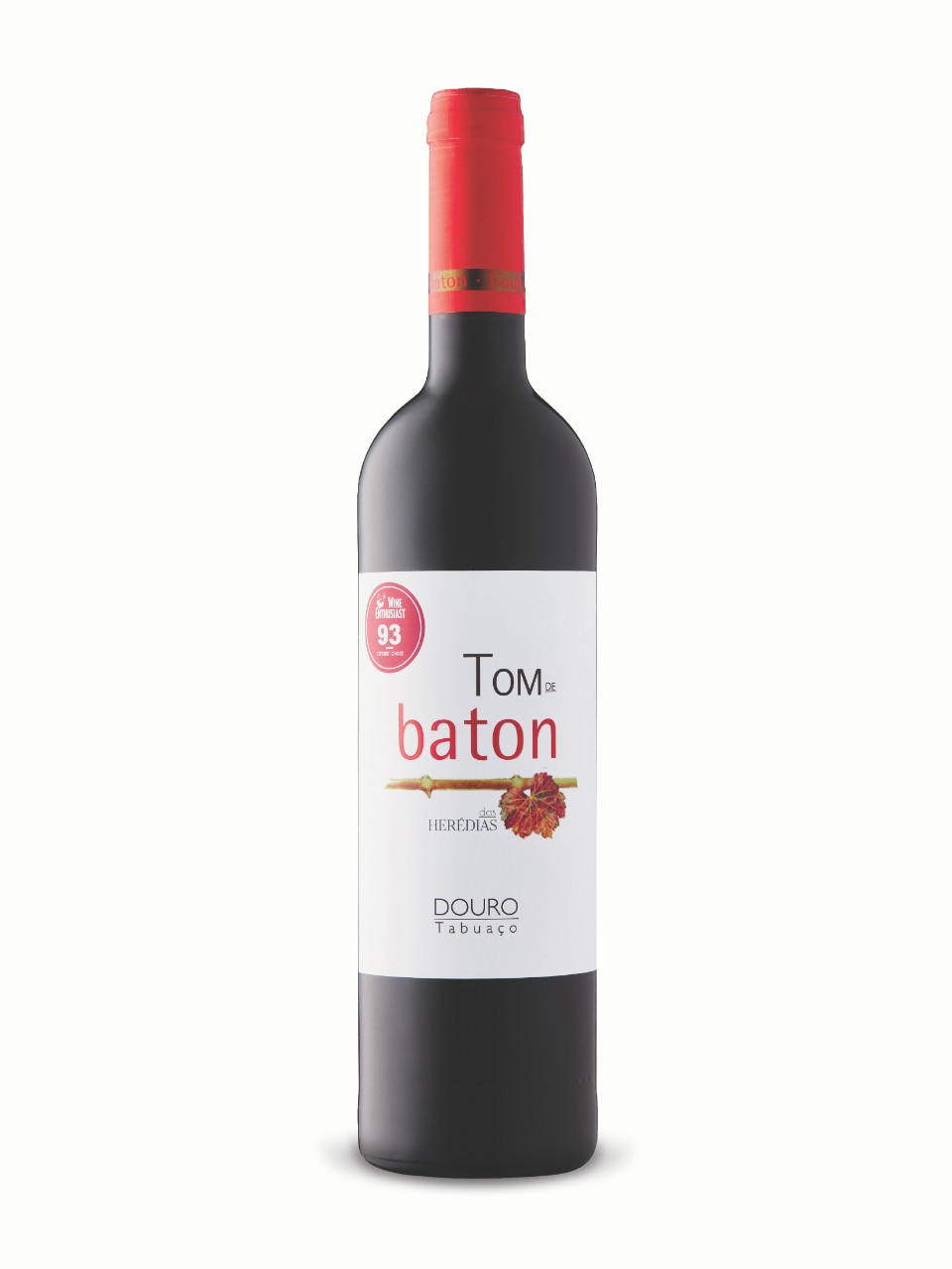
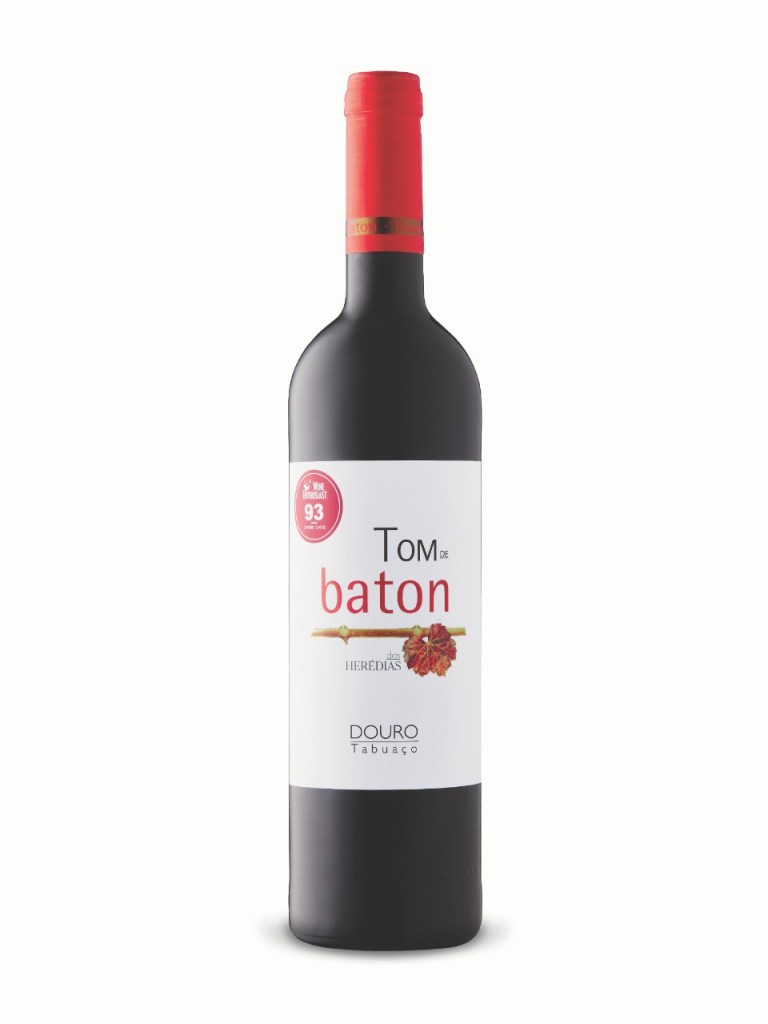
So why not try a Tom de Baton from the Douro. I have been to Portugal several times both for pleasure and on media trips so I know Porto and some of the Douro and its wineries quite well. As this is not a travel article why not just visit the Douro soon for some outstanding wines and foods and as well the terrain I refer to a bit erroneously as Europe’s Grand Canyon.
This wine has a black cherry colour when inspected over a white counter but from a distance it fools you into thinking it is purple. On the nose there is ample black currant, black cherry, blackberry and raisin pie in a gentle oak framework.
On the palate the tannins are just shy of medium intensity. The fruit is tightly intertwined or another way of describing it is “concentrated”. But not so tight you can’t taste the blueberry, cherry, pomegranate and a tiny bit of root beer. A very self-assured wine very confident of its strong yet non ostentatious character. It reminds me somewhat of the Portuguese veneer of formality and manners which if you manage to crack reveals a sense of warmth, subtle humour and pride. I remember a dear Portuguese diplomat friend of mine who worked for several years promoting tourism in Canada smiling with a twinkle in his eye often saying that many matters in life were “difficult”. We met him in Portugal several times and he helped organize a spectacular 3-week trip from the top to the bottom of Portugal which I will never forget. Of course, he introduced me to Portuguese wines and when I was knighted a few years in Portugal to the Order of Port Brotherhood during my enthronement ceremony I am certain he was smiling in heaven as he passed from us far too early.
Without his influence and attitude, I doubt I would have had so many wonderful experiences and friends in Portugal. Thank you JPDS. I try not to think of his untimely passing as it saddens me.
Sorry about my memories taking us off track but writing about wine must be more than nosing, sipping and opining. It should be interspersed with personal history as how many boring reviews can you ingest. As an antique dealer once told me people want a story about their antiques. I often try to relate to you a true story or in my Penniless Pensioner series of wine reviews an interesting fictious story. There is more to wine than simply wine in a glass. My mission is to not only educate but to entertain you.
Speaking of entertainment, you could happily sip this wine but my opinion is that Douro wines are meant to be consumed with food and in my times in the Douro that would range from roast baby goat, roasted pork, grilled ox, Douro Duck Casserole or a Douro Tomato Salad. And for dessert a Molotov Flan with some 40-year-old Tawny Port.
Have I convinced you to head to the Douro yet?
By the way this wine will open up in 2022 and can be consumed with increasing appreciation until the end of 2025.
(Tom de Baton das Herédias 2017, Douro DOC, Terroir D’Origem LDA, Tabuaço, Portugal, $16.95, Liquor Control Board of Ontario # 363168, 750 mL, 13.5%, Robert K. Stephen A Little Birdie Told Me So Rating, 92/100).
Given that the prime responsibility of a golf Marshall is keeping the pace of play on track what causes the majority of threats to a good pace?
Multiple Practice Swings: I don’t know how many times I have felt like yelling “Just hit the ball!”. It is actually painful for some Marshalls and maddening for others to watch a golfer take more than one practice swing. I have seen some golfers take 5 practice swings. The more practice swings a golfer takes the more time is wasted. RUDE!
Excessive Set–Up Time: Again this is a selfish time waster. Walking up to the ball, Wiggling the butt. Holding up the club like a divining rod. In other words getting comfortable as the clock tics. RUDE.
Not keeping an eye behind and in front of you: If you notice golfers waiting on the tee behind you the chances are you are playing too slowly. Generally speaking 12 minutes per hole is considered normal. Now it could be the case there is a single or double behind you and since they play faster they catch up. If your course permits a play through let them play through. You can always ask the Marshall if you are” on pace”. Also remember you should always have sight of the golfers in front of you. If you can’t see them chances are you are too slow. Again if in doubt ask the Marshall who has a time sheet showing according to tee-off times where you should be on the course.
Looking for Balls: Of course no one likes losing a ball but please limit your time to no more than a minute as you are slowing the pace. RUDE.
Grouping: This happens when the group of golfers groups around each hitter then the crowd moves to the next to watch them hit. Nice and social but slow and RUDE.
Listen to the Marshall: A Marshall’s job highly depends on moving the pace of play and since the Marshall can quickly move about the course and get the complete picture they know who the laggards are while you may automatically blame the party ahead of you. For example some unhappy golfers were vociferously complaining to me about the slow golfers just ahead of them. Well I had to fast forward through 8 holes to find the laggard.
Help the Marshall: A Marshall appreciates a golfer pointing out lack of etiquette about golfers on the course. Sort of like an early warning of a pace disaster.
Mind the Gap: If you have a gap of a hole or two ahead of you chances are you are causing a jam up behind you.
Arrive on Time: It is only courteous to arrive in time to be adequately “processed” at the Pro-Shop. Most golfers should arrive at least 15 minutes before their tee-off time.
Be polite: I have seen a few loud squabbles and suffered racist abuse by rude golfers. It bounces off my skin, which is white by the way, but other golfers can be sensitive so put a lid on it. Watch your language if you are golfing with strangers that might not appreciate the vocabulary you’d use amongst friends.
Easy on the Booze and Cannabis: These substances can break down inhibitions and turn people nasty. If you are one of these people restrain yourself please.
Being Mindful of who you are golfing with: This is rather self explanatory but I once encountered some gruff dope smokers who were paired up with two 10-year-olds. Mommy didn’t like this and phoned the Pro-Shop to complain.
You Are Not Self Entitled: Thankfully there are but a few golfers who pay their green fees and think this entitles them to do AS THEY WISH. Rude and More RUDE!
Juniors are a special case. Many are savvy as to golf etiquette but an equal number are clueless. This could be because they have played with parents clueless about etiquette or their parents do not play golf therefore unable to impart good or bad etiquette. Like talking on the green on their cellphones before putting. Or walking slowly like tired mules all bunched up rather than going to the ball and shooting separately. But one thing is a constant they are polite and a little wide-eyed by some old Marshall politely asking them to speed up or giving them a very gentle lesson in etiquette. Occasionally you’ll see a light popping off in their head like they finally understand some rules of etiquette. Although not mentioned in my training I believe it is a duty of a golf Marshall to teach etiquette to young golfers. I won’t dare say to an adult golfer, “Why are you taking five practice swings?” because that mature golfer is obviously rude and inconsiderate and resentful of such “advice”. But I will say to a junior how improper multiple practice swings are. I am making them better golf citizens. They are respectful and open to learning. And what a shame there are no etiquette courses offered at my golf course.
Dear readers the Penniless Pensioner has been cleared of all tax evasion suspicion by the Canada Revenue Agency. It was all just a horrible mistake the CRA said and failed to apologize despite the fact PP spent two weeks in a Roman prison (awaiting extradition to Canada) where he became somewhat renowned for learning how to make Tuscan Boar Stew. In fact he made it better than the famous chef Rocco Spinelli who taught PP and the other inmates in the prison how to make this dish.
He has had some 60 pounds of frozen Tuscan boar shipped to him and I have been invited over to his home discuss a new consulting contract. PP is loaded as the Panamanian bank accounts simply contained the profits from his investment in Bitcoin. Thank goodness his accountants declared these profits in his tax returns!
So we have a dinner of delicious Tuscan Wild Boar Stew over freshly made pasta (another skill picked up by PP as a “resident” of the Roman prison). What PP would like to do is build up stock in his newly designed wine cellar that in beauty and capacity equals that of the Auberge de Cremidia in Toronto. The only rule is that no wine shall be over $29.95. The wines are all to be cellar dwellers with the ability to age and improve. They must be bought in lots of 6 directly from wineries or liquor stores. My payment for this consulting work will be the same number of bottles purchased for his cellar. Oh this murky world of bartering! All purchases will be made in cash. I agree.
This is no easy task considering the strict and low budgetary constraints I am facing. But I am up for the challenge!
So my first stab is a 2018 Les Hauts de La Gaffelière which is a Saint-Émillion Grand Cru. Bordeaux wines are very well known for their ageing capacity but bear in mind years ago the grapes were harvested “green” (earlier than today) with the idea the wine would age well slowly and not be consumed quickly after bottling.
The wine has a transparent black cherry colour. On the nose a solid laser beam of blackberry and black cherry with just a bit of hazelnut wafer cookies and wood suggesting to me newer French oak.
On the palate the tannins are there but they are laid back perhaps for better days? The palate is doing its best to disguise the fruit but the fruit is there and needs at least three more years to shine. There are huge black fruits just waiting to bust out of the slammer and when that happens PP will have scored a big hit. Although most of my points are based on what is the glass right now I have a bit of discretion to take ageing into account.
This wine will cruise into 2030 nicely but after that it’s a crap shoot. By the way it would do nicely with Tuscan Wild Boar Stew right now and will over a few years as the fruit and softness develop will suit lamb particularly well.
(Les Hauts de La Gaffeliére Saint-Émillion 2018, AC Saint-Émillion Grand Cru, Maison Betrand Ravache, France, $26.95, Liquor Control, Board of Ontario # 648923, 13.5%, 750 mL, Robert K. Stephen, A Little Birdie Told Me So Rating 91/100).
As we emerge from over 18 months of this ongoing pandemic, we observe significant changes in customer needs and wants. This is particularly true for travelers, since travel and hospitality has been among the hardest hit industries. Moving forward, travel brands will need to adapt and adjust their products and services to align with these evolving customers values. Here are some key insights to take into consideration from The Traveler Value Index, a recent report from Expedia Group.
Safety and refunds trump low prices
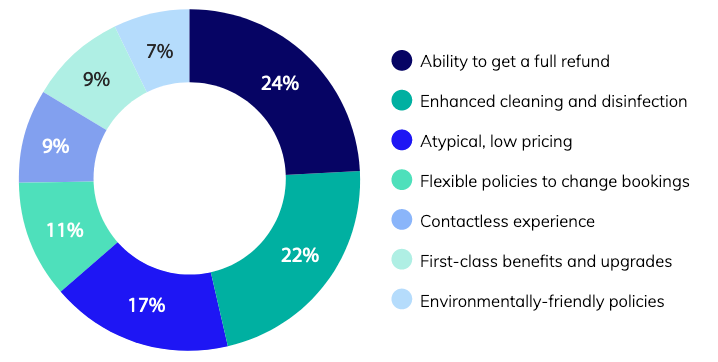
The Expedia Group Traveler Value Index research was conducted by Wakefield Research among 8,000 nationally representative adults ages 18+ in eight markets: US, Canada, Mexico, UK, France, Germany, Japan, and Australia, between April 16 and May 7, 2021. Perhaps the biggest finding from this report is that the number one concern, or value, for travelers is the ability to get a refund if their plans change.
Top traveler considerations when booking for hotels. Source: Expedia Group Traveler Index
This was true not only for hotels but also when travelers sought to book for airlines, vacation rentals, car rentals and cruise travel. In other words, we seek reassurance that we can get a refund across the board in our travel experiences, should our plans change.
More so than seeking a cheaper rate! That’s a big finding, as “price” as traditionally been the #1 consideration for travelers for years.
Coming in as a close second is the whole enhanced cleaning preoccupation, which is a direct consequence of this pandemic and sanitary measures that have been put in place. Travelers now expect travel and hospitality brands to enforce vaccine passports, practice social distancing and ensure proper disinfection in all public spaces and common areas. Thus, whatever your property does to align with this preoccupation should be communicated on your website, social media and other digital outposts.
Considerations vary across different countries
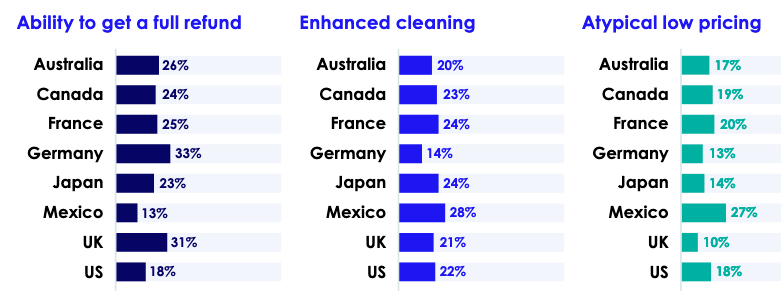
What’s interesting about this study is that it spanned across eight different countries with quite different cultures. Yet the “ability to get a full refund” was the number one consideration in all but one, Mexico. Interestingly enough, Americans have “enhanced cleaning” as their biggest consideration, more so than atypical low pricing and the ability to get a full refund, which are tied in second place.
Traveler considerations vary across countries. Source: Expedia Group Traveler Value Index
Consideration vary across generations, too
Beyond the top three considerations mentioned above, there were four other values evaluated in this research: having a contactless experience, environmentally friendly policies, flexible policies to change bookings and first-class benefits and upgrades. All these values contribute to how travelers shape their decision making, but another finding from this research was how these can vary between generations.
Travel considerations vary across generations. Source: Expedia Group Traveler Value Index
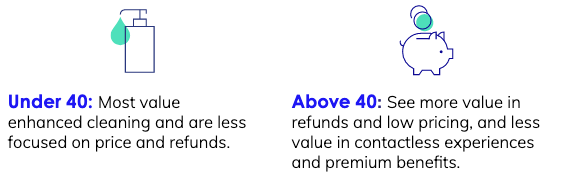
More specifically, and for example, it found that in Japan and the US, travelers under the age of 40 gave most value to enhanced cleaning while focusing less on low price and getting full refunds. Meanwhile, folks over 40 tend to see more value in low prices and don’t seem to care all that much fo contactless experiences or premium benefits such as upgrades.
4 takeaways for hotel and travel brands
So how do we make these insights actionable? Well, make sure you cover these four components, in case you are not doing so already:
1. Clearly communicate your cancellation policies
Since this is now the biggest consideration for a vast majority of travelers across different countries and generations, make sure to properly convey this message across your digital outposts. Is their a clear tab on your website referring to your policy? Have you done Instagram stories about this and are they highlighted on your brand account? Do you mention this regularly in your newsletters and official communications going out to both leisure and business markets?
2. Highlight how you clean and respect sanitary measures
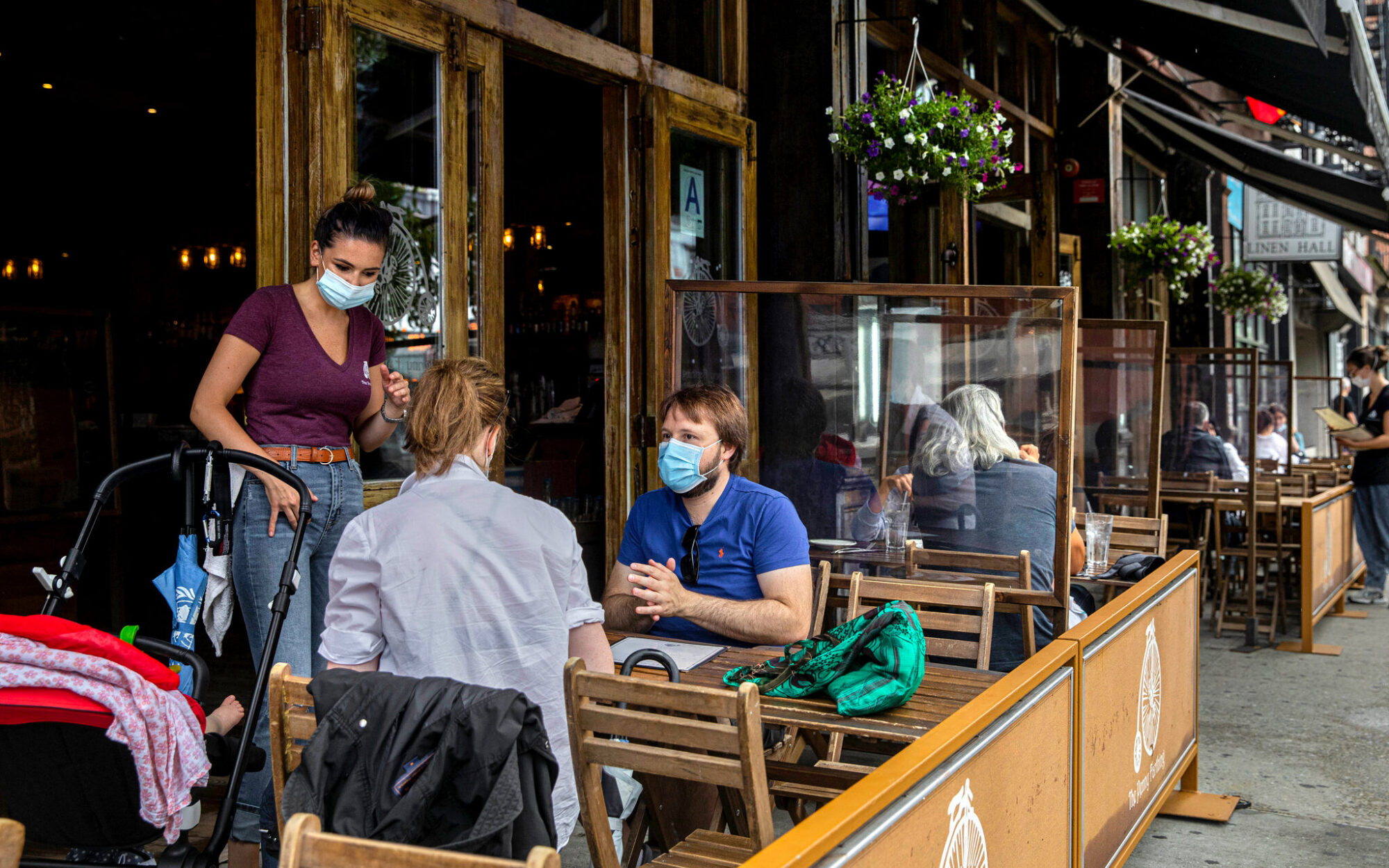
Communicating about your cancellation and refund policies, along with cleanliness measures in place will go a long way in easing traveler anxieties, knowing how this pandemic remains in flux. Make sure to go beyond words and SHOW how your hotel, restaurant or venue applies these measures. Social media are perhaps the best tool for ongoing storytelling, showing your staff in action and demonstrating how things are happening on location through video, images and other formats.
Example of sanitary measures applied in hospitality
3. Offer a range of prices and options
The study showed a clear desire for new experiences. In fact, 75% of travelers surveyed said they would choose a destination they had never gone to for their next trip and 22% were seeking once-in-a-lifetime experiences. Thus, how can you deliver towards this expectation? Have you tweaked some of your products and services, or perhaps added new components and experiences? Then make sure to communication on these new features, as consumers are seeking them out avidly.
4. Highlight commitments to social values
Last but not least, this research also unveils interesting findings with regards to traveler expectations when it comes to sustainability and inclusion. For example, did you know that:
59% of travelers are willing to spend more to make their trip more sustainable
65% are more likely to book with travel providers that identify their practices as inclusive
Thus what is your brand doing with regards to sustainability efforts? This is content that can very well be shared once again across digital outposts where your brand has a presence. Same for inclusion, where annual reports, official press releases and other official tools can tell a story, but often this is better conveyed through reels, posts and other images or videos in your online communication.
Frederic GonzaloFrederic Gonzalo69 postshttp://www.fredericgonzalo.com/enFrederic Gonzalo is passionate about marketing and communications, with over 20 years of experience in the travel and tourism sphere. Early 2012, he launched Gonzo Marketing and works as a strategic marketing consultant, professional speaker and trainer in the use of new technologies (web, social media, mobile). Reach him at frederic@gonzomarketing.biz. Frederic is the creator of the popular video training series, The Future of Digital Travel Marketing, available through the eHotelier Academy.
You see it every outing as a Marshall. Lots of self blame and sometimes loathing flows all over the course with bad shots and putts often accompanied by foul language. And you see plenty of those to the point you might say golf is but a collection of bad shots and errant putts. I try and say to golfers on occasion forget that shot as you have some tremendous ones coming up and after all you are in a beautiful setting and enjoy your surroundings even if your golf game is not going well. That’s my personal philosophy about golf. Best to be mindful and let the bad shots go. Then there are those beautiful shots you know are beautiful the moment you hit them. I’ll give a thumbs up and say words of praise. Then there are the hole in one moments that can send a golfer to the great beyond. I have been there once in 60 years and will be there again soon…I can feel it. I feel it for each game and if there is a day I don’t why bother coming back?
But I guarantee for each shift I have as a Marshall there are shouts of joy and cheers but those overt moments of joy are always outnumbered by four letter words. There are the occasional downcast and beaten-up looking golfers and you know it is a golf tragedy going on in their mind. On occasion I’ll lighten their spirits by giving them a golf ball that has been “blessed” by me as a Marshall. Of course, that is baloney but it really puts a smile on their face and once or twice it actually improved their game. One happy recipient of this blessing actually requested I bless his newly purchased case of golf balls.
Let’s not forget the steady Eddy who neither shouts for joy or curses like a sailor. There are many of those silently struggling and rejoicing.
Also effective October 30, travellers departing from Canadian airports, and travellers on VIA Rail and Rocky Mountaineer trains, will be required to be fully vaccinated in order to travel. To allow travellers time to become fully vaccinated, there will be a short transition period where they will be able to travel if they show a valid COVID-19 molecular test within 72 hours of travel as an alternative to providing proof of full vaccination. That transition period will end on November 30. If travellers have not already started the vaccination process, or do not start soon, they risk not qualifying for travel as of November 30.
The Government of Canada is committed to keeping the transportation sector, including employees and travellers, safe and secure. Mandatory vaccination for the federally regulated air, rail, and marine sectors helps limit the risk of spreading COVID-19 and helps prevent against future outbreaks.
Vaccine requirements for employees in the federally regulated transportation sector
As of October 30, employers in the federally regulated air, rail, and marine transportation sectors will be required to establish vaccination policies for their organizations. Specifically, the vaccination requirement will apply to:
airlines and airports, and other organizations who have employees who enter restricted areas of airports, such as concession and hospitality workers
federally regulated railways, and their rail crew and track employees
marine operators with Canadian vessels that operate with 12 or more crew
Transport Canada will use its specific regulatory and oversight authorities related to operations of federally regulated air, rail, and marine transportation service providers to ensure that the transportation system and these workplaces are safe through vaccination mandates. Each organization will be required to implement a rigorous policy, which must:
Include a provision for employee attestation/declaration of their vaccination status;
Include a description of consequences for employees who do not comply or who falsify information; and
Meet standards consistent with the approach taken by the Government of Canada for the Core Public Administration.
After a short phase-in period, each organization is required to guarantee employees are fully vaccinated or they will be unable to work.
The Government of Canada is engaged with industry and labour groups to discuss the details to ensure an effective implementation of the requirements.
Vaccine requirements for travellers
Effective October 30, air passengers departing from Canadian airports, travellers on VIA Rail and Rocky Mountaineer trains, and travellers on non-essential passenger vessels on voyages of 24 hours or more, such as cruise ships, will need to be vaccinated.
Effective October 30, travellers will need to be fully vaccinated in order to board. Specifically, the vaccination requirement will apply to all travellers 12 years of age and older who are:
Air passengers flying on domestic, transborder or international flights departing from airports in Canada
Rail passengers on VIA Rail and Rocky Mountaineer trains
Marine passengers on non-essential passenger vessels, such as cruise ships, on voyages of 24 hours or more
For travellers who are in the process of being vaccinated, there will be a short transition period where they will be able to travel if they can show a valid COVID-19 molecular test within 72 hours of travel. By November 30, all travellers must be fully vaccinated, with very limited exceptions to address specific situations such as emergency travel, and those medically unable to be vaccinated.
In addition, this vaccination mandate will include specific accommodation to recognize the unique needs of travellers from small, remote communities (some of which are not accessible by road) to ensure they will be able to travel to obtain essential services in support of their medical, health, or social well-being, and return safely to their homes. This accommodation will be informed by engagement with Indigenous organizations and provinces and territories in the coming days.
Enforcement
Transport Canada will oversee compliance by means of inspections and enforcement tools—including Administrative Monetary Penalties—using oversight systems in place for each mode.
For those who falsify information or otherwise fail to comply, there will be serious consequences. For example:
Railway companies could be subjected to compliance actions up to $250,000 per violation, per day, under the Railway Safety Act
In the air sector, individuals—either travellers or employees—could be fined up to $5,000 per violation under the Aeronautics Act, and operators could be fined up to $25,000 per violation
In the marine sector, employees and travellers could be fined for being non-compliant with the obligation to provide proof of vaccination up to $250,000 per violation, per day, and operators could be fined up to $250,000 per violation, per day, for non-compliance to the Interim Order made pursuant to the Canada Shipping Act, 2001
Pan-Canadian Proof of Vaccination
A pan-Canadian, secure, and standardized proof of vaccination for international travel was announced on August 11, 2021, and is being developed in partnership with provinces and territories. This document, which will be available to travellers in digital formats, will be easily recognized and trusted.
This credential will make it easy and quick for travellers to provide transportation operators and border officials in other countries with their validated COVID-19 vaccination history needed to facilitate travel.
Vaccination is one of the most effective ways to fight COVID-19 and the Government of Canada will continue to take action to get as many Canadians vaccinated as possible.
The test kits, which are significantly more affordable than other options on the market, take 15 minutes to use and are an effective screening tool for COVID-19 in our communities.
WATERLOO, ON | OCTOBER 14, 2021— In an effort to make rapid testing accessible to all Canadians, The Canadian Shield will begin offering rapid COVID-19 antigen test kits for sale on their website in packs of 5, at $9.99/test. These rapid tests are an effective tool for the public to easily detect and help prevent the spread of COVID-19.
“With the rising number of COVID-19 outbreaks in schools and workplaces across the country, we recognized the need for more accessible and widespread testing,” says The Canadian Shield CEO Jeremy Hedges. “Due to regulatory issues, everyday Canadians are paying some of the highest prices in the world for rapid testing – we strongly believe that we can play a role in making that no longer the case.”
Following provincial guidance, rapid antigen tests are currently only available for purchase from The Canadian Shield’s website in Ontario, Alberta and British Columbia. It is expected that rapid testing devices will become more widely available as provincial ministries issue interim orders and change the regulatory landscape.
For Ontario businesses, the provincial government, with the help of key stakeholders like Communitech, have rolled out free rapid testing programs in workplaces to limit outbreaks and keep businesses open. While these programs are important, they aren’t accessible to everyone and it’s important that other options are available to Canadians.
For those interested in purchasing Rapid COVID-19 Antigen Test kits from The Canadian Shield, customers must confirm they have reviewed the training resources to validate their skillset and abilities to conduct the test.
Rapid COVID-19 Test Kits are available in 5-packs on The Canadian Shield’s website for $49.95, which works out to $9.99 per test – up to 40 per cent less than other online retailers. Test Kits purchased online are currently only available for shipment in Ontario, Alberta, and British Columbia, or pick-up at The Canadian Shield’s head office, 640 Bridge St.W., Unit 1, Waterloo, ON.
Celebrate the season’s bounty with exceptional VQA wines and Holiday-inspired food pairings experiences at each of our member wineries during ‘Taste the Season’
NIAGARA-ON-THE-LAKE, ON- Wineries of Niagara on-the-Lake is ready to welcome back VQA wine lovers to safely taste exceptional wines paired with seasonal culinary offerings. During the month of November on any Friday, Saturday, or Sunday, guests will be able to discover what makes this place and our wines so special through exclusive, pre-reserved and safe winery experiences.
As our sweaters get thicker, fallen leaves adorn our sidewalks, and we swap salads for soups and stews, we inevitably start thinking about the holiday season and all its festive cheer. This year the Wineries of Niagara-on-the-Lake are especially excited to announce the return of their signature pre-holiday wine and food pairing event to help you get you into a festive mood.
“It is with great excitement that the Wineries of Niagara-on-the-Lake get ready to welcome back visitors for our annual holiday inspired tasting celebration,” says chairperson, Andrea Kaiser. “This will be the first group event since the pandemic began and we are so pleased to be able to resume our signature event in some fashion. We also think the new format will be even more enjoyable as each participating winery is offering a more intimate experience and we continue to offer one-of-a-kind holiday wine packages for sale online for those who are not able to visit,” she explains.
TASTE THE SEASON PREMIUM TASTING TICKETS
Guests will be able to purchase a ONE DAY PASS ($75 plus tax and service fees) for a Friday, Saturday or Sunday in November and will have access to reserve FOUR WINERY TASTINGS on selected day to visit from over 20 partner wineries who will offer exclusive on-site winery experiences. Individual winery tasting experiences must be booked in advance at set times of 11:00am, 1:30pm, 2:30pm and 3:30pm each day based on availability. COVID-19 precautions and proof of vaccination are required all locations.
Taste the Season exclusive one day passports are available on our website, October 15, 2021.
HOLIDAY INSPIRED THEMED PACKAGES
Starting in November, our winery members have also created a one-of-a-kind Taste the Season themed packages to enjoy at home. Shop our wineries today and start stocking up for the Holiday Season. Stay safe and shop online – https://wineriesofniagaraonthelake.com/shop











 A Bird's Eye View of Fashion, Food, Travel, Culture, Beverage and Curiosity