The ragged remnants of the Opposite Party in Zorollia hijacked a Zortixian Spaceline flight from Zortixia City to the Zortixian city of Kloip. The Opposite Party hijackers landed the plane in the Zorollian province of Idididi ruled by the treacherous Kampoola who had distinguished himself through idiotic and cannibalistic acts. At one time he had challenged Redbeard to a cannibalistic contest of how many slug people they could consume. Redbeard cancelled this idiotic challenge. Redbeard had toyed with the idea of crushing Kampoola but had decided against such action. Kampoola may have been insane but he controlled a group of fanatically focused blackbooters. The Opposite Party was weak so why encourage destructive infighting. It would be deleterious to the Opposite Party and shatter the national image Redbeard had so carefully tied to inculcate. And one must not overlook Idididi was well endowed with huilio a fuel used for Zorollian spacecraft. Redbeard figured it was better to pander to the idiot and tolerate his outrageous behaviour with a smile for the meantime.
It was Kampoola that had given refuge to the skyjackers and on the rocket launching site his soldiers were encircling the spacecraft. Obviously the whole affair had been planned by the Zortixian exile community living in Idididi. They played on the incident as evidence that the Zortixians were intolerant of minority groups within their own planet. The skyjackers purported to be members of the Porko Liberation Movement (PLM) who declared those living in the Zortixian province of Grosso should be entitled to form their own nation. They claimed that the ancestors of the Grossians had settled the area long before the Zortixians had “colonized” it. They said the citizens of Grosso were obese and as a result the Zortixian nation pointed threatening fingers at them. The PLM bellowed that the Grossians were wholeheartedly behind their actions because they wanted inter planetary awareness of the problems they were facing in Grosso.
The overwhelming majority of Grossians laughed at the claims of the PLM and their representatives in the Legislative Assembly of Zortixia denounced the PLM skyjackers and emphasized the Grossians were content in the Zortixian milieu. They accused the PLM of not acting in the interest of the Grossians. In their opinion the PLM were nothing but tools of the Kampoola clique of Zortixian Opposite party exiles. Grosso was the scene of heated demonstrations as its citizens marched overwhelmingly in support of the Zortixian status quo.
In Idididi the hostages of the skyjacking were held at the whims of the brutish suicide squad of Kampoola. This squad was comprised of the most brutal and despicable elements of the Zorollian blackbooter corps. They killed for the sheer pleasure of it. In return for their loyalty they received enormous salaries and given wild parties where huge quantities of sausages and intoxicating liquors were served. After satiating themselves at these garrulous affairs they roamed the streets molesting and beating at will. If any citizen dared to complain it lead to their disappearance.
The PLM were demanding autonomy for Grosso within three days or the hostages would be killed one by one. Zortixian authorities were in a quandary as they had never faced such a situation previously. Grosso’s population was on edge, And so Frizzy the Smicket Boy, head of the Zortixian Defence Academy was called to stage a rescue of the hostages. A surprise attack was planned by an elite group of Zortixian commandos. None other than Charles Brunson, a native of Grosso, was to lead the attack.
The overcoming of the PLM skyjackers was easy as eating a plum pudding. The PLM squad was so intoxicated from their evening debauchery they really had no idea what hit them. The Zortixians celebrated their victory. Finally, it seemed they had stood their ground and won a solid victory.
“Meditation is really a non-doing. It is the only human endeavour I know that does not involve trying to get somewhere else, but rather, emphasizes being where you already are. Much of the time we are so carried away by all the doing, striving, the planning, the reacting, the busyness-that when we stop just to feel where we are, it can seem a little peculiar at first. For one thing, we tend to have little awareness of the incessant and relentless activity of our own mind and how much we are driven by it. That is not too surprising, given that we hardly ever stop and observe the mind directly to see what it is up to. We seldom look dispassionately at the reactions and habits of our own mind, at its fears and its desires.”
How to Protect Yourself and OthersUpdated Apr. 2, 2021LanguagesPrint
COVID-19 vaccines are effective at protecting you from getting sick. Based on what we know about COVID-19 vaccines, people who have been fully vaccinated can start to do some things that they had stopped doing because of the pandemic.
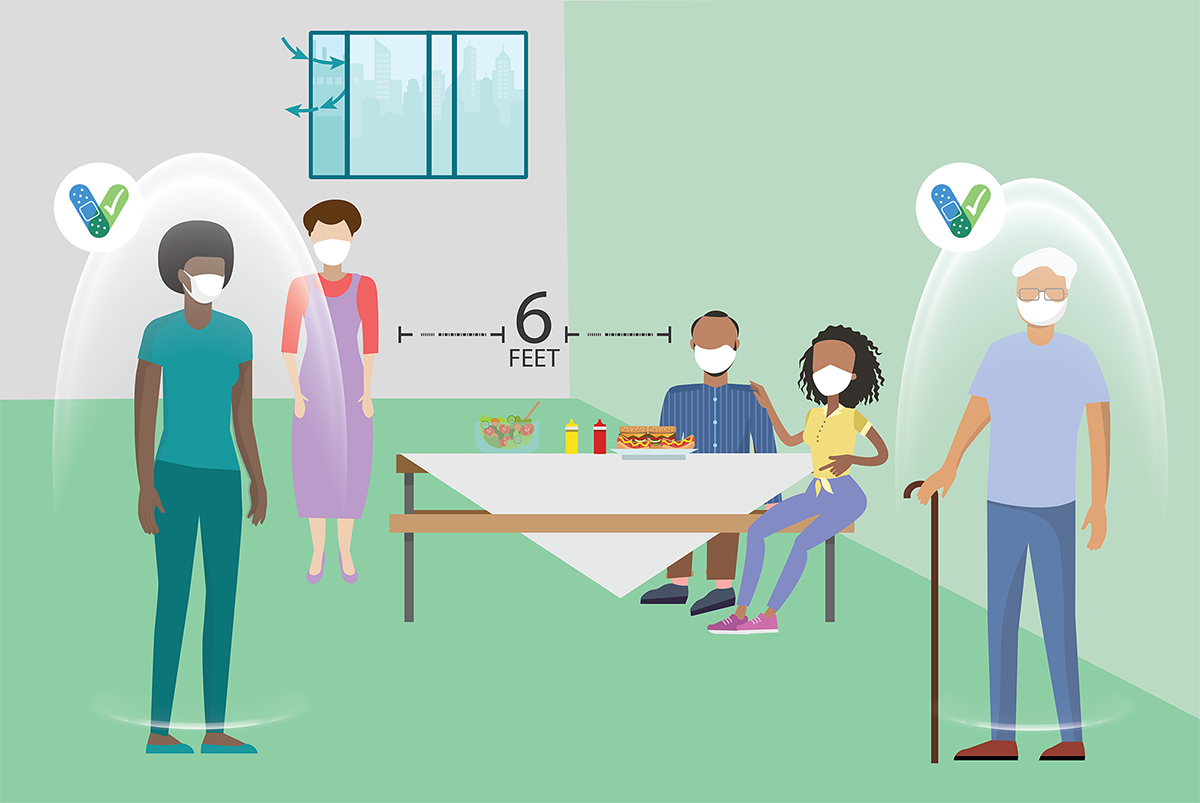
We’re still learning how vaccines will affect the spread of COVID-19. After you’ve been fully vaccinated against COVID-19, you should keep taking precautions – like wearing a mask, staying 6 feet apart from others, and avoiding crowds and poorly ventilated spaces – in public places until we know more.
These recommendations can help you make decisions about daily activities after you are fully vaccinated. They are not intended for healthcare settings.Have You Been Fully Vaccinated?
People are considered fully vaccinated:
2 weeks after their second dose in a 2-dose series, such as the Pfizer or Moderna vaccines, or
2 weeks after a single-dose vaccine, such as Johnson & Johnson’s Janssen vaccine
If you don’t meet these requirements, you are NOT fully vaccinated. Keep taking all precautions until you are fully vaccinated.
What You Can Start to Do
If you’ve been fully vaccinated:
You can gather indoors with fully vaccinated people without wearing a mask or staying 6 feet apart.
You can gather indoors with unvaccinated people of any age from one other household (for example, visiting with relatives who all live together) without masks or staying 6 feet apart, unless any of those people or anyone they live with has an increased risk for severe illness from COVID-19.
If you travel in the United States, you do not need to get tested before or after travel or self-quarantine after travel.
You do NOT need to get tested before leaving the United States unless your destination requires it.
You still need to show a negative test result or documentation of recovery from COVID-19 before boarding a flight to the United States.
You should still get tested 3-5 days after international travel.
You do NOT need to self-quarantine after arriving in the United States.
If you’ve been around someone who has COVID-19, you do not need to stay away from others or get tested unless you have symptoms.
However, if you live in a group setting (like a correctional or detention facility or group home) and are around someone who has COVID-19, you should still stay away from others for 14 days and get tested, even if you don’t have symptoms.
What You Should Keep Doing
For now, if you’ve been fully vaccinated:
You should still take steps to protect yourself and others in many situations, like wearing a mask, staying at least 6 feet apart from others, and avoiding crowds and poorly ventilated spaces. Take these precautions whenever you are:
In public
Gathering with unvaccinated people from more than one other household
If you travel, you should still take steps to protect yourself and others. You will still be required to wear a mask on planes, buses, trains, and other forms of public transportation traveling into, within, or out of the United States, and in U.S. transportation hubs such as airports and stations. Fully vaccinated international travelers arriving in the United States are still required to get tested within 3 days of their flight (or show documentation of recovery from COVID-19 in the past 3 months) and should still get tested 3-5 days after their trip.
You should still watch out for symptoms of COVID-19, especially if you’ve been around someone who is sick. If you have symptoms of COVID-19, you should get tested and stay home and away from others.
You will still need to follow guidance at your workplace.
What We Know and What We’re Still Learning
We know that COVID-19 vaccines are effective at preventing COVID-19 disease, especially severe illness and death.
We’re still learning how effective the vaccines are against variants of the virus that causes COVID-19. Early data show the vaccines may work against some variants but could be less effective against others.
We know that other prevention steps help stop the spread of COVID-19, and that these steps are still important, even as vaccines are being distributed.
We’re still learning how well COVID-19 vaccines keep people from spreading the disease.
Early data show that the vaccines may help keep people from spreading COVID-19, but we are learning more as more people get vaccinated.
We’re still learning how long COVID-19 vaccines can protect people.
As we know more, CDC will continue to update our recommendations for both vaccinated and unvaccinated people.
Until we know more about those questions, everyone — even people who’ve had their vaccines — should continue taking steps to protect themselves and others when recommended.
“’Quite!’ said Longarine. “I’m sure that what you say is true. The fact is that every man who’s ever wanted to be my devoted servant has always started by declaring that my life, my welfare and my honour were all he truly desired. But in the end it’s only their own interests that count, only their own pleasure and their own glory that they really desire. Consequently, the best thing to do is to get rid of them before they’ve finished the first part of their speech. If one waits until they get into the second part, there is less honour in refusing them, for vice should be rejected as son as it is recognized.”
“Once you understand introversion and extroversion as preferences for certain levels of stimulation, you can begin consciously trying to situate yourself in environments favourable to your personality-neither overstimulating nor understimulating, neither boring or anxiety-making. You can organize your life in terms of what personality psychologists call “optimal levels of arousal” and what I call “sweet spots, and by doing so feel more energetic and alive than before.”
My experience with Greek Comedic films is that there is a farcical element to them. In “My Little Greek Godfather” politics are mercilessly lampooned along with several Greek traditions.
The President of Greece for the “Democracy Party” is facing a crucial election and the race is tight on the Greek Island of Crete. In Greece there is a bit of cultural rivalry between the Islanders and the Mainlanders. Crete may even have its own special category of fierce warriors and devout pride of Cretan independence asserted against the Ottoman Turks then the fierce resistance against the German occupiers in the Second World War.
Well there is an important baptism going on in Crete and the candidate for Democracy is Lefteris Panagakis. Panagakis thinks he needs 150 votes to win his seat. So he must win over two families to Democracy.
The President simply can’t make the baptism so he sends Alex his 12-year-old son who being born and schooled in America speaks a weak Greek. As Panagakis says for every Greek word he gets right he gets three wrong,
Panagakis might be insulted with being sent this 12-year-old boy but on he goes schooling Alex with what to say. If they want roads say you’ll give the road. If they want to stop the goat thievery Democracy can deliver and really promise them everything. And by God eat everything they offer you! A hugely funny scene when a plate of sails is passed around in a sauce that has been cooking for three days. Poor Alex. As one lady at the reception says Alex is what happens when a Greek and a foreigner (xenos) mate.
Well before the baptism Alex heads up into the hills and a rumour circulates he has been kidnapped so the two families arm with rifles and discover he is up in the hills investigating. Panagakis says Alex was indeed stolen but by the beauty of Crete. A quick thinker. And the incident unites the two families behind Panagakis.
The baptism comes and let me tell you baptisms are extremely important in Greek culture! A speech is to be delivered by Alex but not the preprepared one but rather a few sentences from the heart finished off by Panagakis’ son, Panos, who is the same age as Alex and somewhat bullied by his father.
The trip goes well and this farce would be a great family movie. The courage of Alex in undertaking the mission is immense and he carries it off well. It might be a bit reminiscent of “Home Alone” as both Kevin in that film and Alex in this film are facing the world alone.
This is not a movie you’ll be laughing up a storm but you may have a smirk on your face at the end.
Filmed in Crete so be prepared for beautiful scenery.
This 2007 film is 86 minutes long as is in Greek with English subtitles. The cast is magnificent although playing on stereotypes in an amusing way.
Part of the Hellenic Film Society of USA’s “Always on Sunday On Demand. It runs from April 4th-May 1st. You’ll have to go to their website to buy tickets https://hellenicfilmusa.org/
Computer vision syndrome, also referred to as digital eye strain, describes a group of eye- and vision-related problems that result from prolonged computer, tablet, e-reader and cell phone use.
Many individuals experience eye discomfort and vision problems when viewing digital screens for extended periods. The level of discomfort appears to increase with the amount of digital screen use.
The average American worker spends seven hours a day on the computer either in the office or working from home. To help alleviate digital eyestrain, follow the 20-20-20 rule; take a 20-second break to view something 20 feet away every 20 minutes.
Causes & risk factors
Viewing a computer or digital screen often makes the eyes work harder. As a result, the unique characteristics and high visual demands of computer and digital screen viewing make many individuals susceptible to the development of vision-related symptoms. Uncorrected vision problems can increase the severity of computer vision syndrome (CVS) or digital eyestrain symptoms. Viewing a computer or digital screen is different than reading a printed page. Often the letters on the computer or handheld device are not as precise or sharply defined, the level of contrast of the letters to the background is reduced, and the presence of glare and reflections on the screen may make viewing difficult.
Viewing distances and angles used for this type of work are also often different from those commonly used for other reading or writing tasks. As a result, the eye focusing and eye movement requirements for digital screen viewing can place additional demands on the visual system. In addition, the presence of even minor vision problems can often significantly affect comfort and performance at a computer or while using other digital screen devices. Uncorrected or under corrected vision problems can be major contributing factors to computer-related eyestrain. Even people who have an eyeglass or contact lens prescription may find it’s not suitable for the specific viewing distances of their computer screen. Some people tilt their heads at odd angles because their glasses aren’t designed for looking at a computer or they bend toward the screen in order to see it clearly. Their postures can result in muscle spasms or pain in the neck, shoulder or back.
In most cases, symptoms of CVS occur because the visual demands of the task exceed the visual abilities of the individual to comfortably perform them. At greatest risk for developing CVS are those persons who spend two or more continuous hours at a computer or using a digital screen device every day.
Symptoms
The most common symptoms associated with CVS or digital eyestrain are:
Eyestrain.
Headaches.
Blurred vision.
Dry eyes.
Neck and shoulder pain.
These symptoms may be caused by:
Poor lighting.
Glare on a digital screen.
Improper viewing distances.
Poor seating posture.
Uncorrected vision problems.
A combination of these factors.
The extent to which individuals experience visual symptoms often depends on the level of their visual abilities and the amount of time spent looking at a digital screen. Uncorrected vision problems like farsightedness and astigmatism, inadequate eye focusing or eye coordination abilities, and aging changes of the eyes, such as presbyopia, can all contribute to the development of visual symptoms when using a computer or digital screen device.
Many of the visual symptoms experienced by users are only temporary and will decline after stopping computer work or use of the digital device. However, some individuals may experience continued reduced visual abilities, such as blurred distance vision, even after stopping work at a computer. If nothing is done to address the cause of the problem, the symptoms will continue to recur and perhaps worsen with future digital screen use.
Diagnosis
CVS, or digital eyestrain, can be diagnosed through a comprehensive eye examination. Testing, with special emphasis on visual requirements at the computer or digital device working distance, may include:
Patient history to determine any symptoms the patient is experiencing and the presence of any general health problems, medications taken or environmental factors that may be contributing to the symptoms related to computer use.
Visual acuity measurements to assess the extent to which vision may be affected.
A refraction to determine the appropriate lens power needed to compensate for any refractive errors (nearsightedness, farsightedness or astigmatism).
Testing how the eyes focus, move and work together. In order to obtain a clear, single image of what is being viewed, the eyes must effectively change focus, move and work in unison. This testing will look for problems that keep the eyes from focusing effectively or make it difficult to use both eyes together.
This testing may be done without the use of eye drops to determine how the eyes respond under normal seeing conditions. In some cases, such as when some of the eyes’ focusing power may be hidden, eye drops may be used. They temporarily keep the eyes from changing focus while testing is done. Using the information obtained from these tests, along with the results of other tests, a doctor of optometry can determine the presence of CVS or digital eyestrain and advise treatment options.
Treatment
Solutions to digital screen-related vision problems are varied. However, they can usually be alleviated by obtaining regular eye care and making changes in how the screen is viewed.
In some cases, individuals who do not require the use of eyeglasses for other daily activities may benefit from glasses prescribed specifically for computer use. In addition, persons already wearing glasses may find their current prescription does not provide optimal vision for viewing a computer.
Eyeglasses or contact lenses prescribed for general use may not be adequate for computer work. Lenses prescribed to meet the unique visual demands of computer viewing may be needed. Special lens designs, lens powers or lens tints or coatings may help to maximize visual abilities and comfort.
Some computer users experience problems with eye focusing or eye coordination that can’t be adequately corrected with eyeglasses or contact lenses. A program of vision therapy may be needed to treat these specific problems. Vision therapy, also called visual training, is a structured program of visual activities prescribed to improve visual abilities. It trains the eyes and brain to work together more effectively. These eye exercises help remediate deficiencies in eye movement, eye focusing, and eye teaming and reinforce the eye-brain connection. Treatment may include office-based as well as home training procedures.
Viewing the computer
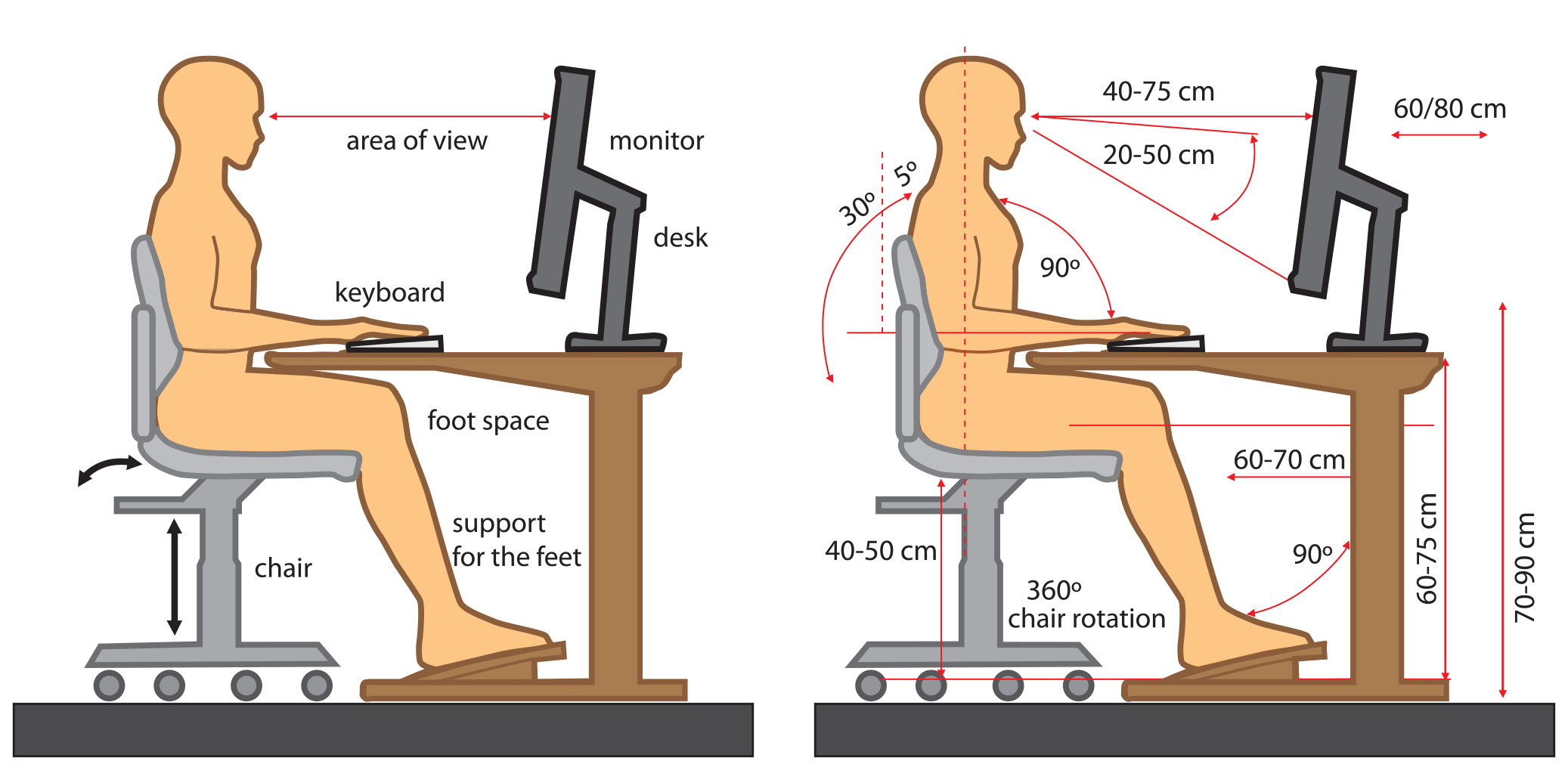
Proper body positioning for computer use. Some important factors in preventing or reducing the symptoms of CVS have to do with the computer and how it is used. This includes lighting conditions, chair comfort, location of reference materials, the position of the monitor, and the use of rest breaks.
Location of the computer screen. Most people find it more comfortable to view a computer when the eyes are looking downward. Optimally, the computer screen should be 15 to 20 degrees below eye level (about 4 or 5 inches) as measured from the center of the screen and 20 to 28 inches from the eyes.
Reference materials. These materials should be located above the keyboard and below the monitor. If this is not possible, a document holder can be used beside the monitor. The goal is to position the documents, so the head does not need to be repositioned from the document to the screen.
Lighting. Position the computer screen to avoid glare, particularly from overhead lighting or windows. Use blinds or drapes on windows and replace the light bulbs in desk lamps with bulbs of lower wattage.
Anti-glare screens. If there is no way to minimize glare from light sources, consider using a screen glare filter. These filters decrease the amount of light reflected from the screen.
Seating position. Chairs should be comfortably padded and conform to the body. Chair height should be adjusted so the feet rest flat on the floor. Arms should be adjusted to provide support while typing and wrists shouldn’t rest on the keyboard when typing.
Rest breaks. To prevent eyestrain, try to rest eyes when using the computer for long periods. Resting the eyes for 15 minutes after two hours of continuous computer use. Also, for every 20 minutes of computer viewing, look into the distance for 20 seconds to allow the eyes a chance to refocus.
Blinking. To minimize the chances of developing dry eye when using a computer, try to blink frequently. Blinking keeps the front surface of the& eye moist.
Regular eye examinations and proper viewing habits can help to prevent or reduce the development of the symptoms associated with CVS.
Prevention
Prevention or reduction of the vision problems associated with CVS or digital eyestrain involves taking steps to control lighting and glare on the device screen, establishing proper working distances and posture for screen viewing and assuring that even minor vision problems are properly corrected.
Suggestions for computer vision syndrome sufferers
Don’t take a vision problem to work. Even if glasses are not needed for driving, reading or other activities, they still may offer benefits for a minor vision problem that is aggravated by computer use. A mild glasses prescription may be needed to reduce vision stress on the job. It’s a good idea for computer users to get a thorough eye exam every year.
Glasses should meet the demand of the job. If glasses are worn for distant vision, reading or both, they may not provide the most efficient vision for viewing a computer screen, which is about 20 to 30 inches from the eyes. Tell the doctor about job tasks and measure on-the-job sight distances. Accurate information will help get the best vision improvement. Patients may benefit from one of the new lens designs made specifically for computer work.
Minimize discomfort from blue light and glare. Blue light from LED and fluorescent lighting, as well as monitors, tablets and mobile devices, can negatively affect vision over the long term. Special lens tints and coatings can reduce the harmful impact of blue light. Minimize glare on the computer screen by using a glare reduction filter, repositioning the screen or using drapes, shades or blinds. Also, keeping screens clean; dirt-free and removing fingerprints can decrease glare and improve clarity.
Adjust work area and computer for comfort. When using computers, most people prefer a work surface height of about 26 inches. Desks and tables are usually 29 inches high. Place the computer screen 16 to 30 inches away. The top of the screen should be slightly below horizontal eye level. Tilt the top of the screen away at a 10- to 20-degree angle.
Use an adjustable copyholder. Place reference material at the same distance from eyes as the computer screen and as close to the screen as possible. That way the eyes won’t have to change focus when looking from one to the other.
Take alternative task breaks throughout the day. Make phone calls or photocopies. Consult with co-workers. After working on the computer for an extended period, do anything in which the eyes don’t have to focus on something up close.
Montenez heard the news of the slug people revolt and the role of Jiber Jr. in that fiasco while he was on his voyage back to Earth. Earth was having enough problems without a power obsessed spaceman running amok. Whatever Jiber Jr. had in mind for Earth would certainly lead to no good.
It struck Montenez that Zortixians had a particular fond disposition towards hero leaders which posed possible dangers to the liberties of Zortixians. If men like Montenez and his father were treated as demi-gods was there not a danger of cultivating one man rule?
If good and its bearers were accepted unquestioningly and placed in positions of power what was to prevent a pretender and followers from seizing power and ruling according to who they really were. Once they had gained power and public trust a coup could theoretically be easily accomplished. Say you are good, pretend to be good, seize power and then slaughter your adversaries. Montenez realized if he had stayed on Zortixia he would eventually assume high political power. If he stayed on Zortixia and became its leader the cult of the hero leader may have continued. It was best to depart. With fortune perhaps the next generation of Zortixians could solve this Zortixian politico-structural defect. Zortixians were technologically advanced but in many cases simple minded and easily taken advantage of with the worst possible consequences.
It was not without regret that he thought of his “pure consciousness” speech. The more he reflected on it the sillier it seemed. It seemed grand and idealistic but false and might ruin more lives than violence could. Violence, unfortunately, was a necessary part of life. It was violence that led to the Jiber being assassinated and his reign of terror and murder ended. Jiber Jr. had made a good point indicating Zortixians were soft as jelly. For the most part the Zortixians were fortunate enough to have had decent leaders. Ironically, however, this facilitated the growth of evil. The Zortixians had lulled themselves into an innocence and ignorance of evil.
Zorollia had lurched back into the hands of Opposite Party refugees from The Federation. Redbeard, the leader of the Zorollian Opposite Party welcomed these fighters. Many believed a life of terror would guarantee a place in the otherworld with 7 virgins. All wanted the Opposite Party to be restored on their planets. A good start was to start terrorizing the goodie goodie planet of Zortixia. And why not start with a hijacking? The destruction of the Zortixian Triple Towers had been an excellent start but continual pressure would be needed to bring Zortixia to its knees.
We have seen it on film, stories and unfortunately have experienced it. You remember Robin Hood who in your childhood was a thief and a highwayman. Rob from the rich to feed the poor! You have been rooting for Sinatra and Sammy Davis Jr. in “Oceans Eleven”. According to the law these people were all criminals but in some cases they had a moral purpose or cause you could admire.
One interesting question you may wrestle with in this fascinating behind the scenes look at Anonymous and Commander X (Christopher Doyon) a key player in the hacktivist network Anonymous. In many cases they fight corrupt big governments and corporations so their exploits can been seen in a high moral fashion. You are certainly entitled to this opinion and I’ll support you in many of their hacks.
But before you take sides have you ever been hacked, held for ransomware, had your website taken down or had your personal information hacked and if so how do you feel about it? How about the Spanair crash in 2008 killing 154 which may have been caused by malware?
Sorry for the digression.
“The Face of Anonymous” is a fascinating look at Anonymous and Doyon. Doyon had an unhappy childhood somewhat rescued by his love of computers even building one from scratch as a child. He then drifted into the realm of political dissent and banded together with other to form Anonymous and play a crucial role in their hacking attacks. Pursued by police and the FBI he found political refuge in Mexico after staying in Toronto.
His hacks on Scientology were met by stiff and skilled resistance. Knowing Scientology you may say they deserved a hit but the Epilepsy Foundation of the United States?
Doyon is a character! Is he in it for politics or for the fun of it? I think a bit of both. It is unfortunate though that criminal hacking to steal money from you certainly does not make a hacker Robin Hood.
Well made 87-minute Canadian documentary directed by Gary Lang and Ian Thornton as film subject/co-producer.
The film is part of Toronto’s Hot Doc Festival and all films are geoblocked so are only available to those in Canada.










 A Bird's Eye View of Fashion, Food, Travel, Culture, Beverage and Curiosity